

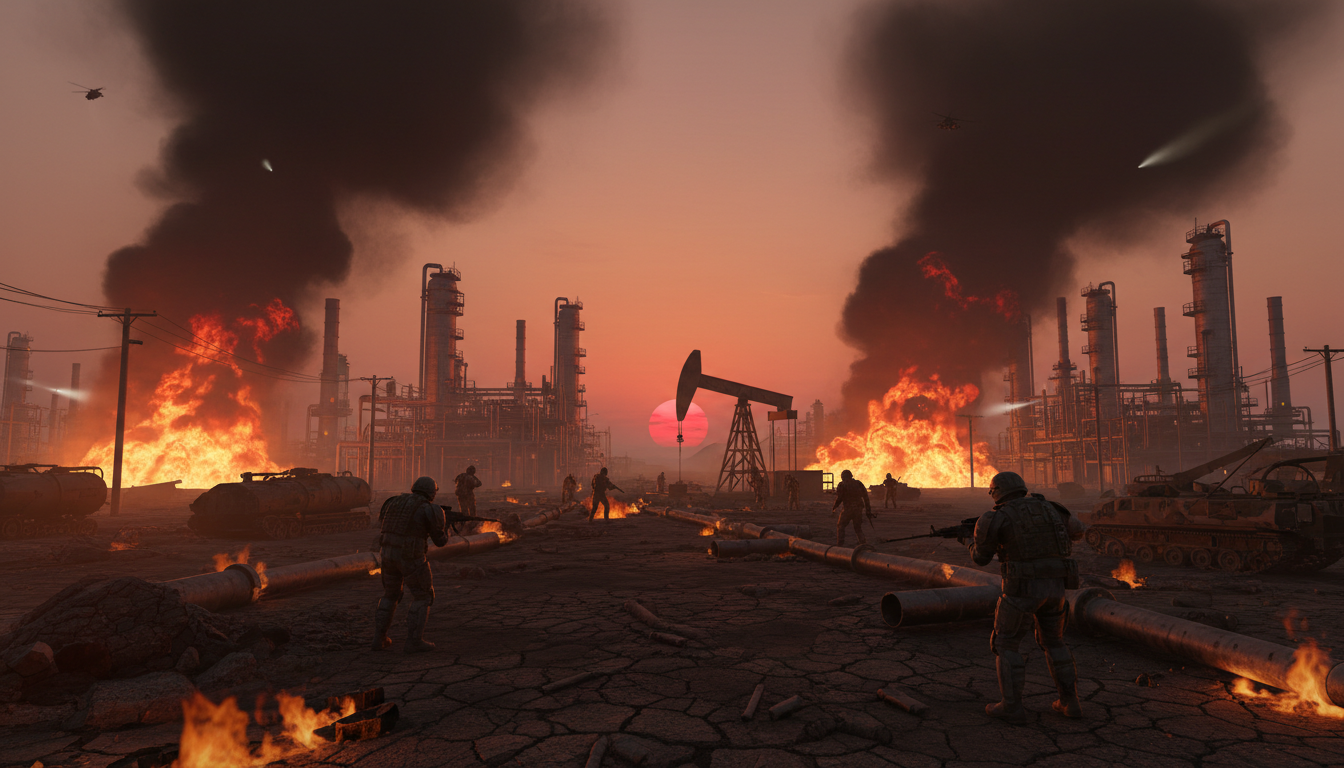
The New Frontline: Resource Control and Its Impact on Oil & Gas Investing
The global economic and military landscape has fundamentally shifted, marking the advent of a new era defined by intense competition for essential commodities. Over the past year, the world has witnessed multiple instances where the supply of critical resources, indispensable for modern economies and defense capabilities, faced severe constraints. From strategic mineral export controls to vital maritime chokepoints, the struggle for resource dominance now stands as pivotal as the pursuit of advanced weaponry. Investors in the oil and gas sector, alongside the broader commodities market, must closely monitor these evolving dynamics, as they directly influence energy security, supply chain resilience, and ultimately, market valuations.
Analysts and policymakers increasingly recognize that securing access to oil, critical minerals, rare earths, and magnets is paramount. Without these foundational elements, a nation’s defense infrastructure and economic might could face significant erosion. The contemporary arms race is intrinsically linked to this burgeoning battle for physical resources that power manufacturing, drive technological innovation, and underpin advanced military development. As Alice Gower, a partner at Azure Strategy, a London-based political-risk advisory firm, succinctly put it, “Great-power competition has returned to basics: who controls the physical resources that modern economies and militaries run on.” She further emphasized, “Energy, critical minerals and industrial capacity are leverage, not just economic assets.” This perspective underscores the profound implications for global trade and investment strategies.
Strait of Hormuz: A Stark Reminder of Energy Vulnerability
Recent escalations in the Middle East, particularly concerning the Strait of Hormuz, have vividly demonstrated the fragility of global energy supply. This critical maritime passage, historically handling approximately 20% of the world’s daily oil and LNG trade, has experienced significant disruptions, effectively limiting tanker traffic for over three weeks. This represents one of the most severe supply shocks in the history of the oil market, exposing the world’s deep reliance on accessible energy resources and the undeniable importance of geopolitical geography in physical supply chains. With substantial volumes of oil and natural gas stranded within the Persian Gulf, the market reacted sharply.
Crude oil prices surged to levels exceeding $100 per barrel, European natural gas prices more than doubled, and Asian spot LNG benchmarks registered multi-year highs. The ripple effects have been particularly acute across Asia, a region heavily dependent on oil and LNG imports from the Persian Gulf. Refiners across the continent are reportedly paying sky-high premiums for non-Middle Eastern crude alternatives, with many actively evaluating or already implementing reductions in processing rates. Governments, in response, have initiated fuel-preserving measures, including proposals for four-day work weeks and restrictions on fuel exports, aiming to conserve dwindling supplies.
The situation in Europe also remains precarious, with the upcoming gas refilling season anticipated to be exceptionally challenging. Asian buyers are now aggressively outbidding Europe for available spot LNG cargoes, particularly after Iranian missile attacks impacted Qatar’s LNG export capabilities, which may not see full capacity restoration for up to five years. Even the United States, despite its status as the world’s leading oil producer and claims of energy independence, is not immune to global supply shocks of this magnitude. The national average price of gasoline in the U.S. is now approaching $4 per gallon, representing an increase of over $1 per gallon compared to just a month prior to the recent conflict. This highlights the interconnectedness of global oil markets, where prices reflect not only fundamental supply and demand but also intense geopolitical trading activity. The reality is clear: there are no immediate surplus resources available to quickly compensate for such a significant disruption in Middle Eastern supply. Furthermore, producers face challenges in ramping up output due to limited storage capacity, which could delay a rapid supply recovery even once stability returns. The strategic control of the Strait of Hormuz, therefore, grants immense leverage to inflict global economic pain, making it a focal point for energy investment risk assessment.
The Scramble for Critical Minerals: China’s Rare Earth Hegemony
While global attention frequently converges on the Strait of Hormuz and oil markets, the strategic contest for rare earths and critical minerals continues unabated. Western nations are actively working to diminish China’s commanding lead in this sector. Since China implemented export restrictions on rare earth elements in early 2025, a concerted effort has emerged among Western countries to establish resilient mine-to-magnet supply chains. This initiative aims to reduce their reliance on Chinese supply for crucial military and automotive industries.
Current estimates from the International Energy Agency (IEA) underscore China’s formidable market position, controlling 59% of global rare earth mining, 91% of refining capacity, and an astounding 94% of magnet manufacturing. In response, the United States has launched initiatives such as Project Vault, a U.S. Strategic Critical Minerals Reserve, and has invested in mineral mining companies. Furthermore, the U.S. is leading efforts to dismantle China’s stronghold on the pricing mechanisms of these minerals, which are indispensable for national security, defense applications, and the burgeoning electric vehicle market.
While eroding China’s dominance will undoubtedly take years, progress is being projected. New research from Bloomberg Intelligence (BI) indicates that increased neodymium-praseodymium (NdPr) supply from countries like the U.S. and Australia is anticipated to reduce China’s market share for NdPr to 69% by 2030, down from an estimated 90% in 2024. Jack Baxter, a Global Metals & Mining Analyst at BI and co-author of the report, noted, “We’re seeing a surge in rare-earth investment as modern technologies demand more critical materials.” However, he also cautioned about the significant hurdles ahead: “That said, we anticipate a significant shortfall in supply due to trade uncertainties, with lead times as long as 10 years to get new material out of the ground.” Baxter concluded that these challenges will likely “give pricing power to the few producers that currently are able to supply critical materials outside of China, fracturing the globalized market.” For investors, this signals potential opportunities in strategically positioned mining and processing companies outside China, though these come with significant development timelines and geopolitical risks.
In an environment marked by increasingly fractured markets and heightened geopolitical uncertainty, one undeniable truth emerges: the next great global competition, running in parallel with traditional military buildups, will be fundamentally waged for control over vital resources, including crude oil and critical minerals. Astute investors must position their portfolios to navigate these complex dynamics, recognizing that resource security is now synonymous with economic and national security.
