


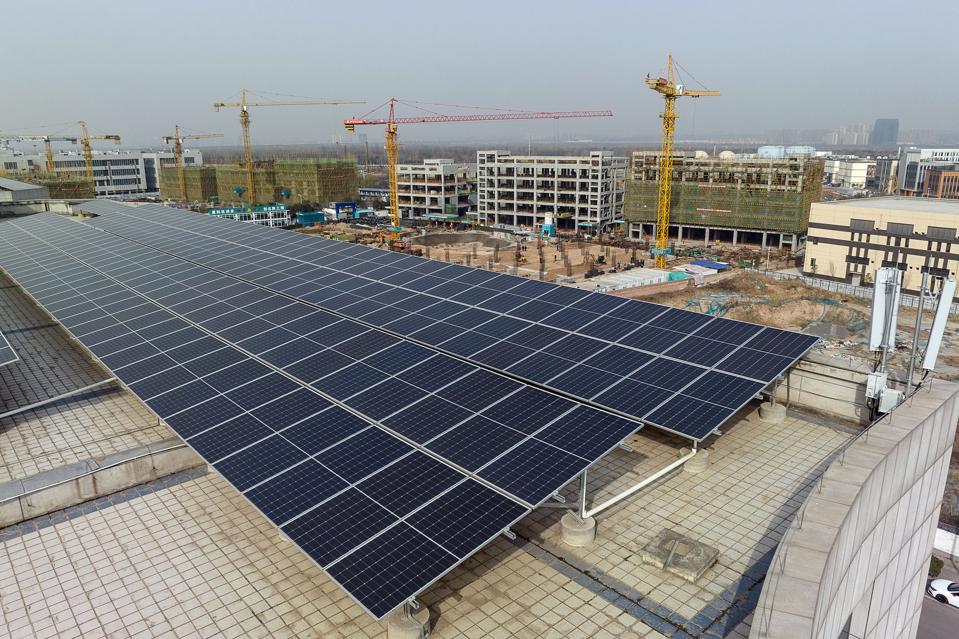
Longi Green Energy Technology Co. solar panels on the rooftop of an office building in Xi’an, China, … More
© 2023 Bloomberg Finance LP
Investors are betting big on renewable energy, which is projected to reach $2.2 trillion this year—more than double the investment in fossil fuels. This accounts for more than 40% of the $3.3 trillion estimated for the global energy sector, according to the International Energy Agency. Solar power stands out, with expectations of attracting $450 billion in investment.
The unprecedented dollars flowing into renewable energy aren’t just reshaping power markets—they mark a tipping point in the global energy transition, where clean power is overtaking fossil fuels as an economic priority. These investments are gaining momentum and building scale, and now, they are changing how we use energy, not just supplementing the existing generation mix.
“Amid the geopolitical and economic uncertainties that are clouding the outlook for the energy world, we see energy security” as the main reason the global community attracted $3.3 trillion, IEA director Fatih Birol said in a press statement for the latest annual World Energy Investment report. “The fast-evolving economic and trade picture means that some investors are adopting a wait-and-see approach to new energy project approvals, but in most areas, we have yet to see significant implications for existing projects.”
He notes that China is leading global energy investment, particularly in renewables. It invests as much as the United States and the European Union combined. Over the past decade, China’s share of global clean energy spending has increased from a quarter to nearly a third, supported by ventures in solar, wind, hydropower, nuclear, batteries, and electric vehicles.
For context, investment in fossil fuels had been 30% greater than in electricity generation, grids, and storage. However, that has changed in 2025: investments in electricity production are now 50% higher than the amount spent on bringing coal, oil, and natural gas to market.
Though battery storage investment is lower at $65 billion, it plays an outsized role in enabling intermittent renewables to provide round-the-clock power. Meanwhile, nuclear energy is gaining momentum and is expected to secure $75 billion by 2025. Compare that to investment in the oil and gas sector, which is expected to decline this year by 6%—the first drop since 2020.
Can The Grid Handle The Rise In Demand?
An aerial photo shows the Zhangbei-Shengli 1000kV UHV AC project of Shengli Substation in Xilingol … More
NurPhoto via Getty Images
The central question is whether the grid can accommodate the new capacity. Indeed, the rise of artificial intelligence, data centers, and electric vehicles—powered by sustainable energy—means the country must at least double regional transmission capacity.
According to the IEA, AI and data centers alone are projected to account for as much as 4% of global electricity use by 2030—accelerating the urgency for grid modernization and new capacity. Along those lines, the Brattle Group estimates that $2 trillion is required by 2030 to modernize. Grid investments are now $400 billion yearly, short of what is necessary.
“Grids have become a bottleneck for energy transitions, but investment is rising, driven by new policies and funding in Europe, the United States, China, and parts of Latin America,” IEA’s report said. “Advanced economies and China account for 80% of global grid spending. Investment in Latin America has almost doubled since 2021, notably in Colombia, Chile, and Brazil. However, investment remains worryingly low elsewhere.”
But how will the U.S. withdrawal from the global climate talks affect the overall trend? Undoubtedly, it will try to reduce federal support for the clean tech sector while creating policies that favor fossil fuels. At a minimum, that will foster business uncertainty and delay key projects. The pending tax bill could slow down or stop investments in renewable energy and infrastructure projects by speeding up the phase-out of critical tax credits.
Even as federal support wanes, state policies and utility mandates will continue to fuel the clean energy movement. In other words, decentralized governance will help maintain momentum, at least in some regions.
There’s a lot more at play. For starters, U.S. President Donald Trump serves four years. That’s it. But there’s an even more powerful force: market economics, which favors the lowest-cost fuels and the ones that pollute the least. To that end, a lot of companies have branded themselves as green. Walking back sustainability claims—or resorting to greenwashing—would carry reputational and financial risks.
Amazon, Google, and Microsoft are among the leading tech giants investing in renewable energy. Meanwhile, Walmart, Target, and Ikea lead the retail sector. General Motors, Boeing, and Ford are at the forefront of the industrial sector.
Equally noteworthy is the effort to attract international investment in key technologies to guide us through the energy transition. If the United States remains uninvolved, that funding will go to others eager to take the lead. Already, China, the EU, and the United Arab Emirates are stepping in to fill the gap left by this country.
“Cheap electricity from renewable sources could provide 65% of the world’s total electricity supply by 2030. It could decarbonize 90% of the power sector by 2050, massively cutting carbon emissions and helping to mitigate climate change,” the United Nations said via the UN website on climate action.
Renewables are now the primary vehicle driving investment in the energy sector. Indeed, the increased money flowing into wind and solar illustrates their viability. As capital and policy continue to align, renewables are positioned not just to compete—but also to lead. Their accelerating scale and declining cost mean they will be the linchpin in the world’s effort to curb emissions and prevent the worst impacts of climate change.
