

Geopolitical Tensions Escalate: Missile Strike Hits Qatar-Chartered Tanker Amid Broader Energy Infrastructure Attacks
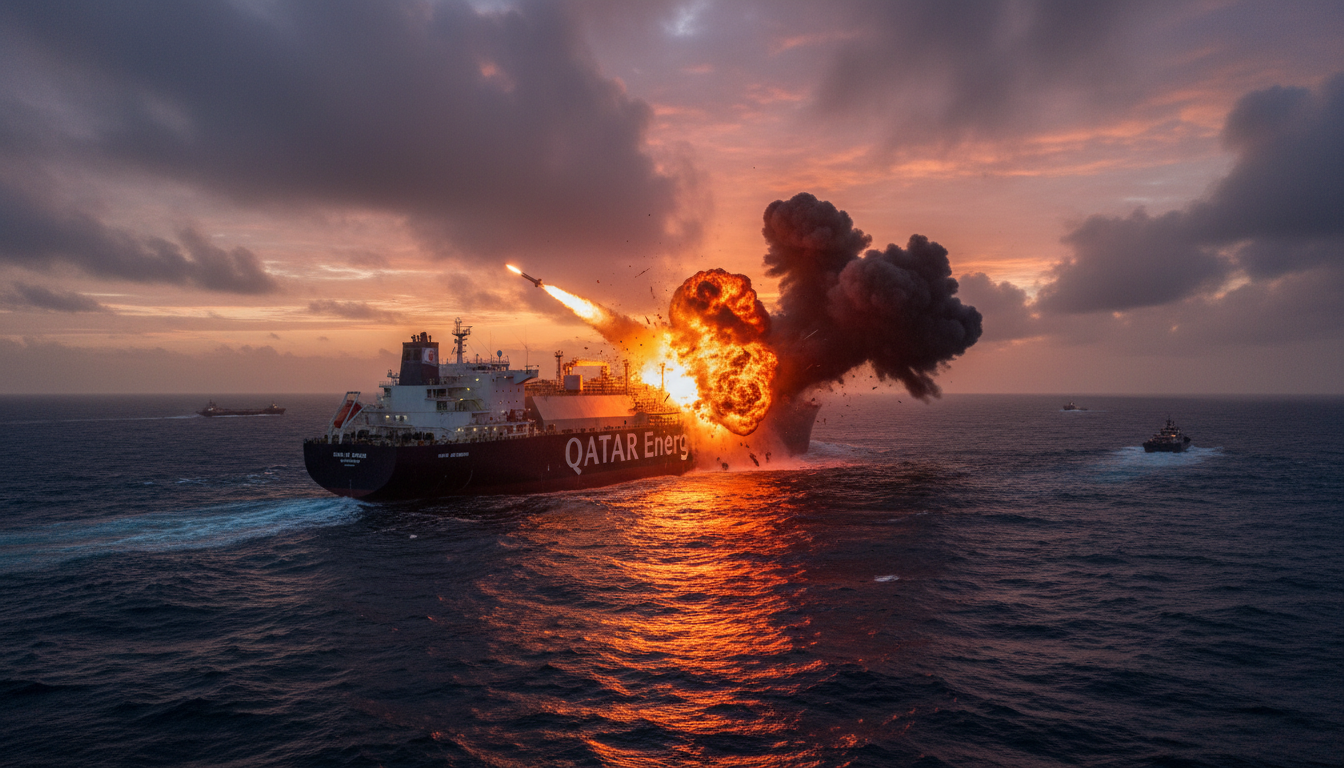
The global energy market is closely monitoring a significant escalation in geopolitical tensions following a recent missile strike on a fuel oil tanker chartered by QatarEnergy. The incident, occurring in the early morning hours on a Wednesday, saw the vessel, named Aqua 1, targeted within Qatar’s territorial waters. Fortunately, all 21 crew members aboard escaped injury, and initial assessments indicate no environmental damage resulted from the impact. This event signals a worrying expansion of regional hostilities directly affecting vital energy logistics and supply routes.
According to Qatar’s Defense Ministry, the Aqua 1 was hit by one of three cruise missiles launched from Iran. Qatari defense systems successfully intercepted two of the projectiles, but the third struck the chartered tanker. This development underscores the heightened risk environment for shipping in the Middle East, particularly for assets linked to key energy producers like Qatar. Investors are now keenly evaluating the potential for further disruption to maritime trade lanes, impacting everything from crude oil and refined products to liquefied natural gas (LNG) shipments, and consequently, global commodity prices.
Qatar’s LNG Production Under Siege: Billions in Lost Revenue and Prolonged Disruptions
This latest attack on an energy asset chartered by QatarEnergy is not an isolated incident but rather the latest in a series of missile strikes targeting Qatar’s critical energy infrastructure. These attacks have intensified amidst the ongoing conflict between Iran and the United States-Israel alliance, placing significant strain on one of the world’s most vital energy exporters. The repeated targeting has compelled QatarEnergy to invoke force majeure on its liquefied natural gas production since early last month, a declaration that sends immediate ripples through the global LNG market.
A prior attack on March 19 inflicted extensive damage on infrastructure within Ras Laffan Industrial City, a cornerstone of Qatar’s energy operations. The financial ramifications are staggering, with QatarEnergy estimating annual revenue losses of approximately $20 billion due to this disruption alone. The repair timeline for the affected facilities is projected to span up to five years, signaling a prolonged period of constrained output. This prolonged outage directly impacts energy supply commitments to critical markets across Asia and Europe, countries heavily reliant on Qatari LNG to meet their energy demands.
Specifically, the March 19 attacks rendered two crucial LNG production units, Trains 4 and 6, inoperable. These two trains together account for a substantial 12.8 million tons per annum (MTPA) of production capacity, representing approximately 17 percent of Qatar’s total LNG export volume. For investors, it is important to note that these trains are partly owned by U.S. energy giant Exxon Mobil Corp., making the incident a direct concern for its operational performance and shareholder value. The cascading effects of this damage are already being felt by major importers, including China, South Korea, Italy, and Belgium, who face the prospect of a five-year force majeure on some long-term LNG contracts, necessitating urgent diversification strategies and potentially driving up spot market prices for natural gas.
Beyond LNG: Pearl GTL and Broader Commodity Supply Chains Face Disruption
The impact of these attacks extends beyond LNG production, significantly affecting other crucial segments of Qatar’s energy sector. The Pearl gas-to-liquids (GTL) facility, a cornerstone project developed in partnership with Britain’s Shell PLC, has also sustained considerable damage. This facility is a key producer of base oils, essential components in the manufacturing of premium engine oils and lubricants used across various industries globally. The interruption to Pearl GTL’s operations is therefore a direct threat to the specialized lubricants market and industrial supply chains.
QatarEnergy’s President and CEO, Saad Sherida Al-Kaabi, who also serves as Qatar’s energy minister, confirmed that one of the two trains at the Pearl GTL facility is currently offline. An assessment of the damage is underway, but preliminary estimates suggest this train will remain out of commission for a minimum of one year. This outage will force global purchasers of base oils to seek alternative suppliers, potentially leading to price volatility and supply bottlenecks in these niche but critical markets.
Furthermore, the sustained attacks and subsequent outages are anticipated to trigger a broader range of production losses across multiple commodities. Projected losses include 18.6 million barrels of condensates, 1.28 million metric tons (MT) of liquefied petroleum gas (LPG), 0.59 MT of naphtha, and 0.18 MT of sulfur. Even niche markets are affected, with an estimated loss of 309.54 million cubic feet per annum (MCFA) of helium production. These figures highlight the widespread impact on hydrocarbon derivatives and other industrial gases, underscoring the interconnectedness of global commodity markets and the profound financial implications of sustained instability in key energy-producing regions.
Investor Outlook: Navigating Geopolitical Energy Risks and Market Volatility
For investors, the recurring attacks on Qatar’s energy infrastructure present a formidable challenge, necessitating a careful reassessment of geopolitical risk in energy portfolios. The potential for prolonged supply disruptions from a major global LNG exporter like Qatar introduces significant volatility into natural gas futures and spot markets. Energy companies with direct investments or supply agreements in the region, such as Exxon Mobil and Shell PLC, face direct operational and financial risks that could impact their earnings and share performance.
The immediate consequence is likely an upward pressure on energy prices as markets price in an increased risk premium for Middle Eastern supply. This environment could favor investments in energy assets located in politically stable regions or those with diversified global footprints. However, the sheer scale of Qatari exports means that any substantial, long-term disruption will inevitably tighten global supply, affecting energy security and potentially accelerating the search for alternative energy sources and supply routes.
Long-term investors must consider the structural shifts that these geopolitical events might catalyze within the energy industry. Companies with robust risk management frameworks, flexible supply chains, and a strategic approach to geopolitical uncertainties are better positioned to weather such storms. The emphasis on diversification, both in terms of geographical sourcing and energy type, will only intensify. As these tensions persist, the interplay between geopolitics and energy economics will remain a dominant theme for global capital markets, demanding vigilance and adaptability from all participants in the oil and gas investing landscape.
