

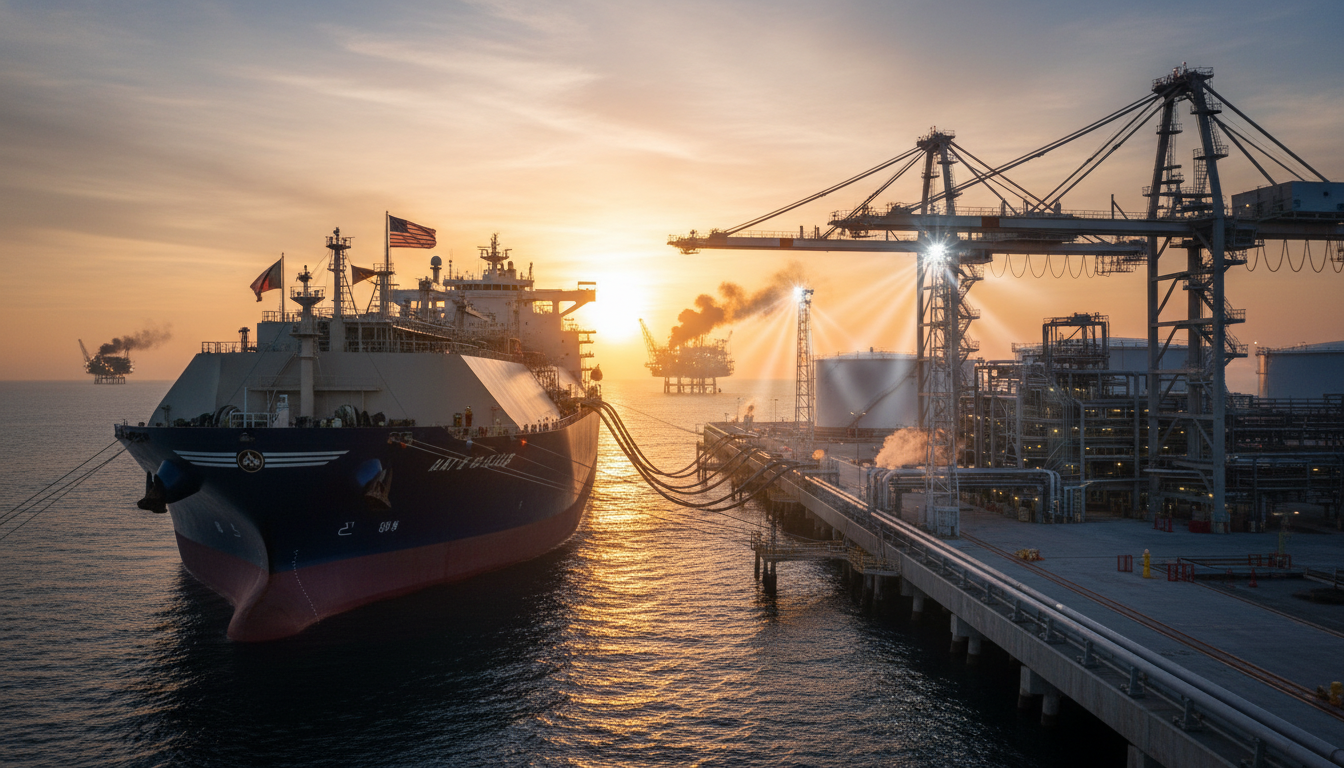
The global liquefied natural gas (LNG) market has welcomed a critical new player as the Golden Pass LNG facility in Sabine Pass, Texas, officially commenced production from its first liquefaction train. This pivotal moment transforms the site from a mere receiving terminal into a significant export hub, arriving at a time when geopolitical tensions are reshaping international energy flows and underscoring the strategic value of resilient supply chains.
A joint venture between energy giants QatarEnergy and ExxonMobil (NYSE:XOM), Golden Pass represents a cornerstone investment in the U.S. energy landscape. The project is designed to feature three trains, with an impressive nominal capacity expected to reach approximately 18 million metric tons per annum (mtpa) once fully operational. This immense output will significantly bolster global LNG supplies, addressing burgeoning demand in Europe and Asia.
Strategic Imperative for Global Energy Leaders
For QatarEnergy, Golden Pass is more than just an expansion; it’s a crucial component of a broader, ambitious $20 billion investment strategy targeting the U.S. energy sector. This U.S. presence complements the company’s massive North Field Expansion project back home, diversifying its global LNG portfolio and enhancing its market reach. The ability to export from a stable, geographically strategic location like the U.S. offers invaluable flexibility and market access.
ExxonMobil, as a key partner, leverages its extensive operational expertise and vast marketing network to maximize the project’s potential. Investors in XOM should recognize this project as a substantial asset contributing to the supermajor’s integrated gas strategy, bolstering its long-term earnings potential from global natural gas markets. The initiation of production translates directly into tangible revenue streams and enhanced asset utilization for the company.
Navigating Headwinds: Project Costs and Delays
The journey to first production at Golden Pass has not been without its challenges. The project incurred notable construction delays and significant cost escalations. Its final expenditure climbed beyond $10 billion, surpassing the initial budget by approximately $2 billion. A major setback occurred in 2024 when the primary contractor declared bankruptcy, leading to thousands of layoffs and a temporary halt in construction before new contractors could be mobilized to resume work.
Despite these hurdles, the successful startup of the first train underscores the perseverance and commitment of the joint venture partners. The remaining two trains are currently projected to come online sequentially in late 2026 and 2027. Investors tracking these developments will be keen to monitor the progress and financial performance as the entire facility scales up to full capacity.
A Critical Supply Arrives Amidst Geopolitical Volatility
The timing of Golden Pass LNG’s debut is particularly poignant, coinciding with an intensifying global energy crisis exacerbated by recent geopolitical events. Qatar’s energy sector, a cornerstone of global LNG supply, has faced severe disruption following attacks on its Ras Laffan Industrial City in March 2026. These strikes significantly damaged key infrastructure, directly impacting Qatar’s primary LNG export hub capacity.
Estimates suggest that repairs to the affected LNG trains could span three to five years, potentially leading to staggering revenue losses for Qatar, up to $20 billion annually. The ramifications extend globally, with major Asian and European customers facing the prospect of reduced supplies and heightened price volatility. In this context, the incremental supply from Golden Pass LNG becomes incredibly valuable, offering a vital lifeline to strained international energy markets and potentially stabilizing prices.
The Expanding U.S. LNG Export Landscape
Golden Pass LNG is a prominent, but not solitary, development in the surging U.S. LNG export arena. The United States continues to solidify its position as a leading global supplier, with numerous other large-scale export terminals under various stages of construction across the Gulf Coast. Investors should keep a close watch on these additional projects and the companies developing them, as they collectively shape the future of global gas trade:
- Venture Global’s Plaquemines LNG plant in Louisiana represents another significant capacity addition.
- Cheniere Energy’s (NYSE:LNG) Corpus Christi LNG Stage 3 in Texas further expands the footprint of an established market leader.
- NextDecade Corp.’s (NASDAQ:NEXT) Rio Grande LNG project in Texas signals new entrants gaining traction.
- Sempra’s (NYSE:SRE) Port Arthur LNG project also in Texas, contributes to the state’s dominant role.
- Venture Global’s CP2 LNG in Louisiana promises further capacity growth from a dynamic developer.
- Woodside Energy’s (NYSE:WDS) Woodside Louisiana project (formerly known as Driftwood LNG under Tellurian) highlights international players investing in U.S. infrastructure.
These projects collectively underscore the robust investment thesis for U.S. LNG. The combination of abundant domestic natural gas resources, advanced liquefaction technology, and strategic access to international shipping lanes positions the U.S. as an indispensable energy partner. For investors, this sector offers compelling growth opportunities, driven by structural global demand, geopolitical shifts, and the ongoing energy transition.
Investment Outlook: Harnessing the LNG Wave
The successful commissioning of Golden Pass LNG’s first train marks a new chapter for its partners and for the broader global energy market. For investors, this event signals the monetization of significant capital expenditures and the realization of long-term strategic visions. Companies like ExxonMobil, Cheniere Energy, NextDecade Corp., Sempra, and Woodside Energy are at the forefront of this transformation, offering direct exposure to the burgeoning LNG export phenomenon.
As global energy security concerns intensify and demand for cleaner-burning natural gas continues to grow, LNG export facilities like Golden Pass will play an increasingly critical role. Investors seeking exposure to long-term energy trends and robust infrastructure assets should consider the ongoing developments in the U.S. LNG sector as a cornerstone of their portfolio strategy, anticipating sustained growth and strategic importance in the coming decades.
