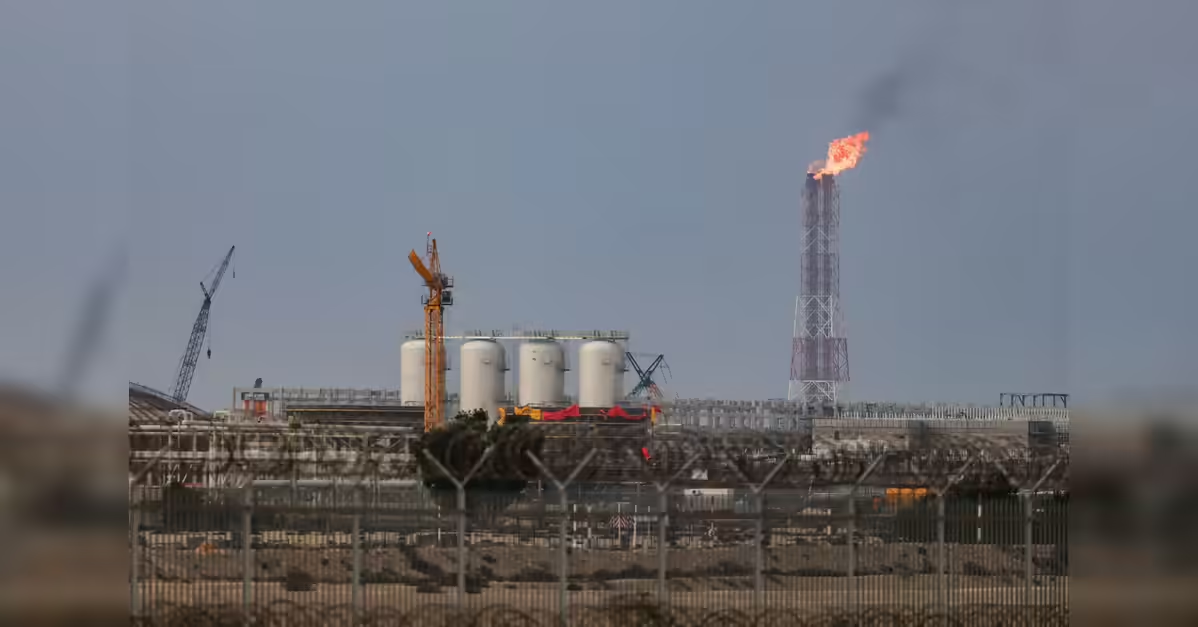
The global energy landscape has been dramatically reshaped following a severe disruption to Qatar’s liquefied natural gas (LNG) export capabilities. Missile attacks on the critical Ras Laffan Industrial City have crippled a significant portion of the nation’s LNG output, with QatarEnergy estimating a staggering $20 billion in annual revenue losses and a multi-year repair timeline. This event is not merely a regional incident; it reverberates through international energy markets, influencing supply dynamics, geopolitical risk premiums, and investor strategies across the entire oil and gas complex. Our proprietary data pipelines highlight increased reader interest in future oil price trajectories and energy security, underscoring the urgency for a comprehensive analysis of this unprecedented situation.
Immediate Supply Shock and Prolonged Recovery
The attacks, which occurred on March 18 and 19, have delivered a significant blow to Qatar’s LNG infrastructure, reducing its export capacity by approximately 17 percent. The primary targets, LNG Trains 4 and 6, boasting a combined capacity of 12.8 million tonnes per annum (MTPA), sustained extensive damage. QatarEnergy’s President and CEO, Saad Sherida Al-Kaabi, has indicated that repairs could span a daunting three to five years, necessitating force majeure declarations on some long-term LNG contracts for a similar duration. This extended outage will critically impact major importing nations such as China, South Korea, Italy, and Belgium, intensifying pressure on an already tight global gas market.
Beyond LNG, the disruption extends to other vital energy products. The Pearl Gas-to-Liquids (GTL) facility, a joint venture with Shell, also suffered hits, with one of its two production trains expected to remain offline for at least one year. This facility is crucial for converting natural gas into cleaner fuels and petrochemical feedstocks. Furthermore, associated product supplies are severely affected, with estimated losses including 18.6 million barrels of condensates (representing approximately 24 percent of exports), 1.28 million tonnes of LPG (13 percent), 0.59 million tonnes of naphtha (6 percent), 0.18 million tonnes of sulphur (6 percent), and 309.54 MCFA of helium (14 percent). These widespread outages underscore the multifaceted impact on global energy commodity markets.
Broader Market Ramifications and Current Price Action
The ramifications of Qatar’s crippled LNG capacity extend far beyond natural gas, creating ripple effects across the broader energy complex. While the immediate focus is on LNG, the heightened geopolitical risk and potential for energy substitution can influence crude oil prices. As of today, Brent Crude trades at $91.9 per barrel, marking a 1.44% decline within a day range of $91.39-$94.21. Similarly, WTI Crude stands at $88.23, down 1.61% within its daily range of $87.64-$90.71. This recent downward trend, mirroring a 7% drop in Brent from $101.16 on April 1st to $94.09 on April 21st, suggests that broader macroeconomic concerns or specific inventory data might be currently weighing on crude markets.
However, investors should not mistake this short-term dip for a diminished long-term risk premium. The Qatar incident introduces a significant and sustained element of supply uncertainty into the global energy equation. A prolonged reduction in LNG supply could lead to increased demand for alternative fuels, including crude oil, particularly in sectors capable of switching. More importantly, the attacks represent a direct escalation of geopolitical tensions, a factor that historically underpins higher oil prices as markets price in increased supply vulnerability. While today’s crude prices reflect other prevailing market forces, the underlying geopolitical risk premium has undoubtedly ratcheted higher, creating a floor for prices and potential for future upside as the full implications of the LNG shortage become apparent.
Navigating Geopolitical Uncertainty and Investor Sentiment
Our proprietary reader intent data reveals a clear focus from investors on market direction, with common questions like “is WTI going up or down” and predictions for “the price of oil per barrel by end of 2026.” The Qatar LNG crisis adds a crucial layer of complexity to these outlooks. Historically, significant geopolitical disruptions to major energy producers introduce a substantial risk premium into commodity prices. While current crude prices might be influenced by a myriad of factors, the long-term outlook for oil and gas has undeniably shifted towards greater uncertainty and potential upward pressure.
The 3-5 year repair timeline for Qatar’s LNG facilities means this is not a transient event. It represents a structural shift in global energy supply security. For investors, this translates into a need to factor in sustained geopolitical risk when assessing energy company valuations. Companies with diversified supply chains, robust refining capabilities, or exposure to alternative energy sources might prove more resilient. Conversely, those heavily reliant on specific, vulnerable geographies could face increased scrutiny. The attack on Ras Laffan serves as a stark reminder that physical supply security remains paramount, directly influencing the long-term price trajectory for both crude and natural gas as markets adjust to a world with less predictable supply from a key player.
The Road Ahead: Key Data and Future Outlook
Investors must closely monitor upcoming energy reports and geopolitical developments to gauge the full impact of the Qatari disruption. The market will be keenly watching the EIA Weekly Petroleum Status Reports, scheduled for April 22nd, April 29th, and May 6th. These reports will provide crucial insights into crude inventories, gasoline demand, and refinery utilization, offering a snapshot of the immediate supply-demand balance in the U.S. and potentially mitigating or exacerbating concerns stemming from the Middle East. Similarly, the Baker Hughes Rig Count on April 24th and May 1st will indicate North American production trends, a critical factor in global supply dynamics.
Perhaps the most significant upcoming event, however, is the EIA Short-Term Energy Outlook (STEO) due on May 2nd. This release will be highly anticipated, as analysts will be looking for revised forecasts that incorporate the multi-year outage from Qatar’s LNG facilities. The STEO’s assessment of global supply, demand, and price projections for both crude and natural gas will be instrumental in shaping market sentiment for the remainder of 2026 and beyond. Any upward revisions to price forecasts or downward adjustments to supply expectations, particularly for natural gas, will signal the market’s deeper digestion of this significant geopolitical event. Investors should prepare for increased volatility and carefully consider how these revised outlooks impact their energy portfolio strategies.


