

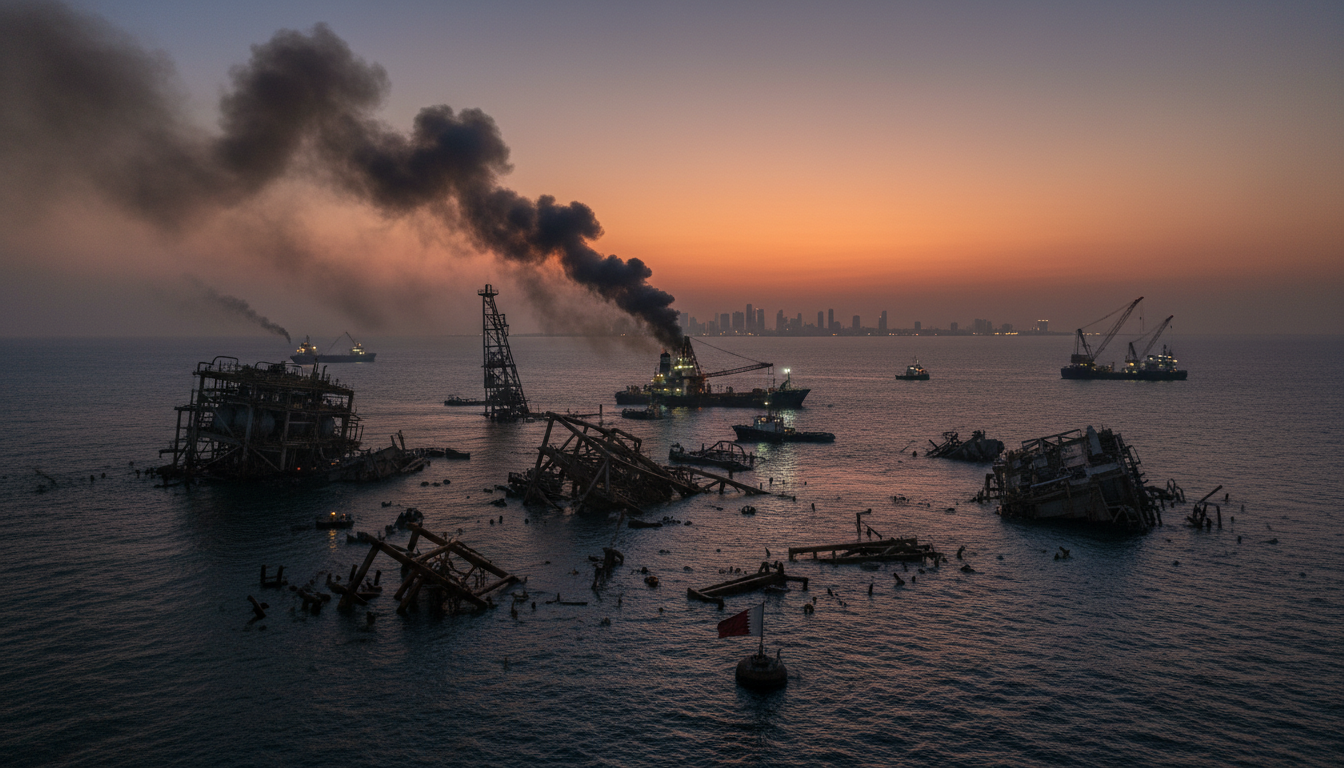
Iranian Strikes Cripple Ras Laffan LNG, Threatening Years of Global Supply Disruption
Global energy markets face an unprecedented challenge following a devastating assault on Qatar’s Ras Laffan complex, the world’s preeminent liquefied natural gas (LNG) terminal. On March 19, Iranian missile and drone strikes inflicted severe damage on the sprawling facility, a critical node supplying one-fifth of the planet’s super-chilled fuel. The implications for international gas prices and long-term supply stability are profound, demanding immediate attention from investors and energy strategists worldwide.
The vast Ras Laffan industrial city, spanning 295 square kilometers, witnessed raging fires across its gas-to-liquids infrastructure. This complex, meticulously built over decades at a cost of tens of billions of dollars, represents a pinnacle of energy engineering. The financial losses stemming from the incident are staggering, estimated to be in the tens, if not hundreds, of millions of dollars. QatarEnergy’s CEO, Saad Sherida al-Kaabi, has indicated the very real possibility of declaring “force majeure” on long-term supply contracts. Such a declaration would release the company from contractual obligations due to unforeseen circumstances, potentially impacting LNG deliveries to key markets like Italy, Belgium, Korea, and China for an alarming period of “up to five years.”
The Fragility of LNG Infrastructure and Supply Chains
While the Persian Gulf region mirrors its oil export contribution by supplying approximately 20 percent of global natural gas demand, the nature of LNG presents unique vulnerabilities. Unlike crude oil, methane, the primary component of natural gas, must be cooled to an extreme -162 degrees Celsius for liquefaction and transportation. This cryogenic process renders steel brittle, necessitating highly specialized, robust, and incredibly expensive infrastructure for storage and shipping. The liquefaction and subsequent transportation can consume as much as 15 percent of the initial natural gas volume extracted, highlighting the immense energy intensity and cost of the entire LNG value chain. The intricate design and specialized materials required for handling such a volatile fuel under extreme conditions mean that repairs are neither simple nor swift, making the Ras Laffan incident a structural rather than merely a logistical problem.
Qatar’s North Field and Iran’s South Pars gas field constitute a single, colossal geological formation, divided only by a maritime border. These fields together form the world’s largest natural gas reservoir. While Qatar primarily focuses on LNG exports, Iran largely utilizes its vast gas resources domestically, with some pipeline exports directed to Turkey and Iraq. The recent strikes, however, have critically impaired approximately 17 percent of Qatar’s overall LNG production capacity. Recommissioning the damaged sections of the Ras Laffan complex will be an arduous, multi-year endeavor. The process demands a slow, controlled warming before repairs can commence, followed by an equally gradual cooling, as rapid temperature shifts risk bending or fracturing crucial pipelines. Furthermore, the sheer scale of components involved—main heat exchangers exceeding 50 meters in length and liquefaction trains, compressors, and turbines weighing up to 5,000 metric tonnes—presents immense logistical challenges for manufacturing and transport. Storage tanks require specialized alloys, double walls, and bespoke insulation, underscoring the bespoke nature of this critical infrastructure and the difficulty in replacing it rapidly.
Global Market Repercussions and Investment Implications
The ramifications of this extended supply disruption will be felt most acutely in Asia, which receives roughly three-quarters of Qatar’s LNG exports. Major consumers such as China, India, Taiwan, South Korea, and Pakistan will face significant supply shortfalls. In Europe, countries like Italy, Belgium, and Poland, also relying on Qatari LNG, will experience adverse impacts. The United Kingdom, though less dependent with only about 1 percent of its supply sourced from Qatar last year (primarily relying on North Sea production, Norway, and the US), will not be immune to the ripple effects on the global market.
As LNG is an integral part of the interconnected global energy landscape, the considerable reduction in supply from Ras Laffan will inevitably drive up international prices. Natural gas, a fundamental feedstock for power generation and industrial processes, will flow to the highest bidder, exacerbating energy costs for many nations. This scenario is likely to trigger a resurgence in coal consumption, particularly in price-sensitive Asian economies such as India, Pakistan, and Bangladesh. Even some European nations, grappling with elevated gas prices, may find coal a more economically viable option for electricity generation. This shift is already evident in the “spark spread” (the profit margin for gas-fired electricity), which has narrowed significantly in Europe, diminishing the advantage over the “dark spread” (profit from coal-fired power). The Dutch Title Transfer Facility (TTF), Europe’s benchmark gas price, has more than doubled since mid-January, while coal prices, though rising due to increased demand, have not matched this surge.
For investors, the long-term nature of this structural supply challenge signals a prolonged period of elevated natural gas prices. The incident at Ras Laffan underscores the inherent geopolitical risks and physical vulnerabilities within the global energy supply chain. Companies with diversified energy portfolios, exposure to alternative gas sources (like US LNG exports), or robust positions in coal and renewable energy may find themselves in a more resilient position. This event marks a significant recalibration of risk assessment for anyone involved in the energy sector, highlighting the critical need for supply security and diversification in an increasingly volatile world.
