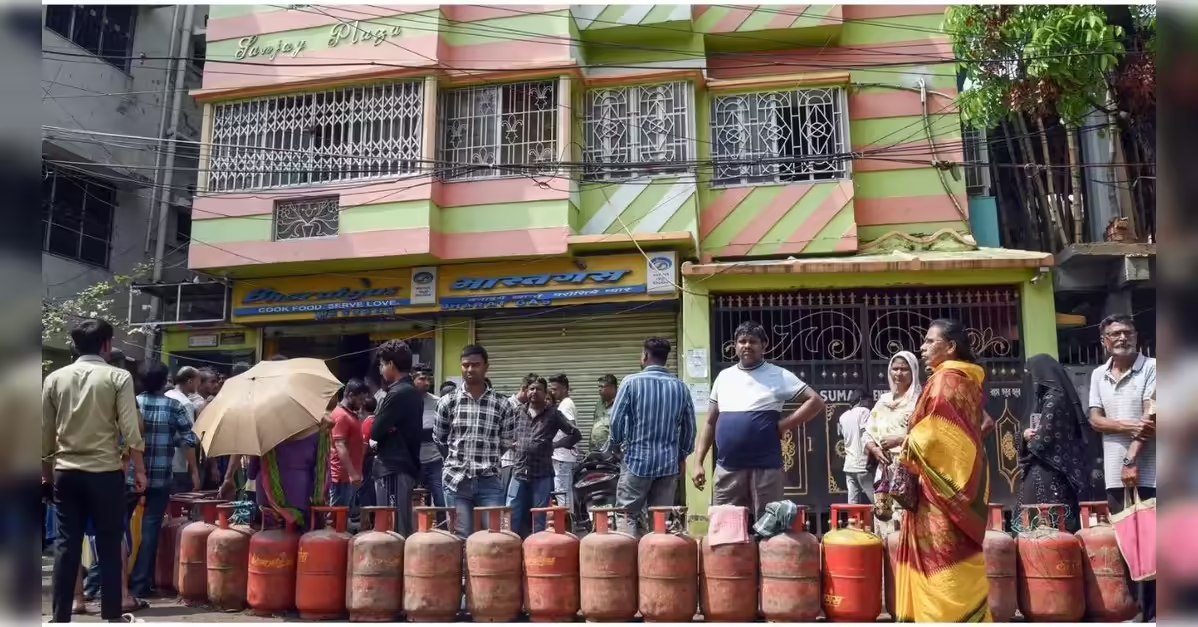
The energy sector, particularly its downstream segments, often presents a complex interplay of global commodity trends and localized operational realities. While global crude benchmarks may exhibit relative stability or predictable movements, regional disruptions can significantly impact specific markets and the companies operating within them. The recent surge of reports detailing severe LPG shortages across Punjab serves as a potent reminder of this dynamic, highlighting critical vulnerabilities in supply chains, distribution networks, and policy implementation. For investors, this localized crisis is not merely a regional news item; it’s a case study in operational risk, consumer sentiment, and the often-unseen challenges that can erode shareholder value in seemingly robust markets. Understanding the underlying causes and potential ramifications of such events is crucial for making informed investment decisions in the broader oil and gas landscape.
The Disconnect: Localized LPG Crisis Amidst Global Crude Moderation
Reports from LPG distributors in Punjab paint a stark picture of inadequate supply, directly contradicting official assertions of sufficient availability. This localized disruption is particularly noteworthy given the current state of global crude markets. As of today, Brent crude trades at $92.99, reflecting a slight decrease of 0.27% within a day range of $92.57 to $94.21. Similarly, WTI crude hovers at $89.51, down 0.18%. This relative stability, if not slight downward pressure, in benchmark crude prices contrasts sharply with the escalating crisis in Punjab. Our proprietary data shows Brent has actually seen a more significant moderation over the past two weeks, declining approximately 7% from $101.16 on April 1st to $94.09 by April 21st. The incongruity between easing global crude prices and rising localized LPG prices – with domestic cylinders increasing by ₹60 and commercial by ₹115 – suggests that the Punjab crisis is driven by factors beyond mere commodity cost fluctuations. Investors in Indian Oil Marketing Companies (OMCs) must recognize that this indicates potential structural weaknesses in regional logistics, inventory management, or regulatory oversight rather than a direct pass-through of global price spikes. The operational challenges faced by distributors, including a reported 20% cut in domestic LPG supplies and software failures hindering bookings, point to internal systemic issues that demand immediate attention.
Policy Missteps and Consumer Panic: An Erosion of Trust
The Punjab LPG crisis has been significantly exacerbated by a series of policy decisions and communication failures that have fueled widespread consumer panic. The imposition of restrictive booking intervals – 25 days for urban consumers and 45 days for rural consumers – coupled with the temporary suspension of booking channels for 3-4 days, directly contributed to the current predicament. Federation of LPG Distributors of Punjab president Gurpal Singh Mann has rightly pointed out the difficulty in justifying such restrictive measures if, as officially stated, there is no genuine shortage. This perception-action gap has led to a surge of pending bookings, with each gas agency in Punjab reportedly grappling with a backlog of 2,000 to 5,000 cylinders. The resulting public fury and safety concerns expressed by distributor staff underscore the tangible impact of these issues. For investors, this scenario is a red flag. Policy inconsistencies and a lack of transparent, timely information from authorities and OMCs can rapidly erode public trust, leading to social unrest and significant operational risks. The parallels drawn by distributors to crisis situations witnessed during the COVID-19 period highlight the severity of the perception of scarcity. Companies with substantial retail footprints in such regions face not only direct financial costs from logistical inefficiencies but also long-term reputational damage and potential regulatory scrutiny, all of which weigh heavily on investor confidence.
Forward Outlook: Balancing Macro Energy Trends with Micro-Market Vulnerabilities
While the Punjab LPG situation represents a localized micro-market challenge, it exists within a broader global energy context that investors continually monitor. Our analysis of upcoming energy events provides crucial insights into the macro environment. Investors are keenly watching the EIA Weekly Petroleum Status Reports scheduled for April 22nd and April 29th, which will offer critical data on U.S. crude oil and product inventories. Further insights into North American supply dynamics will come from the Baker Hughes Rig Count on April 24th and May 1st. On a broader strategic level, the EIA Short-Term Energy Outlook on May 2nd will provide updated forecasts on global supply, demand, and prices. While these events predominantly focus on macro energy trends, the Punjab crisis serves as a stark reminder that even a favorable global supply outlook cannot negate localized distribution failures or policy missteps. For investors, this means a dual focus is required: understanding the overarching supply-demand balance globally, while simultaneously scrutinizing the operational resilience and regulatory environment of specific regional markets where their portfolio companies operate. The ability of OMCs to navigate such localized disruptions, ensure consistent supply, and manage public perception will be a critical determinant of their long-term performance, irrespective of global crude price movements.
Addressing Investor Concerns: Beyond the Barrel Price
Our proprietary reader intent data reveals that a significant portion of investor inquiry remains focused on fundamental price direction: “Is WTI going up or down?” and “What do you predict the price of oil per barrel will be by end of 2026?” These questions underscore the pervasive focus on commodity price volatility. However, the Punjab LPG crisis provides a powerful counter-narrative, illustrating that investment success in the energy sector, particularly for integrated OMCs with extensive downstream operations, is not solely determined by the price of crude oil per barrel. The operational bottlenecks, supply chain failures, and governmental policy impacts witnessed in Punjab highlight that factors such as distribution network robustness, effective inventory management, regulatory clarity, and proactive consumer communication are equally, if not more, critical for sustained profitability and investor confidence in specific market segments. Investors must broaden their analytical lens beyond mere commodity price forecasts to include a thorough assessment of these “non-commodity” risks. A company might benefit from high crude prices, but if its downstream distribution networks are fragile, susceptible to policy shifts, or unable to meet consumer demand efficiently, its overall value proposition can be severely undermined. This crisis serves as a tangible example for investors to consider the comprehensive health of an energy company’s value chain, from wellhead to the end-consumer’s cylinder.


