

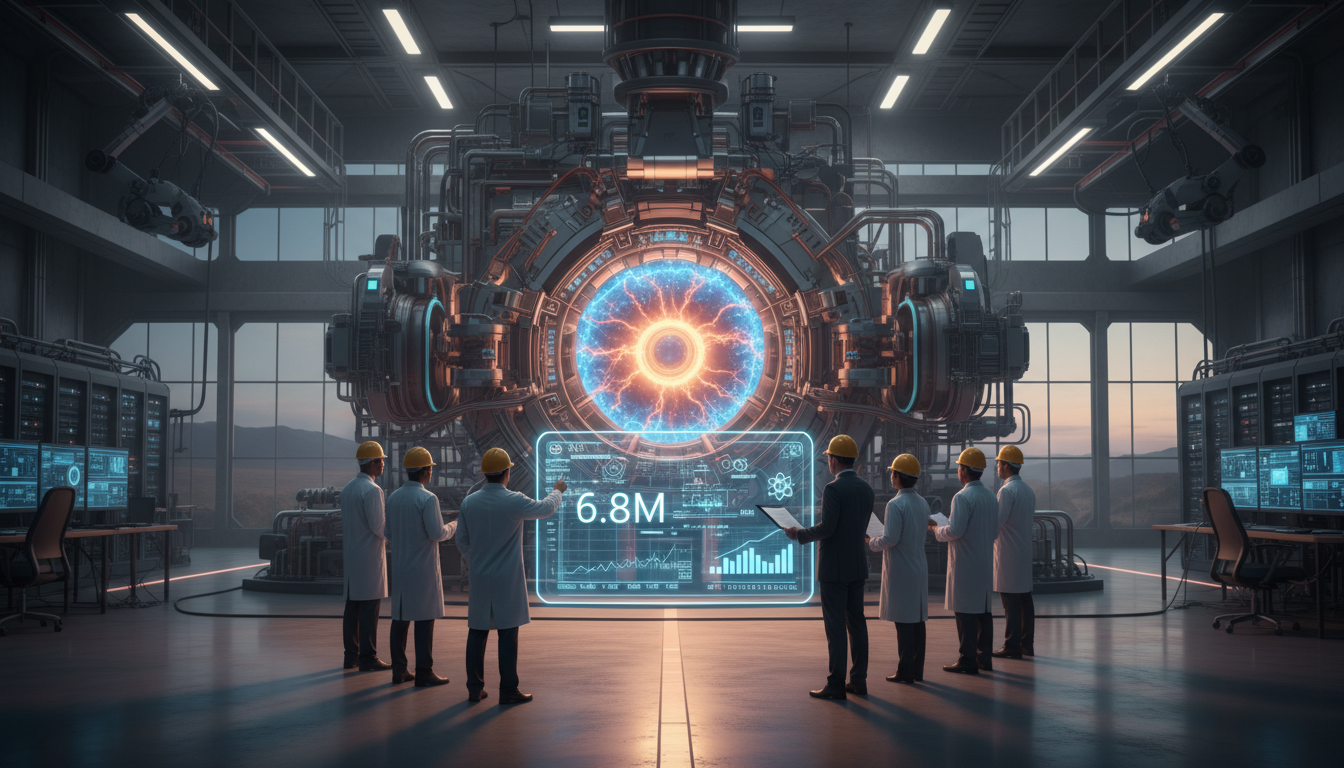
Pranos Fusion Secures $6.8 Million, Signaling Shifting Tides in Energy Investment Landscape
The global energy sector, a landscape traditionally dominated by fossil fuels, continues its relentless evolution. Today, an intriguing development emerges from the deep tech arena as Pranos Fusion, a burgeoning nuclear fusion startup, successfully closed a $6.8 million funding round. This substantial capital injection is earmarked to accelerate the company’s technological advancements, pushing the commercialization of fusion energy closer to reality. For investors monitoring the long-term trajectory of global energy demand and supply, fusion represents a distant yet potent force with the potential to fundamentally reshape future market dynamics.
For decades, nuclear fusion has captured the imagination of scientists and visionaries alike, often dubbed the “Holy Grail” of clean, virtually limitless energy. The process involves coaxing two lighter atomic nuclei to merge into a single, heavier one, releasing immense amounts of energy in the process. Its allure is profound: the primary fuel source, hydrogen, is the most abundant element in the universe, ensuring an inexhaustible supply. Crucially, fusion promises energy generation without the carbon emissions associated with hydrocarbon combustion and, critically, without the burden of highly radioactive, long-lived waste characteristic of traditional nuclear fission power. However, replicating the extreme temperatures and pressures found within stars—conditions essential for sustained fusion reactions—has remained an monumental engineering and scientific challenge, making large-scale energy generation elusive.
Established in 2024 by visionaries Shaurya Kaushal and Roshan George, the India-based Pranos Fusion is specifically tackling these formidable barriers to commercial viability. The company’s strategic focus centers on tokamak technology, a sophisticated magnetic confinement device designed to contain the superheated plasma necessary for fusion. While many tokamak designs resemble a toroidal doughnut, Pranos distinguishes itself with its innovative “PRAGYA” design. This medium-scale, low-aspect-ratio tokamak offers inherent performance advantages, allowing for more efficient plasma confinement and stability.
Pranos’ technological suite extends beyond the PRAGYA reactor. The firm also develops its “JENGA” tokamak design and sophisticated control software, critical for managing the complex plasma dynamics within the reactor. A cornerstone of their innovation is the “MAGGA” High-Temperature Superconducting (HTS) magnets. These advanced magnets are pivotal for generating significantly stronger magnetic fields, which in turn enhance tokamak performance. The efficiency gains and magnetic field strength afforded by MAGGA HTS magnets also facilitate more compact reactor architectures, directly addressing one of the major hurdles to economic viability: the physical footprint and material costs of fusion power plants.
The synergy between Pranos’ technological components is key to its promise. The company asserts that its integrated approach, combining advanced plasma control systems with these state-of-the-art high-temperature superconducting magnets, enables longer plasma confinement times. This enhanced confinement, coupled with stronger magnetic fields, is projected to result in a significantly smaller physical footprint for their fusion reactors. Such efficiencies are vital for reducing construction costs and accelerating the path to commercial deployment, making fusion a more practical proposition for grid-scale energy generation.
Shaurya Kaushal, Co-founder and CEO of Pranos Fusion, articulated the company’s ambitious vision: “We stand on the shoulders of brilliant fusion physics. Now, the world needs the commercial infrastructure to bring it to the grid—the technology to design, construct, and operate fusion power plants at scale. At Pranos, we are building exactly that, and we are beginning our contribution today, from India.” This statement underscores a shift from fundamental scientific research to the practical engineering and commercialization aspects that will ultimately determine fusion’s place in the global energy mix.
The recently secured $6.8 million funding round provides critical impetus for Pranos to accelerate development across its three core technology verticals. A significant near-term milestone for the company is the anticipated “first plasma” event for its prototype PRAGYA compact fusion reactor, scheduled for later this year. Achieving first plasma represents a crucial step in validating their design principles and magnetic confinement capabilities, a key de-risking event for future investors.
The financing round saw co-leadership from prominent venture capital firms pi Ventures and Ankur Capital. Further participation came from existing investor Industrial47, alongside notable individual investors including Lalit Keshre, the founders of Razorpay, and Bhukhanwala Industries. This diverse investor base signals growing confidence in the deep tech sector and the long-term potential of fusion energy, even amidst its inherent challenges.
In a public statement regarding their investment, pi Ventures highlighted the strategic rationale: “Fusion is a quintessential deeptech challenge that we strive to back: high-barrier, high-impact, and inherently global. Our investment in Pranos aligns with India’s long-term imperative to build sovereign capability in critical energy technologies.” This perspective emphasizes not only the transformative global impact fusion could have but also its strategic importance for national energy independence and technological leadership, a narrative increasingly relevant in a world grappling with energy security concerns.
For investors deeply entrenched in the oil and gas markets, Pranos Fusion’s successful capital raise serves as a potent reminder of the ongoing, accelerating energy transition. While fusion remains a long-term play, often projected decades into the future for widespread commercial deployment, the influx of venture capital into such disruptive technologies warrants careful monitoring. These advancements, however nascent, represent potential future competition for traditional energy sources and highlight the imperative for strategic diversification and understanding of evolving energy technologies. The long-term investment horizon in fusion contrasts sharply with the shorter-cycle nature of many upstream oil and gas projects, yet both ultimately aim to power global economies. As global energy demand continues to climb, and pressures mount for decarbonization, breakthroughs in fusion could eventually redefine the energy landscape, influencing everything from power generation to industrial processes and, ultimately, impacting the long-term demand curve for conventional fuels.
Source
