

In November 2025, the Ministry of Foreign Affairs of the Republic of Poland hosted the “Partnership for Resilience Building” conference in Warsaw, which brought together academic, government, and industry participants from Poland and the Asia-Pacific. The conference aimed to seed international cooperation on five strategic issues: critical infrastructure protection, energy security, food security, the digital economy, and the supply chains of critical minerals.
Poland’s Asia-Pacific Outreach
The conference marks the endeavour of another European Union (EU) country – Poland – to grow its security and economic engagements with Asia-Pacific countries, including those in Southeast Asia. Since Poland assumed the EU presidency for the first half of 2025, it has been expanding its diplomatic outreach in the Asia-Pacific to advance its strategic goals and the EU’s priorities in the region.
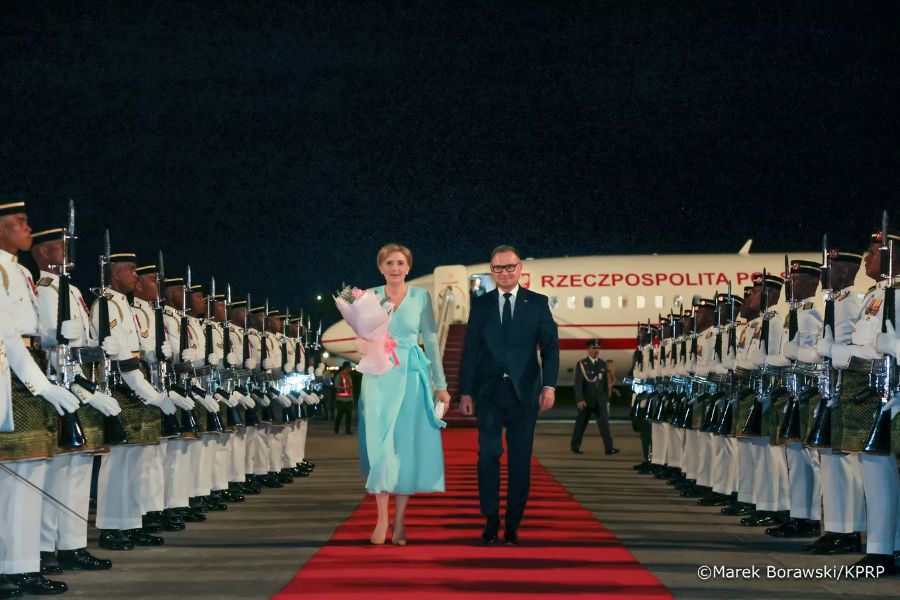
For example, former Polish President Andrzej Duda visited Malaysia in June 2025, where he met Malaysian Prime Minister Anwar Ibrahim, who was then the Chair of the Association of Southeast Asian Nations (ASEAN). They discussed deepening interregional economic cooperation between the EU and ASEAN. The meeting agenda also included enhancing bilateral relations, as Poland seeks to sell more agricultural products, such as apples, to the Malaysian market. Malaysia plans to modernise the PT-91M main battle tanks it previously purchased from Poland.
Andrzej Duda also visited Singapore in June 2025, where his agenda focused on expanding economic and security cooperation, including in cybersecurity and defence. Following this visit, Poland is reportedly considering replacing its locally-made Rosomak armoured personnel carriers (APCs) with the Terrex APC made by Singapore’s ST Engineering and partnering with ST Engineering to produce 40 mm ammunition. Such defence partnerships are crucial to Poland as they increase its military spending to deter the threat from Russia.
In September 2025, the Polish Foreign Minister Radosław Sikorski joined his counterparts from France, Germany and the United Kingdom to meet the foreign ministers of Australia, Japan and South Korea on the sidelines of the 80th United Nations (UN) General Assembly. This meeting underscored the strategic intent of middle powers in Europe and the Asia-Pacific to cooperate in addressing common economic and security challenges as both regions grapple with shifts in the global order.
Particularly with South Korea, Poland shares a substantive defence relationship. Poland is purchasing K2 Black Panther main battle tanks from South Korea as it beefs up its land forces to deter the threat from Russia. South Korea is planning to transfer a Jang Bogo-class submarine to Poland for free to express its interest in participating in Poland’s “Orca” submarine programme. These arrangements make Poland a key European client of South Korea’s defence industry.
Why Poland Engages the Asia-Pacific
The priorities of Poland’s diplomatic outreach to the Asia-Pacific span the economic and security domains. In fact, these two domains are deeply intertwined today and have a significant impact on a country’s ability to achieve its strategic goals of national security and resilience amid geopolitical tensions shaping the global strategic environment. Poland also needs to find policy alternatives, as the EU faces internal challenges catalysed by the protracted war in Ukraine. Furthermore, the credibility of the North Atlantic Treaty Organisation (NATO) is undermined by the problematic relationship between U.S. President Trump and the transatlantic allies.
In that regard, Polish experts have highlighted that their country should enhance its engagement with the Asia-Pacific as the region becomes more important politically and economically. Leveraging the EU’s relations with the Asia-Pacific, such as through the EU-ASEAN Strategic Partnership, Poland could enhance its image and bilateral relations with countries in the region. This effort would be a crucial step towards identifying opportunities for practical cooperation in economic security, supply chain resilience, and sustaining international support for Ukraine’s fight against Russia’s invasion.
Poland’s preoccupation with the Russia threat is understandable. On the territorial front, Poland sees Russia as an immediate military threat due to the invasion of Ukraine and the historical experience of foreign occupation by hostile powers, including the Soviet Union. On the grey zone front, Poland faces drone incursions and disinformation, sabotage and cyber-attacks on critical infrastructure, which are believed to have originated from Russia. On the political front, Poland sees its tense relations with Russia as a contest between democracy and authoritarianism.
Nonetheless, it would be judicious for Poland to calibrate its narrative on the Russia threat while engaging the Asia-Pacific due to their different national positions on the Russia-Ukraine war and their bilateral relations with Russia. For example, countries there continue to engage Russia multilaterally through inclusive regional security architecture such as the ASEAN Regional Forum (ARF) and ASEAN Defence Ministers’ Meeting Plus (ADMM-Plus). Bilaterally, countries such as Indonesia, Vietnam, and India regard Russia as a valuable partner and even a counterbalance to China and the U.S.
Practical Cooperation in Building National Resilience
Instead, Poland could focus on sharing its experiences and fostering practical cooperation with Asia-Pacific countries on strategic issues where the economic and security domains intersect, and there is a like-mindedness in building national resilience in these issues. Indeed, this was the approach seen during the “Partnership for Resilience Building” conference in Warsaw.
For example, on the physical side of critical infrastructure protection, Poland is building its own anti-drone system to better defend its borders from drone incursions that target critical infrastructure such as the power grid. On the digital side of critical infrastructure protection, Poland is launching the “Cyber Legion,” a partnership to connect cybersecurity experts across its military and academia.
Poland is also leveraging the EU’s Galileo satellite system – a civilian-operated system not controlled by major powers – to build resilience against interference in Global Navigation Satellite Systems (GNSS), which are crucial to the operations of digital systems. Galileo is listed in the Plan of Action to Implement the ASEAN-EU Strategic Partnership (2023-2027) as a potential area of interregional space cooperation.
Looking ahead, Asia-Pacific countries seeking to diversify their policy options amid global shifts could consider exploring cooperation with Poland (and Europe) on such strategic issues where it has ample practical experience.
[Header image: Former President of Poland Andrzej Duda during his official visit to Southeast. Credit: Marek Borawski/KPRP]
The views and opinions expressed in this article are those of the author.

Muhammad Faizal is a Research Fellow with the Regional Security Architecture Programme, Institute of Defence and Strategic Studies (IDSS) at the S. Rajaratnam School of International Studies (RSIS), Singapore. He participated in the “Partnership for Resilience Building” conference in Warsaw, where he spoke on critical infrastructure protection.
