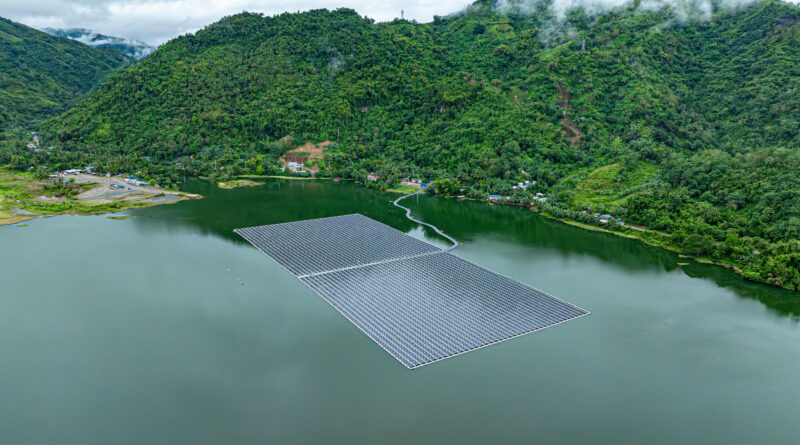
The recent grid connection of the Philippines’ first megawatt-scale floating solar power plant marks a pivotal moment in Southeast Asia’s energy transition. This 4.99 MW facility, strategically located on the Malubog Reservoir, is now supplying approximately 10% of the power demand for the Carmen Copper mining site. For oil and gas investors, this development signals an accelerating shift in industrial energy consumption patterns, potentially impacting long-term demand dynamics for traditional fuels and highlighting new avenues for capital deployment in resilient, localized renewable infrastructure. Understanding the drivers and implications of such projects is crucial for navigating an evolving global energy landscape.
Strategic Pivot to Renewables: Industrial Demand and National Targets
The Philippines’ ambitious goal to derive 35% of its energy from renewable sources by 2030 is clearly gaining momentum, with this floating solar project serving as a tangible step forward. The choice of floating solar technology addresses a critical challenge in land-scarce, island nations: maximizing power generation efficiency while preserving valuable terrestrial resources. Supplying a significant portion of a major industrial consumer like the Carmen Copper mine underscores the immediate economic and operational benefits for large energy users. This direct application in a demanding sector like mining demonstrates how renewables are moving beyond niche applications to become integral components of industrial power strategies, offering a hedge against the inherent volatility of global commodity markets. Investors should note the growing trend of industrial players securing their own power generation, a move that de-risks operations and enhances long-term sustainability profiles.
Engineered Resilience: Mitigating Operational Risks
A key investment consideration for any infrastructure project, especially in a region prone to extreme weather, is its long-term resilience and operational stability. The Malubog Reservoir plant, a collaboration between Black & Veatch and Sungrow FPV, exemplifies robust engineering designed to withstand challenging conditions. The system is engineered to endure ultimate wind speeds of 75 m/s, demonstrating its capability against severe tropical storms. Furthermore, rigorous fatigue tests, reportedly exceeding the industry benchmark of 100,000 cycles, along with an elastic mooring system and enhanced anti-wind design, have improved impact resistance by 50%. Corrosion, a perpetual concern in marine environments, has also been addressed, with composite coatings showing no degradation after over 18,000 hours of real-world marine exposure and passing 4,200 hours of CX-class testing. Such technical specificities are critical for investors assessing the durability and predictable returns of renewable energy assets in high-risk environments, offering a stark contrast to the often unforeseen operational disruptions in other energy sectors.
Market Volatility and the Drive for Energy Security
The strategic move by entities like Carmen Copper to integrate stable renewable power sources gains added context when viewed against the backdrop of volatile global energy markets. As of today, April 16th, Brent crude trades at $98.01 per barrel, marking a significant 3.24% increase within the day, though it has seen a substantial correction. The 14-day trend illustrates this volatility starkly, with Brent crude shedding $13.43, a 12.4% decline from its $108.01 high on March 26th to $94.58 on April 15th. Such rapid price swings profoundly impact the operating costs for industrial consumers heavily reliant on fossil fuels. This inherent unpredictability in traditional energy prices, alongside the day’s WTI crude at $89.65 (+1.72%) and gasoline at $3.08 (+2.33%), reinforces the economic rationale for investing in renewable energy. Floating solar projects offer a predictable cost structure, insulating industrial users from these external shocks and providing a more stable foundation for long-term financial planning and investment.
Investor Focus: Forward Guidance and Strategic Calendar Events
Our proprietary intent data reveals a consistent investor focus on the underlying models powering our market insights and, critically, on building reliable Brent price forecasts for the next quarter. This underscores the perpetual challenge of predicting commodity markets, a challenge partially mitigated by investments in stable, localized renewable generation. For oil and gas investors grappling with these forecasts, the accelerating energy transition, exemplified by projects like the Malubog floating solar, represents a structural shift that will influence long-term demand. Looking ahead, the upcoming OPEC+ Joint Ministerial Monitoring Committee (JMMC) meeting on April 18th and the full Ministerial meeting on April 20th will be crucial in shaping the near-term crude supply outlook. While these events directly impact fossil fuel prices, the strategic pivot towards renewables represents a fundamental shift in demand patterns that investors cannot ignore. Furthermore, weekly indicators like the API and EIA inventory reports on April 21st/22nd and April 28th/29th, alongside the Baker Hughes Rig Count on April 17th and 24th, will continue to provide granular insights into the immediate supply-demand balance, influencing short-term trading strategies. Investors must integrate both the short-term market catalysts and the long-term energy transition narrative into their portfolio decisions.
Global Partnerships and the Expanding Renewable Footprint
The successful deployment of the Philippines’ first megawatt-scale floating solar plant highlights the critical role of strategic partnerships and technological expertise in advancing the energy transition. The collaboration between Black & Veatch, a global leader in infrastructure development, and Sungrow FPV, a specialist in floating solar solutions, demonstrates a synergistic approach to overcoming complex engineering and logistical challenges. Sungrow FPV has explicitly stated its intention to “continue to expand partnerships globally to accelerate renewable energy adoption.” This signals robust growth opportunities for companies positioned within the renewable energy supply chain, from technology providers to project developers and financiers. For investors, identifying key players in this expanding ecosystem, especially those with proven capabilities in challenging environments or emerging markets, offers significant potential. As more nations and industries pursue clean energy targets, the demand for resilient, scalable, and technologically advanced renewable solutions will only intensify, creating a fertile ground for strategic capital allocation.


