

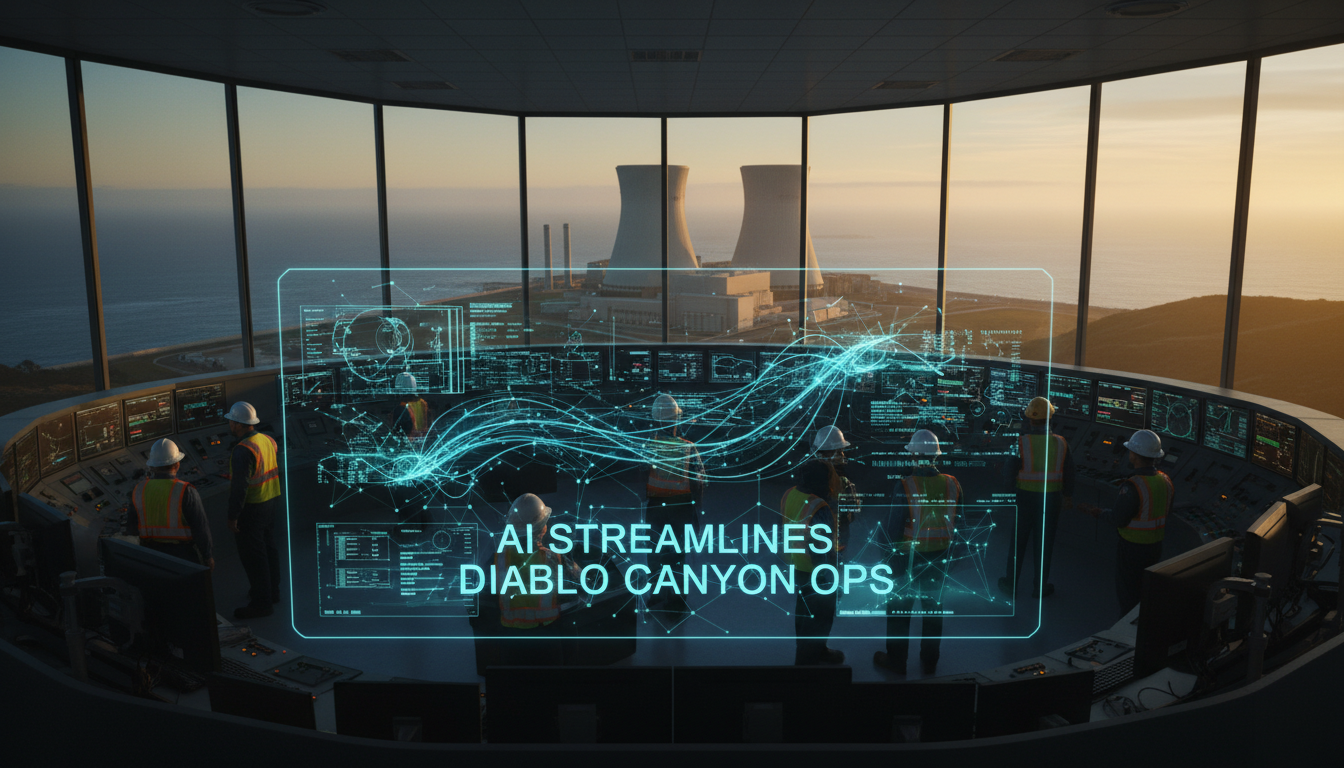
The energy sector routinely navigates dynamic regulatory landscapes and evolving operational demands. For investors focused on utility stability and long-term asset value, the recent strategic shift at California’s Diablo Canyon Power Plant offers a compelling case study in operational resilience powered by cutting-edge technology. Initially slated for shutdown by 2025, a 2016 decision driven by environmental concerns regarding its coastal location and proximity to fault lines, the plant received an unexpected reprieve in September 2022. Governor Gavin Newsom’s signing of SB 846 extended Diablo Canyon’s operational lifespan through October 2030, presenting Pacific Gas and Electric (PG&E) with an urgent challenge: how to rapidly retool operations and ensure regulatory compliance for an asset preparing for decommissioning.
PG&E’s Senior Vice President and Chief Risk Officer, Maureen Zawalick, a three-decade veteran with the utility, articulated the pivot required. The extension necessitated an immediate acceleration of regulatory applications and addressing workforce attrition that had occurred in anticipation of the earlier shutdown. Recognizing the immense administrative burden inherent in nuclear operations, Zawalick identified artificial intelligence (AI) as a crucial lever to streamline the plant’s extensive paperwork processes. This strategic foresight led her to a pivotal meeting in January 2024 with Trey Lauderdale, CEO and founder of Atomic Canyon, an AI startup specializing in the nuclear energy sector.
Lauderdale’s background in the highly regulated healthcare industry, coupled with his proximity to Diablo Canyon, sparked his vision for an AI solution designed to alleviate the substantial administrative overhead in nuclear power. His ambition materialized in a groundbreaking collaboration: PG&E and Atomic Canyon developed Neutron, the first-ever commercial on-site generative AI tool deployed at a U.S. nuclear power facility. Neutron’s core mandate is to empower Diablo Canyon’s workforce by simplifying access to the millions of documents legally mandated for retention, a critical factor for maintaining operational integrity and regulatory adherence.
The nuclear industry operates under stringent federal and state oversight, generating an enormous volume of documentation and data. Diablo Canyon alone manages billions of data points, encompassing everything from detailed engineering schematics and design updates to exhaustive regulatory filings. This vast trove of information resides across six disparate systems, stored securely on-site. Neutron uniquely connects to these various systems over the plant’s internal network, crucially avoiding cloud-based storage, allowing staff to leverage this powerful AI search utility directly from their workstations with a simple web interface. This on-premise deployment addresses paramount security and data sovereignty concerns, particularly vital for critical national infrastructure.
Advanced AI Engineering for Nuclear Precision
The genesis of Neutron began in December 2023 when Trey Lauderdale established Atomic Canyon, assembling a team of AI engineers with expertise drawn from the complex healthcare regulatory environment. Lauderdale’s strategic objective was to engineer a generative AI tool specifically tailored to comprehend the nuanced terminology of the nuclear sector, surpassing the capabilities of general-purpose models like OpenAI’s ChatGPT or Anthropic’s Claude. To achieve this, Atomic Canyon’s development team meticulously trained their AI model by ingesting an astonishing 53 million pages of publicly available industry data sourced directly from the Nuclear Regulatory Commission (NRC), the federal agency tasked with overseeing commercial nuclear power plants.
Further bolstering its development capabilities, Atomic Canyon announced a strategic partnership in May 2024 with the Department of Energy’s Oak Ridge National Laboratory in Tennessee. This collaboration granted Lauderdale’s team access to Frontier, a cutting-edge supercomputer, which was instrumental in training Atomic Canyon’s AI model on its specialized lexicon of nuclear terms. By November 2024, PG&E had officially selected Atomic Canyon to develop and implement what would become the Neutron system at Diablo Canyon, underscoring the utility’s commitment to leveraging advanced technology for operational excellence.
Neutron serves as an indispensable digital assistant for PG&E employees, efficiently retrieving crucial information pertaining to operating and maintenance procedures, historical engineering design modifications, and the intricate web of state and federal regulatory stipulations. As Zawalick noted, Diablo Canyon, a facility over 40 years old, manages more than 9,000 distinct procedures for its operation and maintenance, alongside billions of pages of data. Prior to Neutron, personnel often faced the arduous task of sifting through multiple, disparate systems to locate necessary information. Now, with Neutron, these details are readily accessible from a single, unified database, developed and powered by Nvidia’s robust AI platform, significantly streamlining workflows and reducing potential errors.
PG&E initiated a pilot program for Neutron during the first half of 2024, involving a targeted beta-test group comprising employees from its engineering, maintenance, and operations departments. This phased rollout continued into July 2025, with comprehensive training sessions designed to familiarize employees with the AI-powered search tool. By the fall of 2025, Neutron was fully integrated and made available to all 1,300 workers at the Diablo Canyon facility, marking a complete digital transformation of their document retrieval and information management processes.
Tangible Returns: AI’s Impact on Operational Efficiency and Investment Value
The tangible benefits of Neutron’s deployment at Diablo Canyon quickly became evident. As of January 2025, a PG&E spokesperson confirmed that Neutron’s advanced search capabilities and generative AI summaries had dramatically reduced the overall time required for document retrieval. This efficiency gain translates directly into substantial cost savings and accelerated problem resolution, directly impacting the plant’s financial viability and operational continuity.
Maureen Zawalick provided a compelling illustration of this impact. In a past scenario involving an investigation into a safety valve issue at Diablo Canyon, a dedicated team of 12 employees would typically spend approximately 180 days to gather all prerequisite documentation before any corrective work could commence. With Neutron, that same team now completes the entire documentation retrieval process within a mere 40 days. This staggering 78% reduction in preliminary project time not only curtails labor costs but also minimizes potential operational downtime, enhancing the plant’s overall productivity and safety profile—factors critical for investor confidence.
Looking ahead, Zawalick expressed optimism regarding the broader implications of generative AI tools like Neutron. She foresees these innovations playing a pivotal role in accelerating the development of new energy infrastructure, whether it be solar, wind, or future nuclear facilities, all essential for meeting the burgeoning energy demands across the United States. A tool of this caliber, she emphasized, will be instrumental in streamlining complex regulatory filings, optimizing construction timelines, and refining engineering processes for upcoming projects. This vision suggests a future where AI-driven efficiencies could significantly de-risk large-scale energy investments, making the development of new clean energy assets more predictable and financially attractive.
The successful integration of Neutron at Diablo Canyon underscores a vital trend for investors: the strategic adoption of AI is not merely an operational enhancement but a fundamental driver of efficiency, compliance, and profitability within the energy sector. As utilities face increasing pressure to modernize infrastructure, enhance safety, and navigate complex regulatory environments, solutions like Atomic Canyon’s Neutron offer a clear pathway to unlocking greater value and securing the future of critical energy assets.
