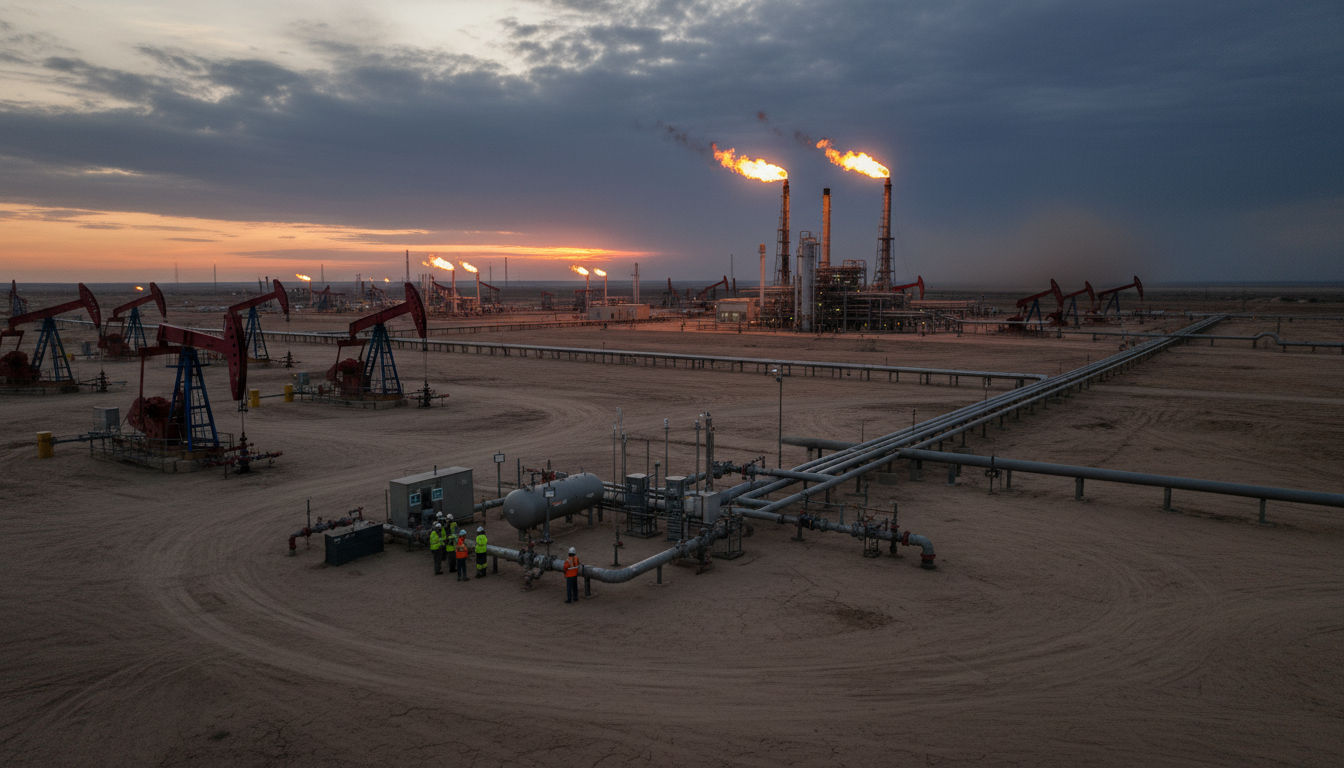
Permian Basin: The Ultimate Oil & Gas Investor’s Barometer Amid Global Shocks
The Permian Basin has a storied history of defying expectations. Time and again, skeptics have questioned its longevity, only to witness it propel U.S. crude output to unprecedented heights. Today, the crucial inquiry is not about the Permian’s ultimate resource limits, but rather its capacity to maintain its decade-long trajectory of expansion and, more critically, its ability to significantly amplify production when global energy markets suddenly demand it.
This challenge has transitioned from a theoretical discussion to an immediate reality. With geopolitical tensions intensifying, notably the conflict in Iran threatening the Strait of Hormuz – a vital chokepoint through which approximately 20% of the world’s oil transits – markets are once again scrutinizing the Permian’s potential as the global system’s primary shock absorber.
The Permian’s Unwavering Role in Global Supply
Despite these complexities, the Permian Basin unequivocally remains the cornerstone of international oil supply growth. Its production has now surpassed an impressive 6 million barrels per day, cementing its status as the most agile and responsive oil-producing region worldwide. Historically, an uptick in crude prices reliably translates into increased operational activity and capital investment within the basin. When global supply dynamics tighten, the Permian invariably becomes the first destination for upstream capital, and we are already observing this investment response take hold.
Indeed, some independent and major producers are strategically ramping up their operations, deploying additional rigs, and revising production guidance upwards, directly correlating with the surge in oil prices triggered by the ongoing conflict. However, the sheer magnitude of potential disruption must be put into perspective. A full-scale interruption of flows through the Strait of Hormuz could result in losses measured in millions, potentially even tens of millions of barrels per day in extreme scenarios. Against such a colossal backdrop, even a robust and rapid response from the U.S. shale sector appears, by necessity, incremental.
This leads to a critical distinction: the Permian possesses the capability to respond, but it cannot fundamentally replace the volumetric losses of a major global supply shock.
Navigating Near-Term Constraints and Long-Term Evolution
In the immediate timeframe, the Permian’s capacity to materially offset a large-scale supply disruption remains inherently limited. Bringing new production online, even in the highly efficient shale plays, requires a time lag. Activities such as well completions, rig mobilization, securing skilled labor, and expanding vital takeaway infrastructure all introduce unavoidable delays. There is, of course, some immediate upside: operators can quickly activate drilled-but-uncompleted (DUCs) wells, potentially adding a few hundred thousand barrels per day relatively swiftly. Yet, this contribution pales in comparison to the immense scale of a global supply crisis emanating from Hormuz.
Beyond this initial DUC inventory, the response timeline stretches further. Most energy companies initiated the current fiscal year with prudently disciplined capital expenditure plans, formulated against a backdrop of lower anticipated oil prices. Even with today’s elevated price environment, many producers maintain a cautious stance, preferring to observe the sustained nature of current market conditions before committing to extensive, large-scale drilling programs. This reflects a fundamental structural transformation within the industry. The Permian Basin is no longer primarily geared for “growth at any cost”; instead, its operational and investment philosophy is rigorously centered on delivering attractive shareholder returns.
This pivot toward profitability profoundly alters how the basin responds to market shocks. Concurrently, the Permian itself is exhibiting signs of maturation. The most prolific “Tier 1” acreage has seen substantial development over the past decade. While high-quality inventory still exists, its availability is more constrained. Operators are increasingly migrating towards “Tier 2” and “Tier 3” locations, where wells generally exhibit lower productivity and are consequently more sensitive to commodity price fluctuations. This shift does not halt overall growth, but it undeniably makes incremental production gains more challenging to achieve.
Decline Rates, Infrastructure, and the Global Balance
A persistent characteristic of shale production is its steep decline rates. While shale wells boast rapid initial production, their output diminishes quickly, necessitating continuous drilling merely to sustain existing production levels. This system functions effectively, but it fundamentally lacks the traditional “spare capacity” often associated with conventional oil fields. This distinction is gaining heightened importance in a global landscape where established spare capacity mechanisms are under significant strain.
Historically, global crude markets relied heavily on OPEC, particularly Saudi Arabia, to provide immediate supply buffers in times of disruption. Today, this traditional system faces considerable pressure, redirecting market attention squarely towards U.S. shale. However, shale is not a simple “plug-and-play” solution; it operates as a price-responsive system, not an instantaneous rapid-response mechanism designed for geopolitical emergencies. Infrastructure, while vastly improved, adds another layer of complexity.
The Permian now benefits from robust pipeline and export terminal capacity, facilitating the efficient delivery of its barrels to international markets. This enhanced infrastructure has allowed the U.S. to reroute crude supply to regions affected by Middle East disruptions, including key markets in Asia. Nevertheless, these capabilities also have their limits. Pipelines, export facilities, and global shipping logistics cannot scale instantaneously to meet emergency demands. Furthermore, if critical global shipping arteries like the Strait of Hormuz are indeed disrupted, the logistical challenge of moving those Permian barrels becomes infinitely more intricate, irrespective of domestic production levels.
Investment Outlook: A Buffer, Not a Replacement
So, what is the realistic expansion potential for the Permian Basin? In the short term, its capacity is modest. While it can contribute incremental supply, help stabilize some market imbalances, and offer alternative barrels to global buyers, it cannot fully offset a major, prolonged disruption originating from the Middle East.
In the medium term, however, greater responsiveness becomes evident. Should persistently higher oil prices become the new normal, drilling activity will undoubtedly accelerate, production will increase, and the Permian will once again solidify its standing as a leading global supply engine. This type of significant response, crucially, unfolds over months, not mere weeks. Looking further into the long term, a fundamental question persists: the Permian is certainly not running out of oil, but it is demonstrably running out of the “easy oil” that characterized its early boom years.
This evolving distinction carries more weight now than ever, given the ongoing transformation of the global energy system. The Permian remains an indispensable component of global oil supply, representing the world’s most flexible and dynamic source of crude. Yet, events like the Iran conflict and the threat to the Strait of Hormuz underscore both its immense strengths and its inherent limitations. It functions as a vital buffer, providing crucial breathing room, but it is not a direct replacement for large-scale, conventional oil supplies. It can help absorb market shocks, but it cannot entirely eliminate them.
Ultimately, the Permian Basin possesses years, even decades, of productive life ahead, but its role in the global energy matrix is undergoing a profound evolution. It stands as the fastest-moving and most responsive basin globally, yet it can no longer unilaterally stabilize international supply amid large-scale, geopolitical disruptions. In a world where 20% of global oil flows can be jeopardized almost overnight, this reality does not signify a failure of the Permian’s capabilities. Rather, it serves as a powerful reminder of how intricately the entire global energy system remains interdependent.