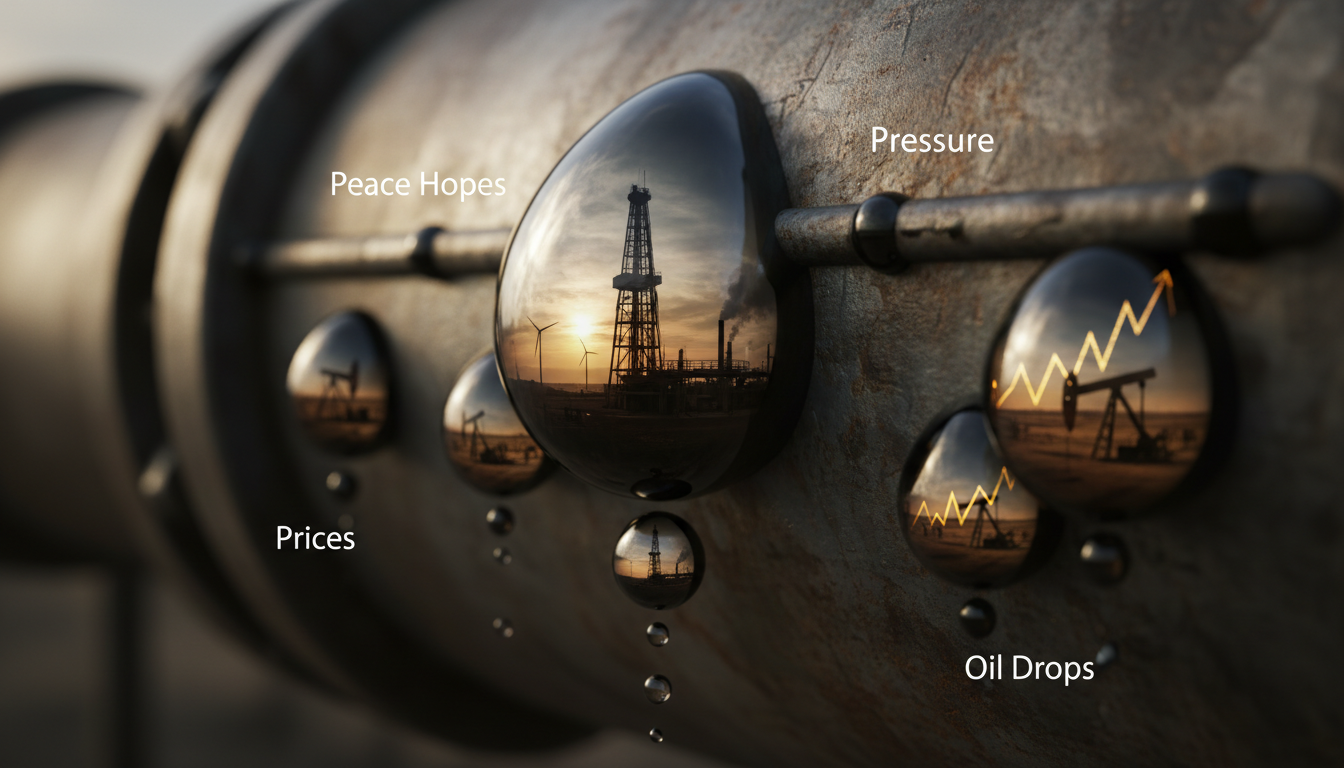
The global crude market recently witnessed a significant recalibration, as emerging signals of potential de-escalation in the protracted Middle East conflict began to erode a long-held geopolitical risk premium. This diplomatic overture, spearheaded by remarks from Iranian state media quoting President Masoud Pezeshkian on readiness to conclude hostilities, coupled with comments from US President Donald Trump, initially triggered a sharp retreat in oil futures. While the market’s psychology eagerly embraced the prospect of peace, discerning investors understand that the path from diplomatic hope to physical market stability is complex and fraught with lingering challenges.
The Shifting Sands of Oil Futures: Risk Premium Erosion and Current Snapshot
The initial euphoria surrounding de-escalation talks had a dramatic impact on oil pricing, sending futures tumbling from recent highs. Our proprietary data shows Brent crude, for instance, experienced a notable decline of over 7% in the past two weeks, moving from $101.16 at the beginning of April to $94.09 by yesterday. This substantial dip underscores the market’s sensitivity to geopolitical developments and its swiftness in pricing in reduced risk. As of today, the market appears to be consolidating after that significant correction. Brent crude currently trades at $93.89 per barrel, marking a modest 0.7% gain for the day, with its trading range oscillating between $91.39 and $94.86. Similarly, West Texas Intermediate (WTI) crude is priced at $90.31 per barrel, also up 0.71% for the session, having moved between $87.64 and $91.41. US gasoline prices, a key indicator for consumer sentiment, remain relatively stable at $3.13 per gallon. This snapshot reveals a market that has largely discounted the immediate geopolitical risk premium, but one that remains keenly attentive to any shifts in the fragile peace narrative.
Physical Realities vs. Diplomatic Optimism: The Supply Chain Disconnect
Despite the market’s enthusiasm for diplomatic progress, the physical realities on the ground present a stark contrast to the swift movements of futures contracts. The conflict, now in its fifth week, has inflicted significant disruptions on the global energy complex, most notably by effectively sealing off the crucial Strait of Hormuz. This vital maritime chokepoint, essential for the transit of a substantial portion of the world’s crude oil, natural gas, and refined products, remains a bottleneck. The immediate consequence of this disruption has been a dramatic surge in energy prices, contributing to global inflation concerns. While recent price action reflects a reduction in perceived geopolitical risk, industry experts, such as Shaia Hosseinzadeh, Chief Investment Officer at OnyxPoint Global Management, rightly emphasize the disconnect. As he succinctly put it, even an immediate cessation of hostilities would necessitate “weeks to months to restore flows,” highlighting that current “price signals are not adequately reflecting the physical reality” of the strained supply situation. Investors must recognize that while a risk premium can be erased quickly, physical infrastructure repairs and supply chain normalization are protracted processes, leaving the market vulnerable to renewed tightness even under a peaceful resolution.
Navigating the Near-Term: Key Data Points and Upcoming Catalysts
Many investors are asking for clarity on whether WTI will be “going up or down” in the immediate future, a question that underscores the current market uncertainty. To gauge the market’s trajectory in the coming weeks, attention will shift from geopolitical headlines to fundamental supply and demand indicators. Our upcoming calendar of energy events provides crucial insights into these catalysts. This Wednesday, April 22nd, and again on April 29th and May 6th, the EIA Weekly Petroleum Status Reports will offer critical data on crude oil, gasoline, and distillate inventories. These reports are pivotal for understanding the actual supply-demand balance in the U.S., which often dictates global sentiment. Preceding these, the API Weekly Crude Inventory reports on April 28th and May 5th will offer early indications. Furthermore, the Baker Hughes Rig Count, scheduled for April 24th and May 1st, will provide an essential update on drilling activity, signaling future production trends. Perhaps the most comprehensive forward-looking analysis will come with the EIA Short-Term Energy Outlook on May 2nd. This report will offer updated projections for supply, demand, and prices, providing a more holistic view of market dynamics that could either reinforce the current price range or signal a new direction for investors.
Long-Term Outlook and Investor Sentiment: Beyond the Headlines
Beyond the immediate fluctuations, a common question among our readers concerns the “price of oil per barrel by end of 2026.” While near-term price action is heavily influenced by geopolitical shifts and inventory data, the long-term outlook for crude oil is shaped by a confluence of structural factors. Even with a de-escalation of current conflicts, the global oil market faces persistent challenges including chronic underinvestment in new production capacity, evolving global demand patterns, and the accelerating energy transition. The significant volatility experienced in recent months, which saw Brent crude record its most substantial monthly gain on record prior to the current de-risking, serves as a potent reminder of the market’s inherent fragility. While the removal of the geopolitical risk premium is a welcome development for consumers, it does not fundamentally alter the tight supply-demand dynamics that have characterized the market for some time. Investors should remain vigilant, understanding that while diplomatic efforts can alleviate immediate concerns, the underlying physical market remains susceptible to disruptions, whether from further geopolitical flare-ups, unexpected supply outages, or shifts in global economic growth. A balanced investment strategy, therefore, requires looking beyond daily headlines and focusing on the enduring fundamentals that will shape the energy landscape through 2026 and beyond.


