

Palmer Luckey recently launched what might be his most ambitious endeavor yet. He’s calling it his “I told you so tour.”
On his raucous, relentless, revenge roadshow, the memelord weapons manufacturer has boasted to Joe Rogan that he has “plenty of money,” and that when he retires he’ll investigate UFOs as “the government’s privately funded X-Files.” He’s told CBS News top dog Bari Weiss that America must become “the world’s gun store,” and has bragged about his distinctive métier: “I build cruise missiles, and I post on X.” He’s told tech’s most terminally online podcasting bros that his AI munitions company, Anduril Industries, “did in two weeks what the Army had been working on for years,” and that — to boost America’s birth rate — he wants teens to get pregnant … right now. (“Let’s not be politically correct.”) He’s called those he spats with on X “retard.” The former journalism major has even taken interviews with the mainstream outlets he loves to hate, like CNBC, Bloomberg, and The Wall Street Journal.
“You even need the hate of the media,” Luckey told firebrand flack Lulu Cheng Meservey in a podcast cameo. “You need to be this thing that people love to hate.”
“Take me with a pound of salt,” Luckey told Bari Weiss. “I am a propagandist.”
Luckey’s big, long gloat is in part a middle finger to Meta, née Facebook, which acquired his VR startup, Oculus, in 2014 for roughly $2 billion and, Luckey alleges, fired him in 2017 for supporting Donald Trump. (At the time, Meta denied Luckey left over his politics.) Ultimately, his gasconading is making what he calls Anduril’s “killer robots” cool among investors, founders, and tech’s ascendant generation.
When Luckey started Anduril soon after leaving Meta, defense was a dirty word in Silicon Valley. At the time, “investors would advise our companies not to sell to the government,” Raj Shah, who cofounded national security-focused venture firm Shield Capital, tells me.
Not anymore. As the Trump administration ramps up defense spending, as the United States and its allies hustle to modernize warfare and keep up with foes like China, and as tech’s elite have shifted to the right, defense has become, short of AI, the tech industry’s buzziest and perhaps most consequential sector.
“Every venture fund” is now ravenous for defense tech, says Shah. Venture capitalists sunk $31 billion into defense-related companies in 2024, up 33% from the year before, according to McKinsey. Stanford students whose North Star used to be Google are now vying for jobs at Palantir; some are skipping college entirely to work for the ICE-contracting data juggernaut. Prominent tech executives like Meta’s Andrew Bosworth and OpenAI’s Kevin Weil are enlisting in the Army Reserve. And factory towns are whirring back to life: Anduril, whose valuation jumped from $14 billion in 2024 to more than $30 billion earlier this year, is planning to open a weapons manufacturing plant outside of Columbus, Ohio, next year.
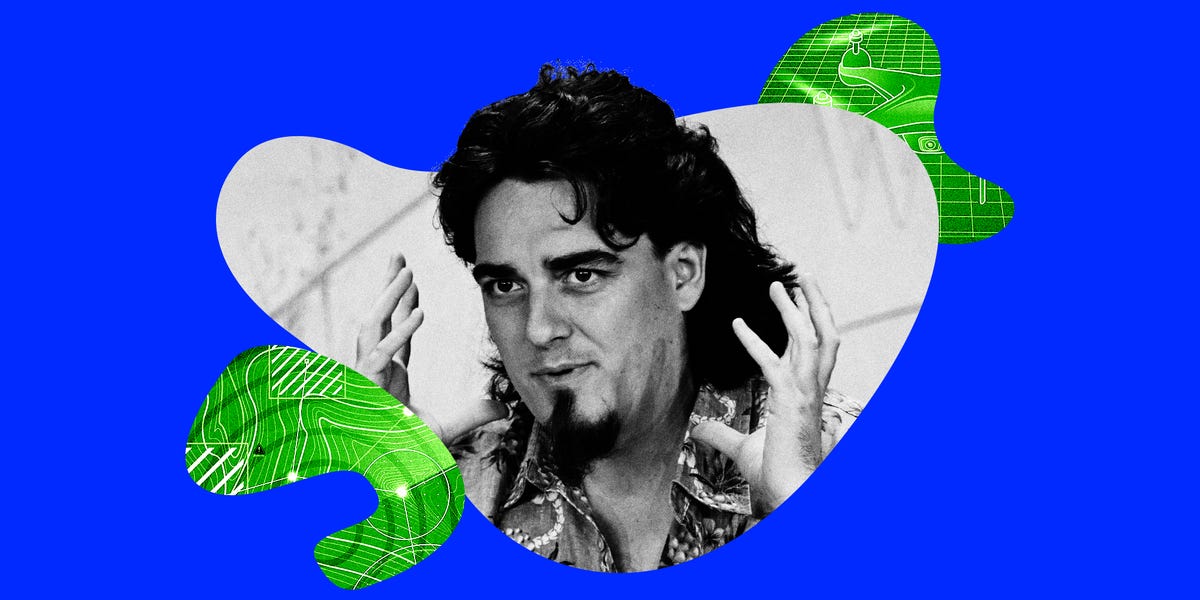
Ew has morphed into oorah. And no one has summoned that vibe shift quite like Luckey. The goateed, mulleted, Hawaiian shirt-and-cargo-shorts-wearing 33-year-old — who has never served in the military — has become the foremost face and proselytizer of tech’s emphatic embrace of war.
Over the past half-century, tech founders have reshaped how humans behave and think. Bill Gates changed how we work. Mark Zuckerberg changed how we relate to each other. Luckey is changing how we kill. And he’s doing it the way he knows best. “Take me with a pound of salt,” Luckey told Weiss in Washington, DC, in October. “I am a propagandist.”
From listening to hours of his “I told you so tour,” it’s clear that Luckey’s cult-of-personality campaign to win over Silicon Valley and the Pentagon, a bravura display of his wily business acumen and winking weirdness, has three rules: attack, attack, attack; lose nothing, post everything; and claim victory, even in defeat.
In 2023, Luckey realized the Defense Department needed a rebrand. Meservey, the comms warrior, explained in a blog post that Luckey thought the DoD sounded flaccid and vague and that the government should resurrect the pre-Cold War name, the Department of War. This would adequately state its purpose: to fight. The propagandist was looking for, as Meservey put it, “a more honest name.”
“The Department of War had a much better track record than the Department of Defense,” Luckey posted on X in August. A week later, Trump signed an executive order to rechristen the department. (Though formally changing the name requires an act of Congress.)
Hollie Adams/REUTERS
A few years ago, Luckey was one of the few in tech to throw his weight behind defense. While Anduril worked on one of its first major projects — equipping the southern border of the US with an AI-powered, virtual surveillance wall — employees at tech giants protested their companies’ military contracts. In 2018, about 4,000 Google workers signed a letter asking the company to cancel Project Maven, an intelligence-gathering Pentagon program, and to get out of “the business of war.” Later that year, after the company did call it off, Luckey chastised Google for being “controlled by a pretty radical fringe.” Anduril later won a Project Maven contract, The Intercept reported in 2019.
In the years since, Luckey has repeatedly retold this story to cast himself as a fearless defender of freedom, a throwback to Cold War-era Silicon Valley, when tech executives and Stanford academics courted the Pentagon. “If both the smartest minds in technology abandoned defense innovation, the United States would forever lose its ability to protect our way of life,” Luckey wrote in an essay for The Free Press earlier this year. “And if no one else was willing to solve that problem, I would.” He’s also long maintained that those concerned with the morality of autonomous weapons should be the ones developing them: “There’s no moral high ground in outsourcing that work to people who are less ethical and less competent than you,” he told Rogan earlier this fall.
Such rectitude has instilled in some tech bros the confidence to start their own chest-thumpingly patriotic companies.
“Palmer is a guy who everyone in the defense tech ecosystem looks up to,” Fil Aronshtein, who cofounded Dirac, an AI manufacturing company, tells me. “He has inspired a lot of founders to be unapologetically themselves instead of trying to fit into Silicon Valley’s idea of a tech founder.” Where this stereotypical founder is “a shy, hunched-over nerd or laptop creature,” Aronshtein insists he isn’t so ungainly. “I’m very pro-American, and I’m proud of that. I lift weights. I can definitely be way more myself after seeing that Palmer can be himself.”
I’m very pro-American, and I’m proud of that. I lift weights. I can definitely be way more myself after seeing that Palmer can be himself.Fil Aronshtein, cofounder of Dirac
When he’s most himself, Luckey — whom his disciples have called a “real-life Tony Stark” — is nerding out over anime and sci-fi. “Science fiction informs reality,” he told reporters in October. “It’s not even so much that it predicted the future as it literally caused the future.” (Anduril is named after the “Flame of the West” sword in “The Lord of the Rings.”)
He’s also bantering with the bros or cracking bawdy jokes on X. In December, when Anduril announced its autonomous submarines had traveled more mission miles than a lap around the Earth, Luckey quipped on the social media site, “almost as far as the circumference of my post-holidays waistline!” Some of his shock jock takes could pass for those of Defense Secretary Pete Hegseth: “There’s too many people who drink Starbucks and not enough who drink Mountain Dew,” Luckey told Rogan. “And you know exactly what I mean when I say that.” Some pro-natalist beliefs he espouses — that having fewer than 2.1 children is treasonous — track the talking points of his serial-X-poster investors.
With Silicon Valley elites going MAGA post—last year’s election, Luckey is taking a Trump-stanning victory lap. After all, he was “one of the true Trump OGs,” he told Rogan. When Luckey was 15, he wrote Trump a letter asking him to run for president: “I loved his extremist rhetoric going back to 2009!” Trump seems to stan Luckey, too: At a press conference in the spring, the president archly called Anduril’s Roadrunner drone a “nasty looking thing.”
The defense tech industry stands to benefit from the Trump administration. This month, Hegseth announced a plan to throw $1 billion behind American drone manufacturing. In November, he said in a speech that the Pentagon will acquire more off-the-shelf tech from companies that surge “at the speed of ingenuity.” That’s a reversal from the government’s decades of work with defense primes like Lockheed Martin and Northrop Grumman, which have long depended on funding from lengthy contracts to make their products. Earlier this year, Army Secretary Dan Driscoll said on tech talk show TBPN that the death of one of those primes would be a “success.”
This has been Luckey’s pitch all along; he told Rogan his goal at Anduril is “saving taxpayers hundreds of billions of dollars a year.” The company bills itself as the antithesis of a traditional defense prime. Instead of using government contracts to cover project expenses, Luckey’s startup sells ready-made weapons to the government at a fixed price. To Shah, the defense tech investor, Anduril is a beneficiary of a “cultural shift where we expect technology to move fast.”
Anduril
That shift is paying dividends. In 2024, Anduril’s unmanned fighter jet Fury beat Boeing, Lockheed Martin, and Northrop Grumman for the Air Force’s Collaborative Combat Aircraft program. The company is on a path to go public in “low single-digit years,” Luckey told Bloomberg this fall. OpenAI is partnering with Anduril to build AI systems to thwart drone attacks. Even Luckey’s old foe Meta is now working with Anduril on augmented reality wearables for the Army. The headsets turn warfighters into, as Luckey has written, “technomancers” who slay IRL opponents while peering at a screen that looks straight out of “Call of Duty.” “I don’t want to sound arrogant here,” Luckey told reporters about the collab, “but I’ve got this shit figured out.”
But will Anduril’s autonomous weapons work reliably in combat? Late last month, The Wall Street Journal and Reuters reported that the company’s software platform, Lattice, as well as its suite of drone and counterdrone products, have been stymied by technical challenges and failed military tests. “It is not surprising that Anduril, as a leading new defense technology company, is subject to increasing scrutiny,” the company wrote in a blog post responding to the reports, adding that the articles covered only “a fraction” of the company’s testing. “We welcome that scrutiny.”
Luckey also fired back on X: “This is what weapons development SHOULD look like,” he wrote, and a few days later added, “We aren’t going to change. We aren’t going to slow down.”
A cadre of Luckey’s fans came to his defense. “This is the way,” Marc Andreessen posted, with an American flag emoji. (His firm, Andreessen Horowitz, is an investor in Anduril.) Palantir’s in-house defense historian wrote an essay in the pro-tech, anti-woke blog Pirate Wires against the “hatchet jobs about Luckey’s Anduril,” proudly proclaiming, “Yes, Blowing Shit Up is How We Build Things.” And a few days later, the Defense Department released a video in which Hegseth visited Luckey and Anduril, demoed some headsets, and, over a triumphant score, made a promotional pitch for the company: “We’re gonna compete,” Hegseth said. “We’re gonna move fast. We’re gonna do open architecture. We’re gonna innovate. We’re gonna scale. And we’re gonna do it at cost.”
As his “I told you so tour” soldiers on, other tech executives have given Luckey plenty of ammo to prove his point. Zuckerberg and Google’s Sundar Pichai were among the several tech billionaires cheering Trump on at his inauguration in January. Nvidia’s Jensen Huang is praising Trump for, as he put it in a recent keynote address, “making America great again.” Executives everywhere are becoming more brash, meme-driven, and nationalistic — from the once-prototypical Zuckerberg kvetching about the “culturally neutered” workplace and calling for more “masculine energy” in the office, to Alex Karp proudly proclaiming that Palantir is “the first company to be completely anti-woke.” Even those that said no to war just a few years ago, like Google, are reembracing the military.
The economic story of tech in 2025 — as you’ve heard, unless you live under a data center — is the AI boom, and possible bubble. The cultural story of tech in 2025 is its leaders becoming more harcore, right-leaning, iconoclastic, and unapologetic. No one has willed or embodied that shift more than the missile maker in the Hawaiian shirt.
And for tech’s future leaders yearning for their own “I told you so tour,” Luckey has a message: “Different founders are going to have different things that are available to them,” he told Meservey. “They’re probably not going to have a cult behind them. Maybe they should try and develop one.”
Julia Hornstein covers Silicon Valley and defense tech for Business Insider. Reach Julia at jhornstein@insider.com or securely on Signal at juliah.22. Use a personal email address, a nonwork device, and a nonwork WiFi connection. Here’s our guide to sharing information securely.
Business Insider’s Discourse stories provide perspectives on the day’s most pressing issues, informed by analysis, reporting, and expertise.
