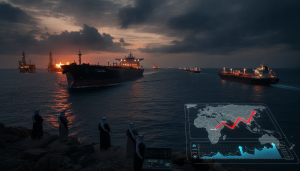
The global oil market faces a significant recalibration following the United Arab Emirates’ decision to withdraw from OPEC and the broader OPEC+ alliance, effective May 1. This seismic shift prompts critical questions for energy investors: How will this impact crude supply, and does it signal a fundamental weakening, or even the eventual dissolution, of the world’s most influential oil cartel?
UAE’s Unshackled Production Potential and Immediate Supply Dynamics
The UAE’s departure grants it unprecedented freedom to dictate its oil output, unburdened by the production quotas that have historically governed OPEC members. Market observers anticipate a surge in supply once geopolitical constraints ease, particularly if the Strait of Hormuz, a critical maritime chokepoint, fully reopens. This potential influx aligns with a period where global nations may seek to replenish depleted strategic oil reserves, driving demand. E.J. Antoni, Chief Economist for the Thomas A. Roe Institute for Economic Policy Studies, points out that an unshackled major producer inherently weakens the cartel’s collective control over global supply. “Each time a member leaves a cartel, the benefit of being a cartel member is reduced,” Antoni cautions, suggesting a potential snowball effect, though he notes such an outcome remains a distant possibility.
However, the immediate impact on market fundamentals may be limited. Simon Flowers, Chairman and Chief Analyst at Wood Mackenzie, characterizes the UAE’s exit as “momentous,” given its status as the nation with OPEC’s second-largest liquids capacity. Yet, he projects minimal impact on market fundamentals through 2026, even with a reopened Strait of Hormuz. Gulf producers, including the UAE, face a lengthy recovery period, taking months to revert to pre-conflict production volumes. Beyond the current year, Flowers warns that losing the UAE will exacerbate OPEC’s struggle to balance the market, elevating the risk of oversupply and downward pressure on prices.
Internal Tensions and the Evolution of OPEC’s Influence
The UAE, a member of OPEC since 1967, contributes approximately 13 percent of OPEC’s total supply and around 9 percent of OPEC+’s collective output. Its withdrawal is not entirely unexpected, analysts suggest, reflecting escalating political tensions between the UAE and Saudi Arabia, further inflamed by the ongoing conflict in Iran. Emily Ashford, Head of Energy Research at Standard Chartered Bank, highlights that discussions surrounding the “death of OPEC” are not new, with members regularly joining and departing the group. Nevertheless, the UAE’s exit, due to its significant production share, will undoubtedly diminish the group’s overall leverage, simultaneously elevating Saudi Arabia’s importance in policy decisions.
Ashford points out that the UAE’s move signals a clear desire to increase production and respond to market conditions independent of the quota system and overproduction compensation cuts that have defined the OPEC+ narrative for several years. She notes the acute pressure Gulf producers have faced recently, with production shut-ins and export control limitations, likely contributing to the UAE’s decision. This decision also significantly reduces OPEC’s spare capacity cushion, which was primarily supported by Saudi Arabia and the UAE. With the UAE gone, this crucial buffer, already at near-zero levels, shrinks further.
Strategic Frustration and Geopolitical Realignments
Recent OPEC+ meetings reportedly fueled the UAE’s frustration. At the last gathering, the opportunity to signal to global markets a commitment to maximize supply and move past a confusing quota narrative was seemingly deferred. The decision to make only a modest supply adjustment, instead of a more decisive increase, likely contributed to the UAE’s dissatisfaction with the group’s cautious strategy.
The OPEC+ alliance had announced on April 5 a collective production boost of 206,000 barrels per day for May, with Saudi Arabia’s required production at 10.228 million bpd, Russia at 9.699 million bpd, Iraq at 4.326 million bpd, and the UAE at 3.447 million bpd. Subsequent compensation plans submitted by Iraq, the UAE, Kazakhstan, and Oman for previous overproduction amounted to 1.214 million bpd in March, declining to 789,000 bpd in April, 895,000 bpd in May, and 899,000 bpd in June. Notably, the UAE’s contribution to these compensation plans was 178,000 bpd in March, with no further plans for April, May, or June, underscoring its divergence from collective obligations.
Long-Term Investor Outlook and UAE’s Ambitions
For investors, the long-term reverberations are significant. Joshua Aguilar, Equity Director at Morningstar, views the UAE’s withdrawal as a continuation of its broader energy ambitions. As one of the Middle East’s largest oil producers, behind only Saudi Arabia and Iraq, the UAE is evolving into a diversified energy powerhouse driven by electrification and economic growth. Outside Saudi Arabia, it possesses some of the most meaningful spare capacity, a key mechanism through which OPEC has historically influenced global oil prices. Aguilar asserts that while immediate impacts might be masked by current disruptions in the Strait of Hormuz, the long-term outcome will be a “structurally weaker OPEC.”
This newfound autonomy allows the UAE to capitalize on its low-cost reserves without external production limits. The nation’s strategic calculus has likely been weighing the benefits of pursuing an independent policy and monetizing its extensive reserves for years. Aguilar suggests that Iran’s recent missile and drone attacks on UAE soil and maritime shipping likely served as the “last straw,” accelerating its decision.
Furthermore, Aguilar frames the UAE’s exit as a foreign policy triumph for the United States, as the departure of a top Middle Eastern producer undermines OPEC’s influence. This move represents a continuation of shifting geopolitical alliances, drawing the U.S. closer to nations outside traditional Western blocs. Investors should therefore consider not only the market mechanics of supply and demand but also the evolving geopolitical landscape that increasingly shapes global energy flows and policy.