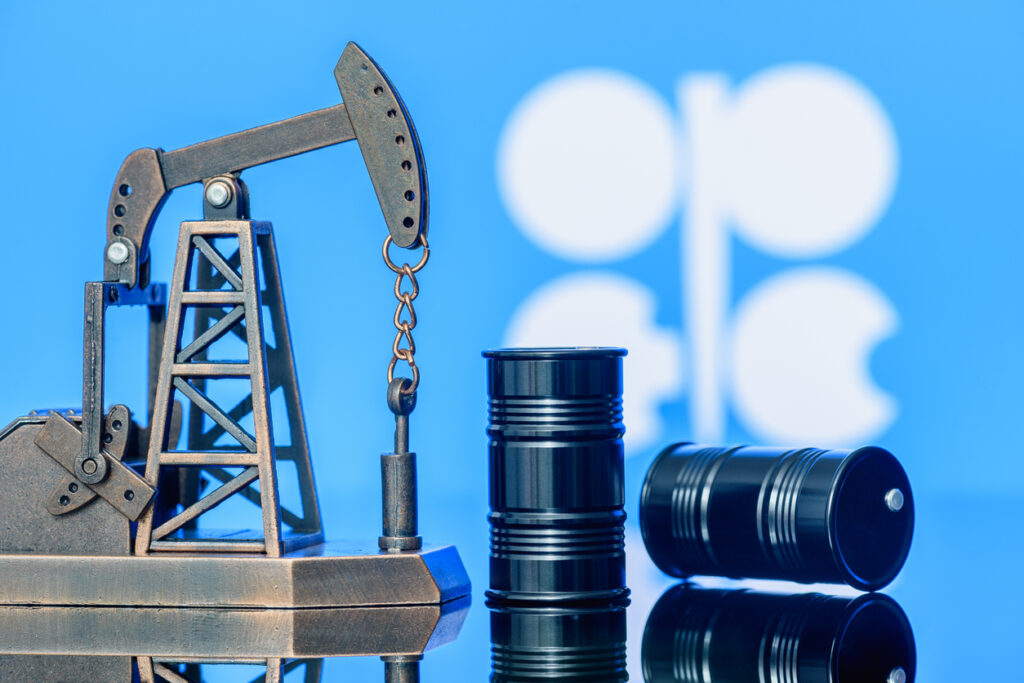
The global oil market is once again pivoting on the strategic decisions of OPEC+, with recent moves signaling a more aggressive stance than initially perceived. While headlines often focus on the immediate supply adjustments, our analysis indicates a profound underlying objective: a deliberate push by group leaders, notably Saudi Arabia and Russia, to reclaim market share and specifically challenge the economic viability of U.S. shale production. This isn’t merely about balancing supply and demand; it’s a calculated long-term play that demands a reassessment of valuation metrics across the independent U.S. E&P sector. Investors must look beyond day-to-day price fluctuations and consider the structural shifts OPEC+ is engineering, which could redefine profitable drilling thresholds and capital allocation strategies for years to come.
OPEC+’s Renewed Market Share Offensive Against U.S. Shale
The echoes of the last oil price downturn a decade ago, which saw OPEC’s previous attempt to curb U.S. shale growth falter, still resonate. Technology and efficiency gains allowed American producers to not only weather the storm but also expand their market footprint significantly. However, the current landscape for U.S. shale is markedly different, presenting a window of opportunity for OPEC+. Production costs for U.S. shale companies have climbed considerably over the past three years. This increase is exacerbated by broader inflationary pressures and the natural depletion of high-quality, easily accessible acreage within prolific basins like the Permian. As producers are forced into secondary areas, the capital expenditure required per barrel rises, directly impacting their breakeven costs. Our proprietary data shows that, according to recent industry surveys, the average U.S. shale producer now requires approximately $65 per barrel to drill profitably. This stands in stark contrast to the estimated production costs for Saudi Arabia, ranging from $3-$5 per barrel, and Russia’s $10-$20 per barrel, highlighting a significant competitive advantage for OPEC+ members.
The May 3 decision by OPEC+ to accelerate output increases, ostensibly justified by “healthy market fundamentals” and “low oil inventories,” carries a dual purpose. While officially aimed at balancing the market, sources close to the group’s leadership confirm a strategic intent to introduce “a lot of uncertainty” into the plans of other producers by pushing oil prices below the $60 per barrel mark. This targets a critical vulnerability for U.S. shale, potentially forcing capital expenditure cuts and a slowdown in drilling activity, thereby gradually eroding their market share gains. From an investment perspective, this implies a higher risk profile for shale-heavy portfolios, demanding closer scrutiny of individual company breakevens and hedging strategies.
Current Market Signals and the Shale Pain Threshold
Understanding the immediate market context is crucial for assessing the efficacy of OPEC+’s strategy. As of today, Brent Crude trades at $96.04 per barrel, reflecting a 1.32% increase for the day, with an intra-day range between $91 and $96.26. West Texas Intermediate (WTI) Crude follows closely at $92.40, up 1.23%, trading between $86.96 and $92.50. While these prices currently sit comfortably above the $65 per barrel average breakeven for U.S. shale, our 14-day Brent trend data reveals a notable softening from $102.22 on March 25 to $93.22 on April 14, marking an 8.8% decline. This downward pressure, even if modest, suggests OPEC+’s increased output is already contributing to a more bearish sentiment, signaling a potential trajectory towards the sub-$60 price targets discussed by group sources.
The spread between current prices and the shale profitability threshold creates a margin of safety, but it is narrowing. Investors must recognize that while a $90+ environment supports robust shale activity, a sustained move below $65, let alone the $55-$60 target range, would fundamentally alter the investment thesis for many U.S. independent producers. Such a scenario would pressure free cash flow generation, impair debt servicing capabilities for highly leveraged firms, and force a reallocation of capital away from growth and towards balance sheet preservation. Our analysis suggests that the current price levels, while seemingly strong, must be viewed through the lens of OPEC+’s stated intent, which aims to inflict pain through a prolonged period of lower prices, rather than an immediate crash. This implies a gradual but persistent squeeze on shale valuations.
Upcoming Events and Investor Outlook: Navigating Uncertainty
The coming weeks are particularly critical for investors seeking clarity on the trajectory of oil prices and the robustness of OPEC+’s resolve. Our proprietary event calendar highlights key dates that will inform the market’s forward-looking assessments. The OPEC+ Joint Ministerial Monitoring Committee (JMMC) meeting on April 18, followed by the Full Ministerial meeting on April 20, are pivotal. These gatherings will provide the next official signals regarding production levels and the group’s commitment to its strategy. Any indications of further output increases or a hardening of the rhetoric against over-producing allies could intensify downward pressure on prices, directly impacting the profitability outlook for U.S. shale.
Beyond OPEC+, weekly data releases will offer crucial insights into market fundamentals. The Baker Hughes Rig Count on April 17 and April 24 will show whether U.S. drilling activity is responding to current prices or anticipating future weakness. Similarly, the API and EIA Weekly Crude Inventory reports on April 21, 22, 28, and 29 will indicate the pace of inventory builds or draws, providing a real-time pulse on supply-demand balances. These data points, when aggregated, will inform the market’s perception of shale resilience in the face of OPEC+’s strategy.
Our proprietary reader intent data reveals that investors are keenly asking for a base-case Brent price forecast for the next quarter, and the consensus 2026 Brent forecast. This underscores the market’s deep concern about price stability and the efficacy of OPEC+’s strategy. Our forward-looking analysis suggests that if OPEC+ maintains its course, a base-case scenario for Q2 2026 could see Brent prices test the lower end of the $80s, with a significant downside risk if the group aggressively pushes towards the sub-$60 target. Investors should model for increased price volatility and a potential divergence in performance between low-cost, integrated majors and higher-cost, pure-play shale producers. Those with robust balance sheets and diversified asset bases will be better positioned to navigate the strategic uncertainty OPEC+ is actively cultivating.