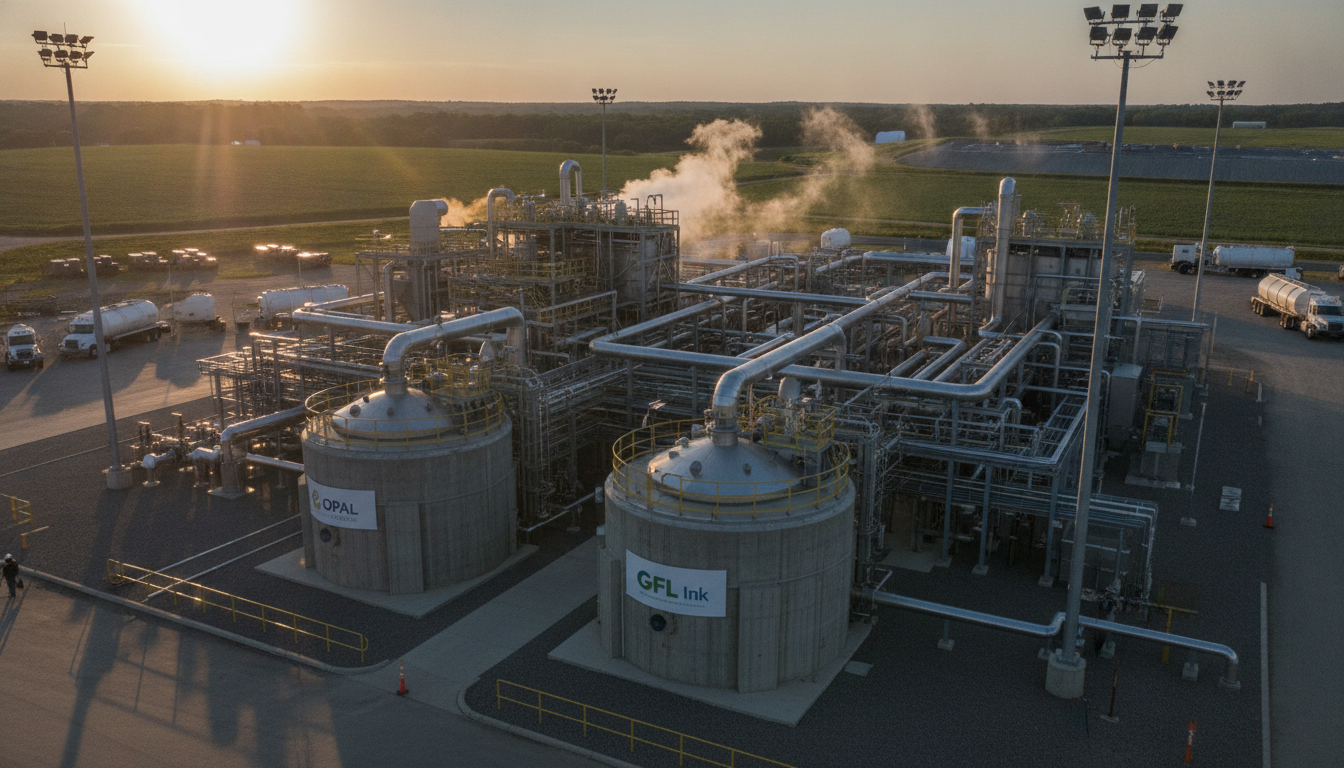
GFL Environmental and OPAL Fuels Drive RNG Expansion with Key Landfill Projects
Leading environmental services provider GFL Environmental Inc. and renewable natural gas (RNG) specialist OPAL Fuels LLC have solidified a strategic collaboration, announcing two significant joint ventures designed to dramatically boost RNG production capabilities. These initiatives will convert landfill gas into clean, pipeline-quality fuel at two critical sites: the Stones Throw Landfill in Tallapoosa County, Alabama, and the Grady Road Landfill situated in Polk County, Georgia. This partnership underscores a burgeoning trend in the energy sector, leveraging waste streams to generate high-value, sustainable energy solutions.
The combined plant design capacity from these projects is impressive, nearing 2 million million British thermal units (MMBTU). Both GFL and OPAL Fuels maintain an equal 50 percent ownership stake in these ventures, aligning their interests in maximizing operational efficiency and long-term profitability. Under the terms of the agreement, OPAL Fuels will assume responsibility for marketing and distributing the entire output from these new RNG facilities. This strategic move leverages OPAL Fuels’ extensive and expanding compressed natural gas (CNG) and RNG dispensing network, further solidifying its vertically integrated business model that spans upstream production to downstream distribution, aiming to unlock profitable growth across the entire value chain.
Powering Heavy-Duty Fleets and Decarbonization Efforts
These state-of-the-art RNG facilities are engineered to provide fuel for approximately 800 Class 8 heavy-duty tractors, representing a substantial impact on decarbonizing the transportation sector. Investors should note the compelling economic advantages RNG offers over traditional diesel fuel, coupled with the critical environmental benefit of achieving zero Scope 1 and Scope 2 emissions. This positions the projects ideally to capitalize on the accelerating fleet conversion activity currently sweeping through the heavy-duty trucking industry.
Multiple factors are fueling this shift. Persistent volatility and elevated pricing for diesel fuel are pushing fleet operators toward more stable and cost-effective alternatives. Concurrently, increased regulatory clarity regarding internal combustion engines and the continuous development of next-generation natural gas engine platforms are providing a robust framework for adoption. These market dynamics create a powerful tailwind for RNG projects, offering a compelling investment thesis in the sustainable energy landscape.
Patrick Dovigi, founder and CEO of Vaughan, Ontario-based GFL, emphasized the broader strategic implications for his company. “These projects are pivotal in advancing GFL’s ambitious greenhouse gas reduction targets,” Dovigi stated. “Beyond generating attractive, stable, and risk-adjusted returns for many years, they will also contribute to fueling our own CNG fleet directly from landfill gas produced at our sites, exemplifying a circular economy approach.” Jonathan Maurer, Co-Chief Executive of White Plains, New York-based OPAL Fuels, echoed this sentiment, highlighting the synergy of their operations. “Bringing new RNG production online precisely when fleet demand is surging powerfully reinforces the strength of our vertically integrated model, effectively connecting our landfill partners with high-value end markets through our rapidly expanding fuel station network.”
OPAL Fuels’ Q1 2026 Financial Performance and Strategic Investments
OPAL Fuels’ recent first-quarter 2026 financial report provides a deeper dive into the company’s operational and investment trajectory. During January through March 2026, the company reported a net design capacity of 2.2 million MMBtu, defined as the volume of feedstock biogas a facility can efficiently process over a given period. From this capacity, OPAL Fuels successfully produced 1.2 million MMBtu of RNG fuel. Sales and delivery volumes during the quarter stood at 17.9 million gallons of gasoline equivalent (GGE) and 39 million GGE, respectively, demonstrating robust activity in its downstream segment.
Crucially for investors, OPAL Fuels significantly ramped up its capital expenditures in the first quarter of 2026, committing $24.4 million to RNG projects under construction and the development of OPAL Fuels-owned fueling stations. This represents a substantial increase compared to the $11.6 million invested during the corresponding period in Q1 2025, signaling an accelerated growth strategy and confidence in future market expansion. Financially, the company reported revenue of $73.38 million for Q1 2026, alongside a net loss of $5.59 million year-on-year. Despite the negative profit figure, management conveyed a positive outlook regarding the company’s trajectory.
Adam Comora, Co-CEO of OPAL Fuels, addressed the results directly, stating, “Despite a seasonally soft first quarter and a challenging operating environment, we remain firmly on track to achieve our full-year guidance.” He further added, “Production trends have improved precisely as we anticipated, and we are particularly encouraged by the recent firming in environmental credit prices, which will positively impact our future profitability.” Jonathan Maurer elaborated on operational resilience, noting, “Given the difficult weather conditions experienced, our RNG facilities delivered strong performance, producing more RNG compared to the first quarter of 2025. This superior outcome is a direct result of the meaningful operational improvements we are implementing across our entire platform, enhancements we fully expect to continue throughout the year.”
Solidifying Capital Structure and Future Growth Prospects
Maurer also highlighted the strategic financial maneuvers undertaken during the quarter. “In the first quarter, we successfully executed several financing transactions that significantly enhanced clarity around our capital structure. These actions strategically position us for sustained investment and robust growth across both our upstream production and downstream distribution segments,” he affirmed. This focus on financial stability and growth underpins the company’s aggressive expansion plans in the burgeoning RNG market.
From a liquidity standpoint, OPAL Fuels maintains a robust position, reporting $232.5 million at the close of Q1 2026. This comprehensive liquidity profile includes $133.2 million in cash and cash equivalents, $39.3 million in unused credit facilities, and a substantial $60.0 million from its undrawn preferred stock facility. Such strong liquidity provides the necessary capital runway for OPAL Fuels to continue its strategic investments in RNG infrastructure, both in production facilities and its critical dispensing network. This financial strength, coupled with the strategic alliance with GFL Environmental and the clear market drivers for RNG, paints a compelling picture for investors interested in the sustainable energy transition within the oil and gas sector.


