The global oil market is once again navigating a treacherous geopolitical landscape, with escalating tensions in the Middle East threatening to disrupt vital supply arteries. While recent trading sessions have seen some price consolidation, the underlying risk premium remains firmly embedded, influenced by the precarious situation around the Strait of Hormuz and the potential for broader conflict. Simultaneously, signals from central banks hint at an improving demand outlook, creating a complex interplay of bullish and bearish forces that demands a nuanced investment approach. For sophisticated investors, understanding the specific catalysts and market signals is paramount to identifying opportunities and mitigating risks in the coming weeks.
Geopolitical Flashpoint: The Hormuz Premium and OPEC Output
The Strait of Hormuz, a narrow maritime chokepoint off Iran’s southern coast, continues to be the epicenter of supply-side risk for the global oil market. With an estimated 18 to 21 million barrels per day of crude transiting this critical waterway, any significant escalation in the region could trigger an immediate and dramatic spike in prices. Iran, as OPEC’s third-largest producer, contributes approximately 3.3 million barrels per day to global supply, placing it squarely at the heart of these concerns. Our proprietary market data indicates that a geopolitical risk premium of at least $10 per barrel is currently priced into crude benchmarks, reflecting the market’s apprehension. The evolving stance of major global powers, particularly regarding potential support for regional military actions, remains a key uncertainty. Investors are closely monitoring official statements, bracing for a potential expansion of the conflict or, conversely, a pivot towards de-escalation, each scenario carrying profound implications for oil price stability.
Demand-Side Tailwinds and Inventory Dynamics
While geopolitical risks dominate headlines, the demand picture is showing encouraging signs of resilience. The Federal Reserve’s recent decision to hold interest rates steady, coupled with indications of two potential rate cuts by year-end, has injected optimism into the market. This dovish pivot is widely expected to stimulate stronger economic activity in the latter half of the year, which historically translates into robust oil demand growth. Further bolstering bullish sentiment, the latest U.S. inventory data revealed the largest crude stockpile draw in over a year. This significant reduction in domestic inventories suggests either tighter supply conditions or unexpectedly strong consumption, adding a fundamental layer of support beneath the geopolitical premium. For investors, these demand-side tailwinds offer a crucial counterpoint to the supply risks, suggesting that underlying market fundamentals may be stronger than initially perceived.
Current Market Posture and Investor Focus
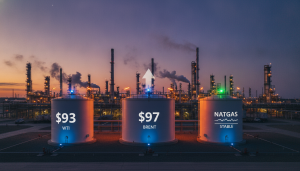
Navigating the current market volatility requires a keen eye on both price action and underlying sentiment. As of April 14th, Brent crude is trading around $93.22 per barrel. It’s noteworthy that despite the intensifying geopolitical rhetoric, this represents a nearly 9% decline from its recent peak of $102.22 on March 25th. This short-term pullback suggests that some of the earlier speculative froth may have dissipated, allowing the market to consolidate while it awaits clearer signals on both supply disruptions and demand recovery. A common question we see from investors this week, as indicated by our reader intent data, centers on constructing a base-case Brent price forecast for the upcoming quarter, and indeed, the consensus 2026 Brent forecast. Our analysis suggests that while the recent dip provides a temporary respite, the floor for crude prices is likely elevated by the sustained geopolitical premium. Any meaningful de-escalation could see prices retreat further, but a supply disruption could easily send them soaring past recent highs. The current pricing reflects a delicate balance, where the market is attempting to discount both the immediate risk of supply shock and the longer-term prospect of stronger demand.
Upcoming Catalysts and Strategic Positioning
The next two weeks are packed with critical events that will significantly shape the market’s trajectory, demanding active monitoring from investors. On April 18th and April 20th, the OPEC+ Joint Ministerial Monitoring Committee (JMMC) and the full Ministerial Meeting, respectively, are scheduled. These meetings will be pivotal in determining the group’s output policy, especially in light of the current geopolitical climate and any potential supply shortfalls from within the alliance. Any decision to adjust production quotas, or even a strong statement regarding market stability, could move prices significantly. Furthermore, the market will be closely watching the API Weekly Crude Inventory reports on April 21st and April 28th, followed by the EIA Weekly Petroleum Status Reports on April 22nd and April 29th. These data releases will provide fresh insights into U.S. demand trends and inventory levels, confirming or challenging the bullish signals seen in recent draws. Finally, the Baker Hughes Rig Count on April 17th and April 24th will offer a gauge of North American drilling activity, providing an early indicator of future supply capacity. Given these immediate catalysts, investors should be prepared for heightened volatility and position themselves to capitalize on shifts driven by either OPEC+ policy, inventory surprises, or further geopolitical developments. A diversified approach, considering both long-term fundamentals and short-term event-driven trading, remains crucial.