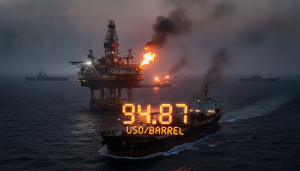
Global crude markets reacted sharply this week as Iran announced a critical halt to its diplomatic exchanges with the United States regarding ongoing tensions surrounding Israel. This pivotal development instantly injected a significant risk premium into oil prices, signaling a renewed era of geopolitical uncertainty for energy investors.
Following the news, Brent crude futures surged, hitting an intraday high of $96.10 per barrel. Similarly, West Texas Intermediate (WTI) benchmarks pushed above the $92 per barrel threshold, reflecting heightened anxiety among traders. The immediate catalyst was a report from Iran’s semi-official Tasnim news agency, confirming Tehran’s decision to cease message exchanges in protest of Israel’s escalating military actions in Lebanon. This move underscores the delicate balance of power and the ever-present threat of wider regional destabilization that directly impacts global energy supply.
Geopolitical Flashpoint: Iran-US Diplomacy at a Standstill
The suspension of communications marks a stark reversal from recent diplomatic efforts. Washington and Tehran had been engaged in an intricate series of indirect messages, striving to finalize a draft agreement designed to extend a fragile ceasefire. A key component of these discussions involved facilitating the resumption of Persian Gulf energy exports, critically reliant on safe passage through the Strait of Hormuz. Investors had cautiously optimistic outlooks that such a deal could ease supply concerns, contributing to a retreat in crude prices just last week.
However, Iran’s latest stance introduces fresh complexities. While former President Donald Trump recently expressed a belief that “it will all work out well in the end” despite recent military exchanges, Tehran maintains that a durable truce in Lebanon — where Israeli ground operations have expanded — is indispensable for any broader agreement. Furthermore, Iran has openly accused the U.S. of deliberately protracting negotiations, adding another layer of distrust to an already fraught diplomatic landscape. This escalating rhetoric and diplomatic impasse directly translate into increased volatility for oil futures, forcing investors to re-evaluate their risk exposure to Middle Eastern energy flows.
The Imperative of the Strait of Hormuz for Global Energy
The geopolitical maneuvering around Iran and its implications for the Strait of Hormuz cannot be overstated for energy markets. This narrow waterway serves as the world’s most critical chokepoint for oil shipments, handling a substantial portion of global seaborne petroleum trade. Any disruption or perceived threat to shipping through Hormuz sends immediate ripples across the entire oil supply chain. Indeed, the dramatic slowdown in transit through this vital passage since the broader conflict erupted in late February has already propelled Brent futures up by more than 30%. The current diplomatic freeze suggests that this significant risk premium is unlikely to dissipate soon, solidifying a higher floor for crude prices.
Market analysts are not under any illusion about the nature of these diplomatic overtures. Tamas Varga, an analyst at brokerage PVM, succinctly articulated the prevailing sentiment, stating, “We should not be under the illusion that the current negotiations are peace talks. They are laying the groundwork for an extension of the ceasefire, during which the crucial issues will be discussed.” This assessment highlights that even if communications resume, the underlying, fundamental disagreements remain unresolved, implying sustained geopolitical risk for the foreseeable future.
Broader Supply Side Pressures: Ukraine and Russia
Beyond the Middle East, other geopolitical flashpoints continue to exert upward pressure on global energy markets. In Eastern Europe, Ukraine has intensified its campaign against Russian energy infrastructure, with attacks on Russian oil refineries reaching a record high in May. These sustained assaults introduce additional uncertainty into the global refined products market, potentially tightening supply and impacting prices for gasoline, diesel, and jet fuel.
In response to these operational disruptions and to safeguard domestic supplies, Moscow has imposed a ban on jet fuel exports, effective through November. This preventative measure underscores the vulnerability of Russian energy exports and the cascading effects of regional conflicts on international trade. For global investors, the confluence of heightened Middle Eastern tensions and ongoing supply disruptions from the Russia-Ukraine conflict paints a challenging picture for energy market stability, emphasizing the need for robust risk management and diversified portfolios in a volatile commodity environment.
In conclusion, the latest developments demand astute attention from investors. Iran’s decision to halt communications with the U.S. has immediately recalibrated risk assessments across the oil complex. With prices surging in response, and the critical Strait of Hormuz remaining a focal point of geopolitical leverage, sustained volatility is a certainty. Coupled with persistent supply-side risks from the Eastern European conflict, the global energy landscape faces formidable challenges, compelling investors to closely monitor diplomatic breakthroughs and geopolitical escalations that will dictate the trajectory of crude markets.