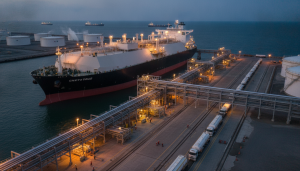
The global oil market stands at a precarious juncture, with the critical Strait of Hormuz once again emerging as a flashpoint dictating supply stability and, by extension, crude price trajectories. Geopolitical tensions in the Middle East, specifically surrounding the Iran-U.S. dynamic and the fragile ceasefire in Lebanon, cast a long shadow over investor sentiment. Our proprietary market data shows Brent crude trading at $99.13 as of today, a modest 0.22% decline within a daily range of $97.55-$101.32, while WTI sits at $94.4, down 1.51%. These figures reflect a hesitant market, weighing immediate profit-taking against significant supply risks. Analysts at Citi have outlined stark scenarios for the coming months, suggesting potential price spikes and massive inventory drawdowns that could fundamentally reshape the investment landscape for energy equities. Understanding these pathways is crucial for investors navigating the volatile waters of oil and gas.
The Hormuz Crucible: Geopolitical Tensions and Market Volatility
The Strait of Hormuz, a narrow chokepoint through which roughly one-fifth of the world’s oil supply transits, remains the epicenter of market anxiety. A recently brokered two-week ceasefire, intended to stabilize the region, saw a brief reopening of this vital shipping lane last Friday. However, optimism quickly evaporated as Iran swiftly re-closed the strait following President Trump’s refusal to lift the blockade on Iranian ports. This abrupt reversal highlights the fragility of diplomatic efforts and the immediate impact on global energy flows. Our reader intent data indicates a strong focus on the stalled US-Iran negotiations and the looming Tuesday deadline for the ceasefire’s extension, underscoring investor concerns about the broader geopolitical stalemate.
The core issue revolves around Iran’s insistence that a full ceasefire is contingent upon the lifting of the port blockade, a demand the U.S. has so far rebuffed. This impasse has direct implications for global oil supply. While recent discussions suggest Israel and Lebanon have agreed to a three-week ceasefire extension, sporadic exchanges of fire persist, demonstrating the delicate nature of peace in the region. Should the Strait of Hormuz remain significantly disrupted, the implications for supply security and price stability are profound. Investors are acutely aware that sustained closure would not only drive up immediate crude costs but also trigger a scramble for alternative supplies, pushing freight rates higher and increasing operational complexities for refiners and traders alike.
Navigating Citi’s Scenarios: Inventory Drawdowns and Price Projections
Citi analysts have provided a critical framework for understanding the potential market impact, outlining several scenarios. The most favorable outcome for energy markets, as per their analysis, involves a ceasefire extension being signed this week, allowing flows through the Strait to gradually resume throughout May, reaching pre-disruption levels by the end of June. In this “best-case” scenario, global crude and product inventories are projected to decline by approximately 900 million barrels. Under this pathway, Citi anticipates international benchmark Brent oil prices averaging $95 a barrel in the second quarter, before moderating to $80 and $75 in the third and fourth quarters, respectively.
However, the risks are heavily skewed towards the upside. Citi warns that if flows through the Strait of Hormuz remain disrupted for an additional month, even with diversions through Bab al Mandeb and Fujairah maintained, the total loss of crude and products from the market could soar to an estimated 1.3 billion barrels. Such a severe and prolonged disruption would lead to significantly higher prices, with analysts projecting Brent to hit $110 per barrel in the second quarter, before settling to $90 and $80 in the third and fourth quarters, respectively. As Max Layton, Citi’s global head of commodities research, starkly put it, “Each day that passes we literally burn through around 13 million barrels of crude and oil products.” Even if the conflict were to end this week, global crude and product inventories are forecast to reach their lowest levels in eight years by the end of June, highlighting the existing tightness in the market. This scenario directly addresses investor questions about what would push Brent above $120; a prolonged, severe disruption beyond even Citi’s “worst-case” $110 Q2 projection could certainly achieve that threshold.
Live Market Pulse: Current Prices and Recent Trends
Despite the significant geopolitical risks emanating from the Middle East, the immediate market reaction today shows some tempered sentiment. As of this morning, Brent crude trades at $99.13, marking a slight decline of 0.22% within its daily range of $97.55 to $101.32. West Texas Intermediate (WTI) crude is also seeing downward pressure, currently at $94.4, down 1.51%, with its daily trading range between $92.68 and $97.85. Similarly, gasoline prices are down modestly at $3.33, a 0.3% dip. This contrasts sharply with Monday’s trading, where WTI futures surged 7% and Brent crude futures climbed 5%, reflecting the intense uncertainty surrounding peace talks at the time.
Looking at the broader trend, our proprietary data reveals that Brent crude has actually seen a notable softening over the past two weeks. From an intra-day high of $109.27 on April 7th, Brent has retreated to $99.78 as of yesterday, representing a decline of $9.49, or 8.7%. This recent downward trajectory suggests that while geopolitical risks provide a strong underlying bid, other factors, perhaps related to demand concerns or short-term profit-taking, are exerting counter-pressure. Investors are actively questioning whether WTI is going up or down, and the current snapshot indicates a slight pull-back, even with the Hormuz threat looming. This divergence underscores the complex interplay of geopolitical premiums, inventory data, and broader macroeconomic sentiment influencing daily price movements.
Forward Outlook: Key Events Shaping the Next Fortnight
Looking ahead, the market will scrutinize a series of upcoming energy events for further signals on supply and demand dynamics, all against the backdrop of the Hormuz situation. Next week brings the API Weekly Crude Inventory report on Tuesday, April 28th, followed by the EIA Weekly Petroleum Status Report on Wednesday, April 29th. These reports will be critical indicators of U.S. inventory levels, providing insight into whether the “13 million barrels per day burn rate” cited by Citi analysts is starting to manifest in tangible stock drawdowns. Given the potential for 900 million to 1.3 billion barrels of product loss under various Hormuz scenarios, any significant draws could amplify upward price pressure.
Further into the first week of May, the Baker Hughes Rig Count on Friday, May 1st, will offer a glimpse into future production intentions, though its impact is more long-term. Of particular importance will be the EIA Short-Term Energy Outlook (STEO) published on Saturday, May 2nd. This report will provide the U.S. government’s updated projections for global and domestic supply, demand, and prices, and its assessment of the geopolitical risks will be closely watched. The following week repeats with API and EIA inventory reports on May 5th and 6th, and another Baker Hughes Rig Count on May 8th. These recurring data points will offer continuous opportunities for investors to assess the market’s fundamental health and gauge the real-time impact of any developments in the Strait of Hormuz, informing their strategies on whether Brent will trend towards $80 or potentially surge above $120.