The global oil market is once again navigating a complex confluence of geopolitical currents and fundamental data, leaving crude prices in a tight range as conflicting signals battle for dominance. Despite renewed concerns over supply stability stemming from international trade rhetoric, crude benchmarks are struggling to maintain upward momentum. This article will delve into the forces currently shaping market sentiment, leveraging proprietary data to provide actionable insights for investors.
Geopolitical Jitters Meet Market Resistance
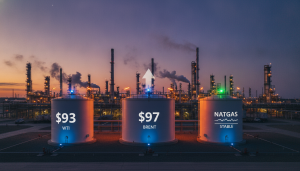
Crude prices are currently facing headwinds, with Brent Crude trading at $93.93 per barrel, down 1.62% today, while WTI Crude sits at $85.76, a 1.9% decline. This recent pullback follows a period where geopolitical friction attempted to inject a fresh supply fear premium into the market. Notably, recent comments regarding India’s role in processing Russian crude flows have reignited concerns that energy markets remain vulnerable to political maneuvers and potential disruptions. However, this geopolitical tailwind appears insufficient to overcome broader market resistance, especially considering the significant downward pressure Brent has experienced, dropping from $118.35 on March 31st to $94.86 as of yesterday, a nearly 20% correction in just three weeks. This trend suggests that while political rhetoric can stir the pot, the underlying market structure is currently predisposed to downward pressure or consolidation, rather than a sustained rally.
Market Positioning: A Volatile Foundation
A critical factor influencing current price dynamics is the prevailing market sentiment and positioning among speculators. Our analysis of recent CFTC data indicates that institutional players have accumulated a rare net short position in WTI. This positioning is significant because it suggests a consensus view that prices may trend lower or remain capped. However, such an aggregate short stance also creates a highly combustible environment. Should a sudden, unexpected bullish geopolitical headline or a significant supply disruption emerge, the potential for a rapid short squeeze is considerable. This could force short sellers to cover positions quickly, driving prices sharply higher in a scramble. This inherent volatility, driven by speculative positioning, means that even minor geopolitical developments, such as shifts in discussions around European stability or the Ukraine conflict, could trigger outsized market reactions, catching many off guard.
Upcoming Events to Watch: Catalysts on the Horizon
The coming weeks are packed with crucial energy sector events that could provide the next directional cues for the market, offering both opportunities and risks for investors. On April 21st, the OPEC+ Joint Ministerial Monitoring Committee (JMMC) meeting will be closely watched for any signals regarding production policy adjustments or compliance levels, which could directly impact global supply perceptions. Following this, the market will turn its attention to the EIA Weekly Petroleum Status Reports on April 22nd and April 29th, alongside the API Weekly Crude Inventory reports on April 28th and May 5th. These inventory data releases are vital for gauging demand strength and the balance between supply and consumption in the world’s largest oil consumer. Furthermore, the Baker Hughes Rig Count on April 24th and May 1st will offer insights into future U.S. production trends. Rounding out this busy period, the EIA Short-Term Energy Outlook (STEO) on May 2nd will provide a broader perspective on supply, demand, and price forecasts, potentially influencing longer-term investment strategies and setting the tone for the coming months.
Investor Queries and the Search for Clarity
Our proprietary reader intent data reveals a market grappling with uncertainty, with many investors asking fundamental questions about market direction. The most frequent query, “is WTI going up or down?”, perfectly encapsulates the current indecisiveness. While geopolitical risks like those concerning Russian oil flows or the Ukraine conflict attempt to push prices higher, the underlying market structure and recent price action, including the significant Brent correction, suggest a struggle for sustained upside. Investors are also keenly focused on the longer-term outlook, with questions like “what do you predict the price of oil per barrel will be by end of 2026?” dominating discussions. Predicting an exact price point is challenging given the array of variables, from OPEC+ policy and global economic growth to the evolving geopolitical landscape and the pace of energy transition. However, the upcoming EIA STEO on May 2nd will offer valuable data-driven projections that can help inform these longer-term perspectives. For investors holding positions in companies like Repsol, which one reader asked about specifically, the broader crude price trajectory is paramount. The recent nearly 20% drop in Brent crude over the past three weeks undoubtedly pressures the profitability outlook for exploration and production firms, highlighting the importance of tracking both macro crude trends and company-specific fundamentals.