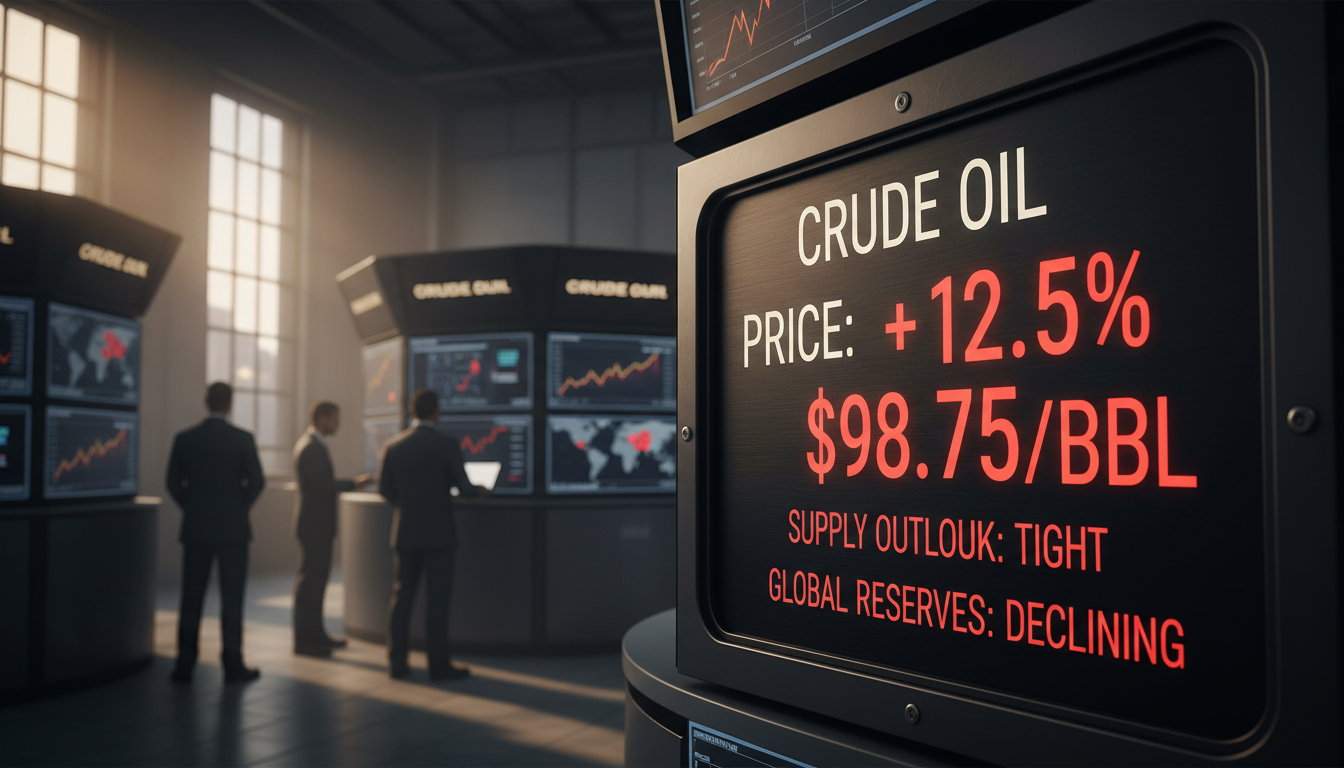
The global oil market is once again commanding investor attention as crude prices experience a significant upward surge, driven by persistent supply concerns that show little sign of abating. This rally underscores the delicate balance of supply and demand, where geopolitical tensions, inventory shifts, and even the often-overlooked dynamics of human capital within the energy sector converge to create a complex investment landscape. For astute investors, understanding the multi-faceted drivers behind these gains is paramount to navigating the volatility and identifying strategic opportunities in the months ahead.
The Current Price Rally and Deepening Supply Tensions
The bullish sentiment currently dominating crude markets is evident in recent price action. As of today, Brent Crude trades at $112 per barrel, marking a 1.45% increase within the day’s range of $110.86 to $112.43. Similarly, WTI Crude has climbed to $106.13 per barrel, up 1.01% with an intraday range of $104.98 to $106.65. This upward momentum is not a fleeting phenomenon; our proprietary data reveals a compelling 14-day Brent trend, having surged from $99.36 on April 13th to $111.7 on April 30th, representing an impressive $12.34 or 12.4% gain. This sustained rally is a clear signal that the market is pricing in structural supply deficits.
The fundamental “supply woes” are multifaceted. Geopolitical flashpoints continue to introduce uncertainty, with the potential for disruptions in key producing regions always looming. Capacity constraints, underinvestment in new production over recent years, and the ongoing discipline from major oil producers contribute to a tighter market. Adding to this, the price of gasoline has also seen an uptick, currently at $3.66 per gallon, up 1.11% on the day. This reflects the downstream impact of higher crude prices and strong seasonal demand, indicating that these supply pressures are translating directly to the consumer level and, consequently, impacting refining margins and overall energy sector profitability.
Human Capital: A Critical, Yet Overlooked, Supply Constraint
While headlines often focus on geopolitical events or inventory levels, the human element within the oil and gas sector plays a profound, albeit often underestimated, role in shaping long-term supply capabilities. The industry is currently grappling with significant workforce flux, a phenomenon that can introduce considerable friction into operational continuity and project execution. When major energy companies signal intentions for global workforce reductions, even with extended notice periods, it creates a palpable sense of unease. This atmosphere of uncertainty, where skilled professionals face months of pending decisions, can lead to a dual strategy among employees: an intense drive to prove value or a strategic preparation for exit.
For investors, this internal dynamic is not merely a human resources issue; it’s a potential supply constraint. The loss of institutional knowledge, the impact on morale, and the diversion of focus from core tasks can directly affect drilling efficiency, project timelines, and the ability to bring new production online rapidly. In an environment where every barrel counts and supply struggles to keep pace with demand, the degradation of human capital due to poorly managed transitions can exacerbate existing supply woes. Companies that effectively navigate these periods, retaining critical talent and maintaining operational focus, are better positioned to capitalize on high price environments, demonstrating resilience and superior long-term value creation compared to those experiencing significant talent drain and productivity dips.
Investor Focus: Decoding Market Signals and Forecasting Future Supply
Our proprietary reader intent data reveals a clear investor preoccupation with the supply side of the oil market. Questions such as “Which OPEC+ members are over-producing this month?” and requests to “Build a base-case Brent price forecast for next quarter” underscore the market’s intense focus on quantifying supply stability and predicting future price trajectories. Investors are keenly aware that geopolitical factors, including ongoing negotiations and regional tensions, can swiftly alter the supply outlook, directly impacting their portfolios.
The consistent demand for “2026 weekly trend for crude oil” also highlights a desire for granular, short-term insights into market direction. This investor appetite for detailed data reflects the high stakes involved in energy sector investments. While immediate price movements are driven by a multitude of factors, the underlying health and stability of the industry’s workforce directly influence its capacity to respond to market signals and deliver on future supply commitments. Therefore, a comprehensive investment analysis must integrate both macro-level market data and micro-level operational health, including human capital management, to accurately forecast supply and price potential.
Upcoming Catalysts: Navigating Near-Term Volatility
The immediate horizon is packed with key data releases that will offer critical insights into the evolving supply picture and potentially introduce further volatility. This Friday, May 1st, the Baker Hughes Rig Count will provide an updated snapshot of drilling activity across North America, a bellwether for future production. Following this, the EIA Short-Term Energy Outlook on Saturday, May 2nd, will offer a comprehensive forecast for global supply and demand, often setting the tone for market sentiment.
The weekly rhythm of energy data continues with the API Weekly Crude Inventory on May 5th and the EIA Weekly Petroleum Status Report on May 6th, both crucial for assessing immediate crude and product inventory levels. These reports provide invaluable detail on the current supply-demand balance. The following week brings another Baker Hughes Rig Count on May 8th, followed by a repeat of the API and EIA weekly reports on May 12th and 13th, respectively. Crucially, the IEA Oil Market Report on May 12th will deliver an independent global assessment of oil fundamentals, often offering a different perspective from other agencies and potentially shifting market expectations. Each of these events serves as a critical data point for investors, offering opportunities to refine their outlook on the persistence of current supply woes and the trajectory of oil prices.


