

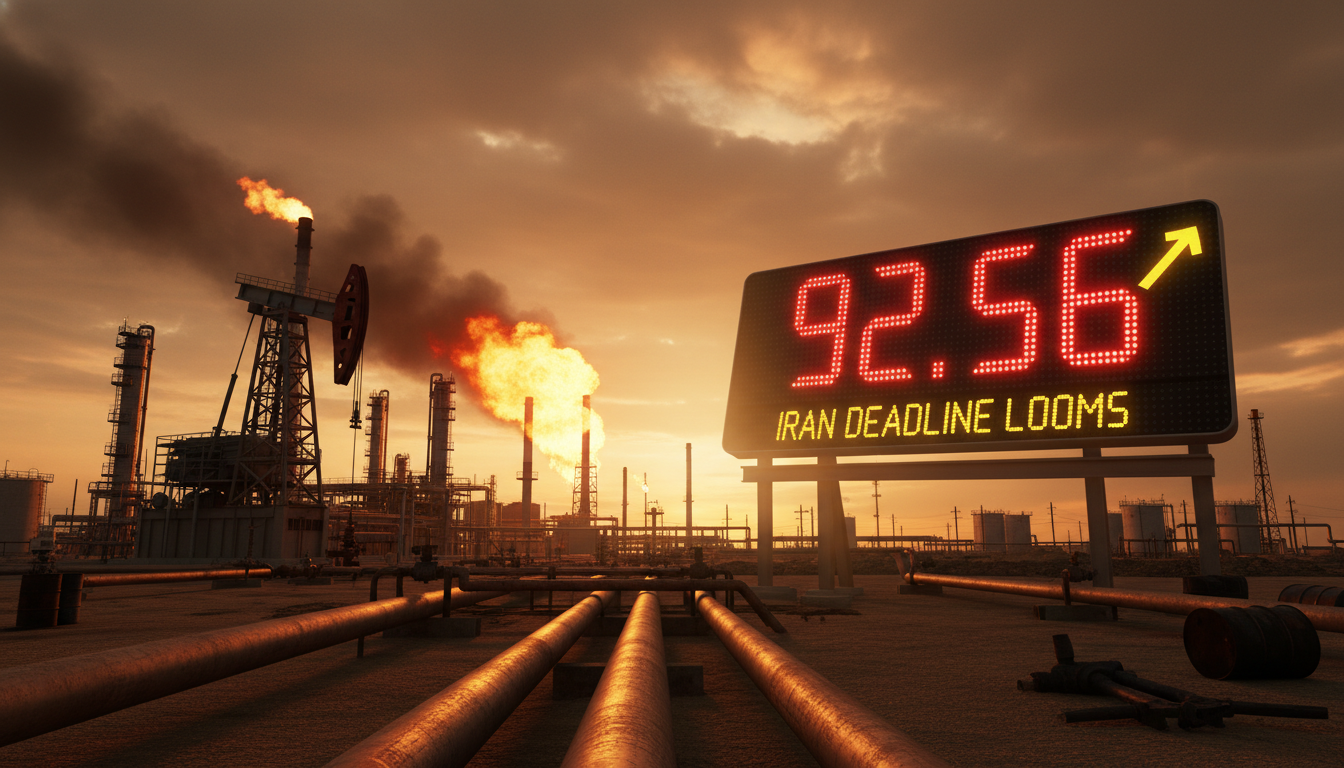
Geopolitical Deadlines Dominate Oil Market Outlook as Iran Tensions Escalate
The global oil market has fundamentally shifted its compass. No longer primarily navigating by the traditional stars of supply and demand, it now reacts with acute sensitivity to the ticking clocks of geopolitical deadlines. This paradigm shift has brought unprecedented volatility and risk, particularly as a critical ultimatum regarding Iran looms large.
President Donald Trump’s declaration of a definitive Tuesday deadline for Iran to reach an accord has thrust the energy landscape into a starkly binary phase: an agreement, however fragile, or an escalation with potentially severe consequences. This high-stakes ultimatum transcends mere diplomacy, injecting profound economic uncertainty as investors grapple with the potential for further disruption in one of the world’s most vital energy arteries. The implications for global crude flows and refined product pricing are paramount for any serious energy portfolio.
Tehran’s response has been unwavering and resolute. The rejection of a proposed ceasefire framework underscores Iran’s insistence on a more enduring resolution. Their demands include comprehensive sanctions relief and concrete security guarantees, signaling a firm stance against temporary measures. This steadfast position effectively maintains significant pressure on the Strait of Hormuz, thereby constraining global energy throughput and precluding any immediate de-escalation of market risk premiums. For crude oil investors, this translates directly into a persistent supply risk factor.
Consequently, the market finds itself operating within a tightly constrained band of uncertainty. Oil prices have exhibited only modest movements in recent trading sessions, reflecting a delicate equilibrium between the looming specter of escalation and the slender hope for a negotiated settlement. However, this recent calm should not obscure the underlying volatility. Earlier in this tense period, U.S. crude futures experienced a dramatic surge, jumping over 11% in a single trading session, before stabilizing as market participants meticulously assessed the often-conflicting signals emanating from both diplomatic camps.
This pattern of price behavior offers crucial insights into the current market psychology. Oil prices are no longer reacting in a straightforward, linear fashion. Instead, the market is engaged in a constant process of recalibration, first pricing in worst-case scenarios, then marginally retreating as diplomatic headlines suggest a glimmer of progress, only to reset to higher risk premiums when talks inevitably encounter roadblocks. For energy investors, this dynamic signifies that market analysis is less about directional predictions and more about evaluating probabilities, and those probabilities, regrettably, still lean towards continued disruption.
Even as behind-the-scenes negotiations persist, confidence in a swift and comprehensive resolution remains markedly low. Each rejected proposal and every new ultimatum serves to reinforce the perception that this geopolitical standoff could extend far longer than initially anticipated. This prolonged uncertainty, in turn, ensures that the potential for significant energy disruption remains a central tenet of global market thinking, impacting everything from futures contracts to long-term investment strategies in the energy sector.
The ramifications extend far beyond mere fluctuations in crude oil prices. This scenario fundamentally impacts the critical elements of access, timing, and reliability within the global energy supply chain. These are the foundational pillars upon which the smooth functioning of international commerce and industrial operations depend.
The Strait of Hormuz undeniably stands as the pivotal variable in this equation. As long as energy flows through this vital corridor remain constrained, even partially, the market is compelled to factor in tighter supply conditions, the necessity for longer and more costly shipping routes, significantly elevated insurance premiums, and an overarching increase in volatility across both crude oil and all categories of refined products. Investors in maritime logistics, refining, and even petrochemicals must closely monitor this choke point.
This is precisely why the specter of energy disruption remains front and center for sophisticated investors. It’s not predicated on a complete disappearance of supply, but rather on the erosion of predictability within the intricate global system designed to transport it. In today’s highly sensitive market, the mere presence of sustained uncertainty is sufficient to underpin higher prices and maintain elevated risk premiums across the entire energy complex. This uncertainty itself has become a quantifiable commodity.
Even the eventual arrival of a ceasefire, should diplomatic efforts prevail, may not immediately untangle these complex threads. The intricate systems governing global shipping, insurance, and logistics require substantial time to normalize. Restoring trust in the secure passage of vital energy shipments demands an even longer period of demonstrable stability. Savvy market participants understand that merely reopening supply flows is a distinct challenge from fully restoring long-term market confidence and operational stability.
This brings the intense investor focus back to the impending deadline. President Trump’s “final” timeline is clearly intended to force clarity and expedite a resolution. However, in the inherently complex and often opaque realm of energy markets, true clarity rarely adheres to a strict schedule. Instead, the more pertinent question for investors is how long this pervasive uncertainty will persist, and more crucially, how profoundly it will reshape the fundamental behaviors and strategies within the global energy sector.
At this moment, the market signal is unambiguous. What began as a geopolitical standoff has unequivocally transformed into a profound market event. Here, the intricate interplay of diplomacy, the tangible threat of supply disruption, and evolving risk perception are simultaneously driving prices. Until one of these powerful forces definitively breaks through and establishes clear dominance, crude oil pricing will remain less about traditional supply-demand fundamentals and more about the ever-unfolding narrative of “what happens next” on the geopolitical stage.
