Global energy markets are currently navigating a complex confluence of geopolitical flashpoints and evolving macroeconomic signals, creating a highly dynamic landscape for oil investors. While initial trading saw significant surges in crude benchmarks driven by heightened Middle Eastern tensions, a subsequent recalibration underscores the delicate balance between immediate risk premiums and underlying market sentiment. This intricate interplay demands a nuanced understanding from investors seeking to position themselves effectively in the energy sector.
Geopolitical Tensions Drive Volatility, But Prices Temper
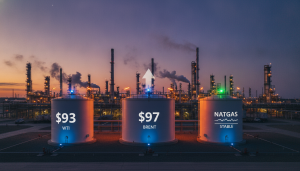
The week commenced with a palpable risk premium baked into crude prices, primarily fueled by renewed concerns over Middle Eastern stability. Reports of the United States interdicting an Iranian cargo vessel immediately amplified fears of disruptions to vital shipping lanes, particularly near the Strait of Hormuz. This friction initially propelled both West Texas Intermediate (WTI) and Brent crude significantly higher. However, crude futures experienced a notable recalibration by yesterday’s market close. As of today, Brent crude trades at $99.13, reflecting a modest 0.22% decline, while WTI crude stands at $94.40, a sharper 1.51% retreat within its day range of $92.68 to $97.85. This current Brent price point is also a notable retreat from the $109.27 seen on April 7th, marking an 8.7% decline over the past two weeks, demonstrating the market’s sensitivity to both escalations and perceived de-escalations.
Our proprietary reader intent data reveals a keen investor interest in the broader geopolitical picture, with specific questions arising around potential ceasefire negotiations. This underlying optimism, which appears to have overridden some initial weekend concerns, likely contributed to the unwinding of the initial risk premium. The market’s quick pivot from an immediate surge to a more measured posture highlights how rapidly sentiment can shift, emphasizing the need for investors to remain agile in their assessment of geopolitical developments.
Macroeconomic Headwinds and Inflationary Pressures
Beyond immediate geopolitical influences, broader financial markets continue to exert significant pressure on commodity demand. US Treasury yields registered minimal movement, though the subtle emergence of a ‘bull flattening’ trend signals market expectations of future economic slowdowns or anticipated easing of monetary policy – both dampening factors for future oil consumption. Concurrently, the US Dollar Index initially gapped higher at Monday’s open, reflecting its traditional ‘safe haven’ appeal. However, this initial premium quickly unwound as renewed optimism surrounding potential ceasefire negotiations reduced the dollar’s allure.
Globally, inflation data remains a critical determinant of central bank policy and, by extension, economic growth and oil demand. Following a subdued March inflation report from Canada, the first-quarter 2026 Consumer Price Index (CPI) figures from New Zealand captured significant market attention. Both annual and quarterly inflation metrics surpassed expectations, printing at a robust 3.1% year-over-year and 0.9% quarter-over-quarter. While these readings bolstered the New Zealand Dollar, the annual rate remained unchanged from Q4 2025. This suggests that while inflationary pressures persist, their acceleration may be leveling off. Nevertheless, rate markets continue to price in approximately 78 basis points of additional monetary tightening by the Reserve Bank of New Zealand (RBNZ) by year-end, reflecting an underlying expectation that central banks globally will continue efforts to bring inflation back to target, potentially at the cost of economic growth.
Upcoming Catalysts and Key Investor Questions
For energy investors, the immediate future holds several critical data releases that will shape market sentiment and price action. Our proprietary data pipelines show that the next two weeks are packed with high-impact events. On April 28th and May 5th, investors will keenly await the API Weekly Crude Inventory reports, followed closely by the official EIA Weekly Petroleum Status Reports on April 29th and May 6th. These inventory figures are paramount, as significant draws could signal tighter supply and support higher prices, while builds could exacerbate selling pressure. Furthermore, the Baker Hughes Rig Count on May 1st and May 8th will offer insights into North American production trends, a key supply-side indicator. Finally, the EIA Short-Term Energy Outlook on May 2nd provides official government forecasts that can significantly influence market expectations for both supply and demand.
Our internal analytics reveal that investors are actively grappling with the potential extremes in oil prices, specifically asking “What would push Brent below $80?” and “What would push it above $120?”. These upcoming data points, coupled with evolving geopolitical narratives, are central to answering such questions. Sustained, unexpected inventory builds across multiple weeks, combined with clear signs of de-escalation in the Middle East and a definitive global economic slowdown, could certainly pressure Brent towards the $80 threshold. Conversely, significant inventory draws, coupled with any re-escalation of geopolitical tensions that threaten critical shipping lanes or production, could provide the tailwind necessary to push Brent back towards the $120 mark. While the long-term impact of EV adoption on oil demand is a topic our readers are also exploring, the immediate price trajectory remains heavily influenced by these weekly supply/demand snapshots and the unpredictable nature of global politics.
Navigating the Investment Outlook
The current market environment underscores the intricate dance between geopolitical risks, macroeconomic fundamentals, and supply-demand dynamics. Investors in oil and gas must remain vigilant, recognizing that initial price surges driven by geopolitical events can quickly recalibrate as broader market sentiment shifts or prospects for de-escalation emerge. The ongoing efforts by central banks to combat inflation, as evidenced by New Zealand’s CPI and the RBNZ’s tightening expectations, suggest a persistent drag on potential demand growth. However, the volatility introduced by Middle Eastern tensions provides a strong counter-narrative, ensuring that supply disruptions remain a significant upside risk.
Looking ahead, the regular cadence of inventory reports and production data will offer crucial insights into the fundamental supply-demand balance. Investors should closely monitor these releases for deviations from expectations, as they will likely dictate short-term price movements. Longer-term, the interplay between global economic health, central bank policies, and the ever-present geopolitical wildcards will continue to define the investable landscape for crude. Prudent portfolio management in this sector requires not just an understanding of immediate headlines, but a deep dive into the underlying data and forward-looking catalysts that shape the true value of energy assets.