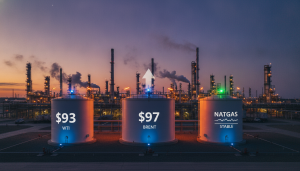
The global energy landscape finds itself at a critical juncture, with escalating geopolitical tensions in the Middle East casting a long shadow over crude oil markets. At the heart of this volatility lies the Strait of Hormuz, a narrow yet profoundly vital waterway that serves as the conduit for approximately 20% of the world’s daily oil and gas demand. Recent developments, including Iran’s actions to curtail shipping and the sustained U.S. blockade of Iranian ports, have significantly disrupted the normal flow of energy resources from this pivotal region to international buyers, directly fueling the multi-day surge in crude prices.
Investors must closely monitor the intricate dance between geopolitical strategy and tangible logistical impact. The immediate repercussions are evident in the shipping lanes themselves. Vessel-traffic data reveals a stark reality: at least six Iranian oil tankers have been forced to abandon their journeys and turn back duer to the U.S. blockade, effectively removing their cargo from the international supply chain. Before the outbreak of hostilities on February 28, the Strait of Hormuz typically witnessed a robust daily transit of 125 to 140 ships. This crucial maritime traffic has now noticeably dwindled, exacerbating supply concerns and tightening an already strained market. Even in the optimistic scenario of an immediate cessation of hostilities, market analysts warn that resolving the resultant supply outages, alleviating severe port congestion, and untangling shipping bottlenecks could realistically extend over many months. This protracted recovery period inherently embeds a significant risk premium into crude oil prices, providing a substantial foundation for continued upside potential in the near term.
WTI Crude: Decoding Market Action Amid Geopolitical Headwinds
The daily chart for West Texas Intermediate (WTI) crude oil offers a compelling narrative of the market’s response to these unfolding events. Since the onset of the conflict, WTI prices have largely consolidated within a well-defined trading range, oscillating between robust support at the $80 per barrel mark and formidable resistance at $120 per barrel. However, it is essential for investors to contextualize this current action within the broader historical framework. Prior to the escalation of hostilities, WTI exhibited a distinctly constructive price pattern, characterized by strong bullish momentum. This pre-war strength was particularly evident as prices comfortably maintained their position above the critical long-term support level of $55 per barrel, signaling underlying market resilience and growing demand.
The shift in market dynamics was dramatic and swift. As the war commenced on February 28, WTI decisively breached a significant downtrend line that had previously constrained price action around the $70 per barrel region. This breakout was a powerful technical signal, indicating a major shift in market sentiment and the overcoming of prior resistance. Following this pivotal breakout, crude prices experienced an explosive surge, rapidly ascending to test the $120 per barrel ceiling. This rapid upward trajectory underscored the market’s immediate reaction to perceived supply threats and heightened geopolitical risk. However, as is often the case with such rapid moves, a subsequent correction ensued, bringing the price back down towards the 50-day Simple Moving Average (SMA) at the $80 per barrel level. This level now serves as a dynamic support, with its integrity being keenly watched by traders seeking clues about WTI’s immediate directional bias.
For discerning investors, the current consolidation within the $80-$120 range signifies a period of market digestion, where competing forces of supply scarcity and demand considerations are actively at play. A sustained breach above the $120 resistance could unlock further significant upside, potentially targeting higher historical levels, particularly if the geopolitical situation deteriorates further or supply disruptions intensify beyond current projections. Conversely, a failure to hold the $80 support, especially if accompanied by a break below the 50-day SMA, would signal a weakening of the current bullish momentum and could open the door for a deeper retracement. However, given the entrenched supply concerns and the enduring risk premium associated with the Strait of Hormuz, the path of least resistance appears to favor the upside in the medium term.
The interplay between fundamental geopolitical risks and technical market structures remains paramount for energy investors. The Strait of Hormuz, with its enduring strategic importance and the current operational bottlenecks, continues to anchor a substantial risk premium in crude prices. As long as Iranian shipping remains curtailed and U.S. blockades persist, the global supply deficit will likely keep prices elevated. Even beyond the immediate conflict, the challenges of normalizing shipping lanes, restoring port efficiencies, and rebuilding trust within the supply chain indicate that the impact on crude markets will be prolonged. Investors should therefore anticipate continued volatility, with both fundamental geopolitical developments and key technical levels providing crucial guidance for navigating the complex and dynamic landscape of oil and gas investments.