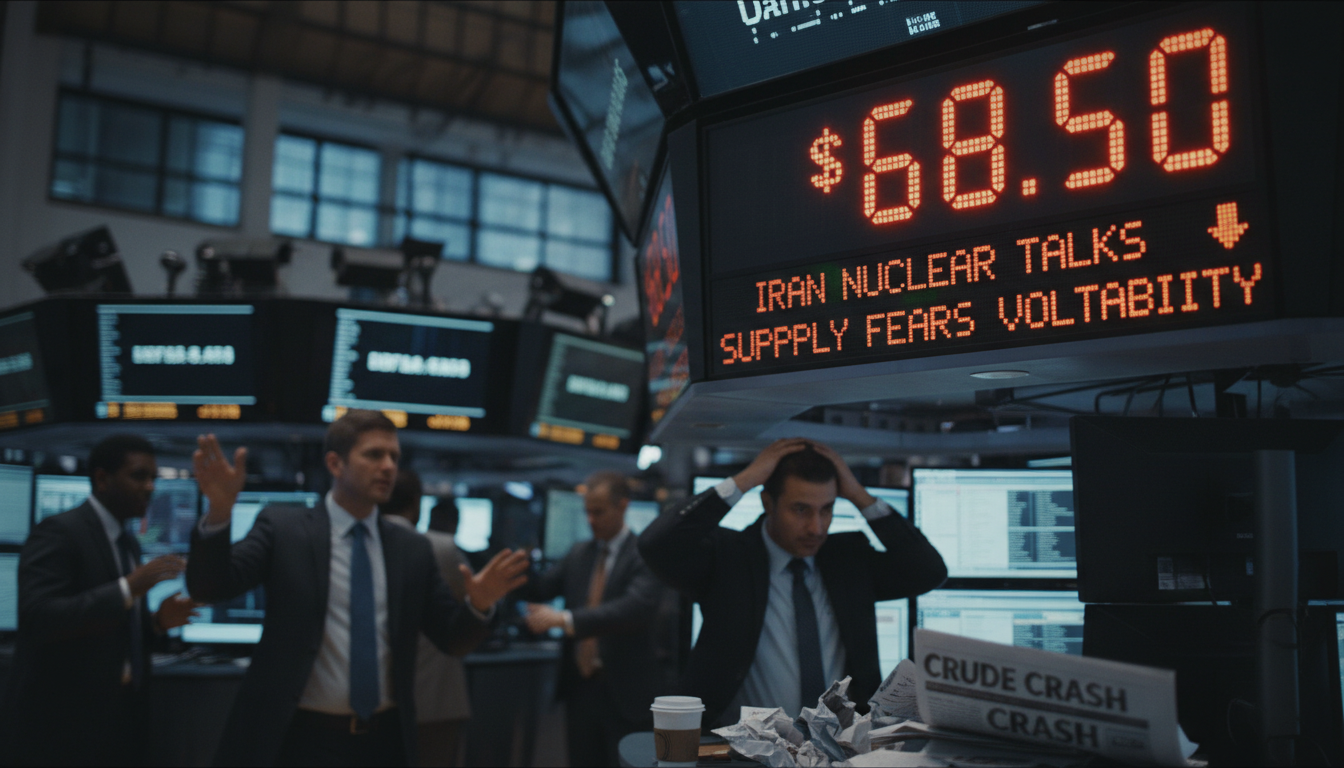
The global oil market continues its volatile dance, with crude benchmarks experiencing renewed downward pressure as diplomatic overtures with Iran remain mired in complexity and conflicting signals. While the prospect of a de-escalation initially offered a temporary reprieve from surging prices, the continued lack of a clear resolution, coupled with ongoing military posturing, has left investors grappling with heightened uncertainty. This intricate geopolitical landscape is directly impacting the market’s risk premium, leading to significant price adjustments and a palpable sense of caution among traders. Understanding the confluence of these diplomatic maneuvers, military deployments, and underlying market fundamentals is crucial for any energy investor navigating the current environment.
Geopolitical Crosscurrents: Discounting Risk Amidst Unresolved Talks
The ongoing diplomatic efforts surrounding Iran have become a primary driver of recent oil price movements. While the White House maintains its engagement in peace discussions, Tehran’s public rebuff of US overtures and its outlining of new conditions for a cessation of hostilities have created a complex and often contradictory narrative. This diplomatic tug-of-war has partially eroded the geopolitical risk premium that had previously buoyed oil prices. Our proprietary data reveals that Brent crude has shed significant value over the past two weeks, declining from $101.16 on April 1st to $94.09 yesterday, a notable 7% reduction. This trend suggests the market is actively discounting some of the conflict-related risk, despite the absence of a definitive breakthrough. However, this discounting is not absolute; the extreme volatility observed in futures contracts indicates that traders remain on edge, meticulously dissecting every statement and development related to the strategically vital Strait of Hormuz. The market’s interpretation of a higher probability of a ceasefire, even if tenuous, has led some investors to view the recent dip as an opportune moment to exit previously accumulated long positions, further contributing to the price softening.
Current Market Snapshot: Brent Slips Below $93 as Uncertainty Persists
As of today, the downward momentum continues across key crude benchmarks. Brent crude trades at $92.45 per barrel, marking a 0.85% decline for the day, with an intra-day range between $91.39 and $94.21. Similarly, West Texas Intermediate (WTI) crude is priced at $88.73 per barrel, registering a 1.05% drop, having traded within a daily range of $87.64 to $90.71. These figures underscore the market’s ongoing sensitivity and the persistent uncertainty stemming from the unresolved geopolitical situation. The relative stability of gasoline prices, currently at $3.1 per gallon with a modest 0.96% decrease, suggests that while crude markets react sharply to geopolitical headlines, the immediate impact on refined products might be somewhat buffered by demand dynamics and existing inventory levels. The daily price swings, evident in the day ranges, highlight the lack of conviction among market participants, with many retreating to the sidelines and contributing to a noticeable decline in overall market liquidity.
Investor Focus: Navigating Price Direction and Long-Term Outlook
Our proprietary reader intent data reveals a clear sentiment among investors this week: a burning desire for clarity on market direction. Queries frequently center on the immediate trajectory of WTI and broader questions about the price of oil per barrel by the end of 2026. This reflects the profound challenge investors face in reconciling daily geopolitical headlines with fundamental supply-demand dynamics. The high level of volatility, driven by conflicting signals from Washington and Tehran – such as the US administration’s reported 15-point peace proposal juxtaposed with Iran’s five key demands and simultaneous troop deployments – makes directional bets exceptionally risky. While short-term movements are heavily influenced by news flow, the longer-term outlook remains clouded by the potential for either a full de-escalation, which could release significant supply and further depress prices, or a dangerous escalation that could send prices soaring. Investors are, therefore, less concerned with the mechanics of market data and more focused on identifying reliable signals for future price trends, a task made increasingly difficult by the fluid geopolitical environment.
Forward View: Key Data Points and Looming Catalysts
While geopolitical events dominate headlines, investors must not lose sight of the critical fundamental data releases scheduled for the coming weeks. These reports offer vital insights into the underlying supply and demand picture, which can either amplify or mitigate the impact of geopolitical developments. This week, the EIA Weekly Petroleum Status Report on Wednesday (April 22) will provide crucial updates on crude inventories, refinery activity, and product demand. Following closely, the Baker Hughes Rig Count on Friday (April 24) will offer a glimpse into future production trends. As we move into next week, the API Weekly Crude Inventory on Tuesday (April 28), followed by another EIA Weekly Petroleum Status Report on Wednesday (April 29), and the Baker Hughes Rig Count on May 1st, will continue to shape market expectations. Of particular significance is the EIA Short-Term Energy Outlook (STEO) due on May 2nd, which will offer revised forecasts for global supply, demand, and prices for the coming months and year. These scheduled events, alongside the unannounced but highly anticipated progress (or lack thereof) in diplomatic talks and the ongoing implications of military deployments, including the 2,000 soldiers from the 82nd Airborne Division and additional Marine Expeditionary Units, will provide the next set of catalysts for market movement. Prudent investors will monitor these data points closely, seeking to identify any shifts in fundamental balances that could offer clearer directional signals amidst the current geopolitical fog.


