WTI crude futures advanced more than 3% during the final full trading week of 2025, rising to $58.46 after gaining $1.94 since last Friday. The rally stands out during a traditionally muted period between Christmas and New Year’s, when thin liquidity often dampens movement. Instead, geopolitical events have reshaped short-term sentiment, prompting traders to reprice supply risk despite widespread expectations that 2026 will bring heavy oversupply.
Reduced participation has amplified price action, leaving the market more sensitive to developments involving Venezuela and Russia. With traders closing books for the year, headline-driven flows have been strong enough to sustain a meaningful weekly advance.
U.S. Pressure on Venezuela Boosts Risk Premium and Influences Oil Prices Forecast Discussions
The sharpest catalyst for this week’s gains has been the escalation in U.S. enforcement actions targeting Venezuelan crude shipments. President Donald Trump confirmed that another tanker is now being pursued, following the seizure of two vessels and their cargo. The Centuries—carrying roughly 2 million barrels—was boarded recently, signaling a willingness by Washington to intensify pressure on Nicolas Maduro’s government.
Even though Venezuela supplies less than 1% of global crude, the operational risk this introduces matters to traders. The volumes are small, but the implications for shipping security and market psychology are far-reaching. Any suggestion that…
WTI crude futures advanced more than 3% during the final full trading week of 2025, rising to $58.46 after gaining $1.94 since last Friday. The rally stands out during a traditionally muted period between Christmas and New Year’s, when thin liquidity often dampens movement. Instead, geopolitical events have reshaped short-term sentiment, prompting traders to reprice supply risk despite widespread expectations that 2026 will bring heavy oversupply.
Reduced participation has amplified price action, leaving the market more sensitive to developments involving Venezuela and Russia. With traders closing books for the year, headline-driven flows have been strong enough to sustain a meaningful weekly advance.
U.S. Pressure on Venezuela Boosts Risk Premium and Influences Oil Prices Forecast Discussions
The sharpest catalyst for this week’s gains has been the escalation in U.S. enforcement actions targeting Venezuelan crude shipments. President Donald Trump confirmed that another tanker is now being pursued, following the seizure of two vessels and their cargo. The Centuries—carrying roughly 2 million barrels—was boarded recently, signaling a willingness by Washington to intensify pressure on Nicolas Maduro’s government.
Even though Venezuela supplies less than 1% of global crude, the operational risk this introduces matters to traders. The volumes are small, but the implications for shipping security and market psychology are far-reaching. Any suggestion that additional tankers could face seizure complicates insurance assessments, increases transit uncertainty, and raises the probability that other exporters may face similar setbacks. During a holiday week with reduced liquidity, these developments have carried even greater weight.
Ukraine Expands Strikes on Russian Energy Assets, Elevating Supply Concerns
Ukraine’s latest actions against Russian energy infrastructure have added another layer of upward pressure. A drone strike on a Russian shadow-fleet tanker in the Mediterranean marked a new milestone in Kyiv’s campaign, extending its reach beyond prior targets in the Black Sea and Caspian regions. Two vessels and two piers were damaged along the Black Sea coast, reinforcing concerns about the reliability of Russia’s export network.
The shadow fleet—tankers used to bypass sanctions—has become critical to sustaining Russia’s oil flows. Any interruption, even temporary, tightens available supply and prompts traders to price in additional uncertainty. This comes despite diplomatic conversations between U.S. and Ukrainian officials that were described as constructive, though they produced no visible progress toward de-escalation. Markets are treating the continued attacks as a sign that Ukraine views pressure on Russian oil revenue as a core strategic tool, independent of negotiations.
EIA Inventory Draw and Delayed Report Support Underlying Market Tone
Another focus for traders is the Energy Information Administration’s weekly petroleum report, which has been delayed until December 29 due to the holiday schedule. The most recent data, reflecting the week ending December 12, showed a 1.3-million-barrel crude draw that pushed U.S. inventories to 424.4 million barrels—4% below the five-year average. With refineries running at 94.8% of operable capacity, processing demand remains firm, helping anchor WTI as geopolitical headlines dominate.
Traders expect the delayed report to offer a key read on whether U.S. crude balances continue tightening or whether the draw proves temporary. Either outcome has potential to influence early-year positioning, especially after this week’s rally.
Oversupply Still Central to Oil Prices Projections for 2026
Despite the strong week, long-term expectations for crude remain bearish. The EIA’s latest Short-Term Energy Outlook projects Brent averaging $55 in the first quarter of 2026, reflecting anticipated inventory builds exceeding 2 million barrels per day next year. The IEA reinforces this view, noting that global supply is on track to rise by 3 million barrels per day in 2025 and another 2.4 million barrels per day in 2026, while demand growth remains under 1 million barrels per day in both years.
Major supply gains from the U.S., Brazil, Guyana, and Canada continue to outpace consumption. As inventories climb, traders expect commercial storage constraints to resurface, with some barrels potentially moving into costlier floating storage if land-based capacity tightens.
Weekly Light Crude Oil Futures
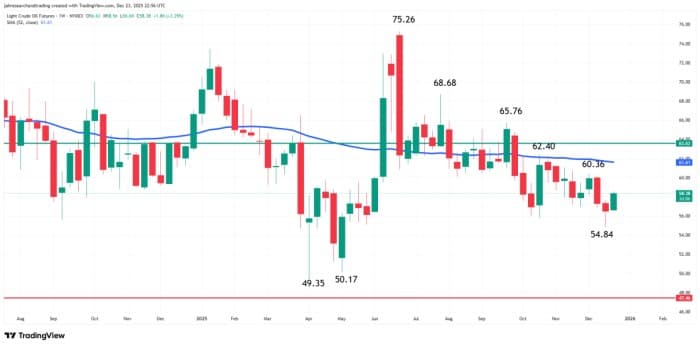
Trend Indicator Analysis
Light crude oil futures are in a position to finish higher this holiday-shortened week. After hitting its lowest level since May 16 at $54.84 last week. The market is up sharply, suggesting aggressive short-covering and end-of-the-year position-squaring.
Despite the strong performance on Monday and Tuesday, however, the main trend is still down with traders facing potential resistance at $60.36.
The 52-week moving average at $61.61 is the first significant resistance level. Overcoming and sustaining a rally over it will indicate increased buying pressure with the long-term 50% resistance coming in at $63.62.
On the downside, a trade through $54.84 will signal a resumption of the downtrend.
Weekly Technical Forecast
The direction of the weekly Light Crude Oil Futures market for the week ending January 2 is likely to be determined by trader reaction to $56.52.
Bullish Scenario
A sustained move above $56.52 will signal strong short-covering and renewed buying interest. If this move generates sufficient upside momentum, the 52-week moving average at $61.61 will come into play. However, unless the buying is strong enough to overtake this indicator, we’ll remain in “sell the rally” mode.
Bearish Scenario
A sustained move below $56.52 will indicate active selling pressure. This could trigger a sharp decline through last week’s low at $54.84, putting $50.17 to $49.35 on the radar.
Short-Term Outlook: Bullish as Near-Term Supply Risks Dominate
This week’s rally underscores how quickly crude can react to geopolitical stress, especially during periods of thin holiday liquidity. U.S. seizures of Venezuelan crude and Ukraine’s expanding strikes on Russian energy infrastructure have introduced meaningful uncertainty around short-term supply flows, overshadowing the otherwise bearish fundamental outlook for 2026.
From a technical standpoint, the broader trend remains lower, but near-term momentum has turned to the upside. The next major test sits at the 52-week moving average resistance at $61.61, which could present headwinds if WTI attempts to extend this week’s advance.
Short-term forecast: Bullish. Supply disruption risk continues to drive price action, and WTI enters year-end with firm upward momentum.