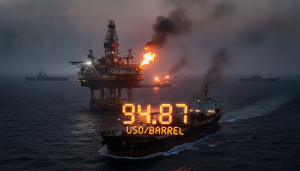
The global oil market continues to navigate a complex web of geopolitical tensions and fundamental shifts, with recent diplomatic overtures regarding the Ukraine conflict injecting fresh volatility. While headlines initially suggested a climb in oil prices as the prospect of a swift resolution dimmed following a high-stakes White House meeting, the underlying currents of the market reveal a more nuanced and indeed, often contradictory, picture for energy investors. Understanding these dynamics is crucial for positioning in an environment characterized by rapid price swings and evolving policy landscapes.
Geopolitical Headwinds Continue to Shape Market Sentiment
Recent diplomatic engagements surrounding the Ukraine conflict have once again underscored the profound impact of geopolitics on crude oil valuations. The meeting between U.S. President Trump and Ukrainian President Zelenskiy, initially eyed by some as a potential catalyst for de-escalation, ultimately served to temper expectations for a rapid peace accord. President Zelenskiy’s emphasis on finding “diplomatic ways” to end the conflict, rather than signaling an immediate breakthrough, resonated through trading floors. This sentiment suggests that the flow of Russian crude, a perennial concern for global supply, will likely remain constrained by ongoing sanctions and market self-sanctioning for the foreseeable future, preventing a rapid return of significant volumes to the global market.
For years, energy traders have experienced a whiplash effect from alternating hopes for ceasefires and threats of escalating sanctions. This persistent uncertainty has limited sustained risk appetite in either direction, keeping oil prices tethered to geopolitical headlines. The latest developments reinforce the view that the conflict remains a primary driver of market volatility, influencing everything from short-term trading decisions to long-term investment strategies in energy infrastructure and production capacity. Investors must remain vigilant to incremental shifts in diplomatic rhetoric and on-the-ground realities, as these factors directly impact the perceived risk premium embedded in crude prices.
Navigating Current Market Swings Amid Broader Downtrends
While the immediate aftermath of the White House meeting saw crude prices tick upwards, with West Texas Intermediate advancing about 1% to settle above $63 a barrel and Brent crude rising more than 1% to settle below $67, the broader market trend and current snapshot reveal a different story. As of today, Brent crude trades at $90.38, reflecting a significant 9.07% decline from its previous close, with WTI not far behind at $82.59, down 9.41%. This sharp reversal illustrates the powerful interplay between immediate geopolitical reactions and larger market forces at play. Over the past two weeks, the Brent benchmark has seen a substantial decline, falling from $112.78 on March 30th to $91.87 on April 17th, representing an 18.5% drop. This broader bearish pressure indicates that while geopolitical events can spark intraday rallies, persistent concerns about global economic growth, central bank policies, and the potential for increased supply continue to exert downward pressure on crude valuations.
The market’s current state is a testament to the complexity of forecasting oil prices. Even as geopolitical risk premium persists, fears surrounding the fallout from international trade policies and the looming question of OPEC+ supply adjustments are creating a counter-narrative. The significant daily declines underscore investor apprehension regarding a potential oversupply scenario or a weakening demand outlook, overriding the initial, short-lived rally spurred by a prolonged conflict outlook. This dynamic environment demands a holistic view, integrating both headline-driven events and fundamental supply/demand indicators.
Upcoming Catalysts and Investor Concerns
Our proprietary reader intent data highlights a keen focus among investors on the future trajectory of oil prices, with many asking about potential price targets for crude by year-end 2026 and the impact of OPEC+ production quotas. These questions underscore the significance of key market catalysts on the horizon that could provide clarity and shape investment decisions. The immediate spotlight falls on the upcoming OPEC+ Joint Ministerial Monitoring Committee (JMMC) meeting on April 18th, followed by the Full Ministerial Meeting on April 19th. These gatherings are critical for assessing the cartel’s collective strategy regarding output levels. With previous discussions hinting at plans to rapidly return barrels to the market, any definitive statements or production adjustments will significantly influence global supply expectations and, consequently, crude prices.
Beyond OPEC+, weekly inventory data provides crucial insights into real-time supply and demand balances. Investors will closely watch the API Weekly Crude Inventory reports on April 21st and April 28th, along with the official EIA Weekly Petroleum Status Reports on April 22nd and April 29th. These releases offer a pulse check on U.S. crude stockpiles, refining activity, and product demand, acting as bellwethers for short-term market direction. Furthermore, the Baker Hughes Rig Count, scheduled for April 24th and May 1st, will offer an indication of North American drilling activity and future production trends. Collectively, these upcoming events provide critical data points that will help answer investor questions about market fundamentals and the potential for price stabilization or further volatility through the remainder of 2026.
The Trade Policy Wildcard and Demand Implications
Adding another layer of complexity to the oil market is the unpredictable nature of global trade policies, particularly those involving major economies and their energy procurement strategies. U.S. President Trump’s recent actions have illustrated a differentiated approach, notably singling out India for purchasing Russian crude by imposing hefty tariffs, while simultaneously signaling a willingness to hold off on increasing levies on Chinese goods despite their similar purchases. This selective application of trade measures creates an uneven playing field and introduces significant uncertainty into global crude flows and demand projections.
The fallout from these trade policies extends beyond individual nations. By attempting to dictate who can purchase Russian crude and at what cost, these measures inevitably reshape traditional trading routes and can impact global demand by potentially hindering economic growth in targeted regions. While some markets might see increased competition for non-Russian barrels, others could face higher import costs or supply disruptions. For oil and gas investors, this signifies a market where geopolitical risk is not only about direct conflict but also about the economic repercussions of trade disputes and targeted sanctions, which can dampen overall demand growth and complicate supply chain logistics. Monitoring the evolving landscape of trade relations will be as vital as tracking traditional supply-side fundamentals in the months ahead.