

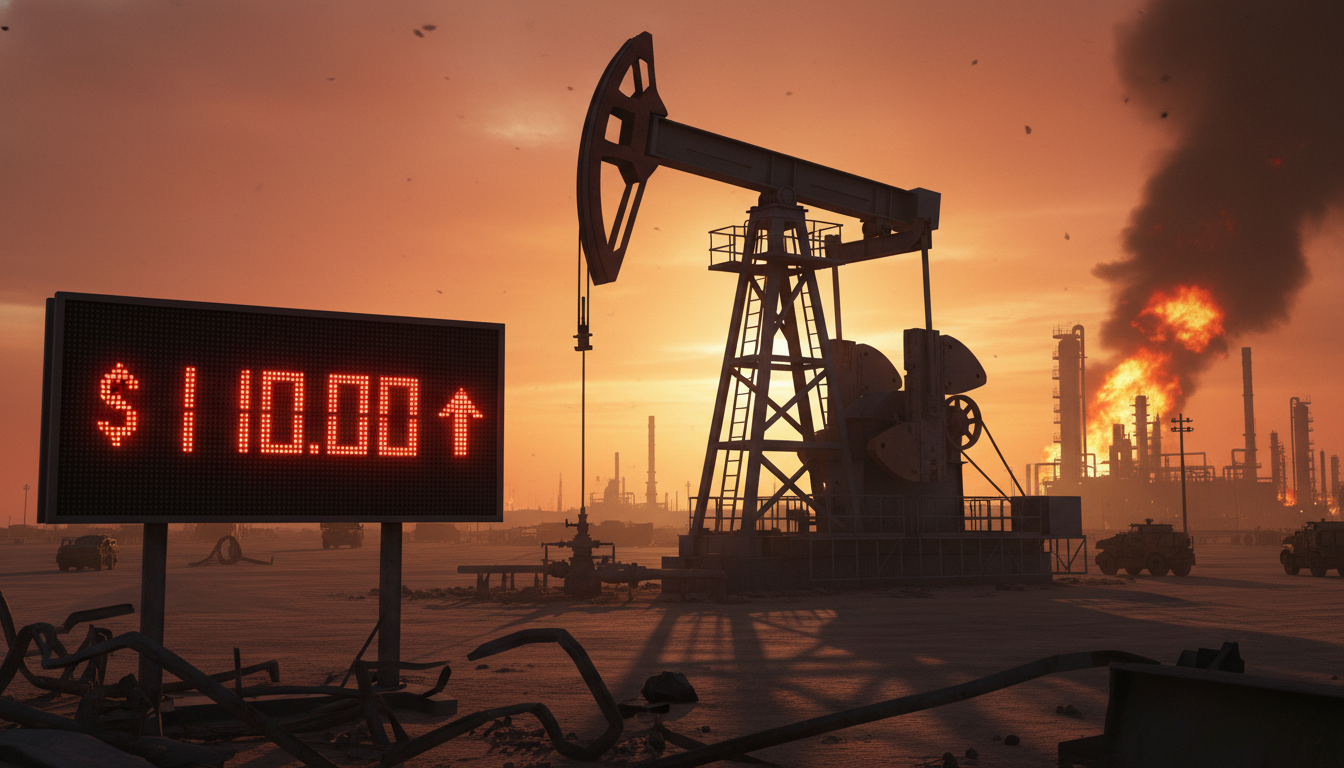
Geopolitical Tensions Ignite Crude Markets, Fueling Supply Disruption Fears
Global oil markets experienced a significant surge in prices on Thursday, with Brent crude climbing toward the $110 per barrel mark. This sharp ascent was primarily driven by escalating geopolitical rhetoric, as former President Donald Trump declared the United States would persist with aggressive actions against Iran. The statements reignited investor fears regarding prolonged disruptions to the world’s vital oil supply routes, particularly the Strait of Hormuz.
At 13:02 GMT, Brent crude futures registered a substantial gain of $7.96, or 7.9%, settling at $109.12 per barrel. Concurrently, U.S. West Texas Intermediate (WTI) crude futures saw an even more dramatic increase, up $12.48, or 12.5%, reaching $112.60 per barrel. This marked WTI’s highest level since March 9 and positioned it for the largest absolute price rise observed since 2020. Despite these considerable gains, both benchmarks remained below the near-$120 per barrel highs touched earlier in the current conflict, indicating the market’s ongoing sensitivity to geopolitical developments.
Iran’s Role in Market Volatility
The catalyst for today’s market jolt originated from Trump’s uncompromising stance on Iran. He asserted, “We’re going to hit them extremely hard over the next two to three weeks. We’re going to bring them back to the Stone Ages where they belong.” Such assertive declarations, delivered without accompanying details on any potential diplomatic off-ramps or a path to reopening critical maritime passages, immediately resonated through energy trading desks globally. Investors are acutely aware that a prolonged confrontation could severely impact oil flows from the Middle East, a region central to global crude supply.
Analysts highlight the market’s specific reaction to the absence of any “clear mention of ceasefire or diplomatic engagement” in the former president’s remarks. This omission signals an elevated risk of sustained hostilities, prompting traders to price in the potential for significant supply disruptions. Should these tensions intensify further or maritime security risks escalate, crude prices could very well test fresh highs as the market recalibrates for a potentially constrained supply environment.
The Critical Strait of Hormuz and Global Supply Chains
The Strait of Hormuz remains at the forefront of market concerns. This narrow chokepoint, through which a substantial portion of the world’s seaborne oil passes, is exceptionally vulnerable to geopolitical instability. Any impediment to its free passage sends immediate shockwaves through global energy markets. Significantly, Trump’s statements did not include any specifics on potential steps that might lead to a reopening of this crucial waterway, leaving investors in a state of heightened uncertainty.
In a parallel effort to address this critical vulnerability, Britain is currently hosting a virtual gathering involving approximately 40 nations. The discussions are centered on exploring various options for ensuring the safe and open passage through the Strait of Hormuz. Notably, the United States is not scheduled to participate in these talks, a detail that further underscores the complex and multi-faceted international response to the regional instability. The practical implications of the Strait’s potential closure are already manifesting; some market participants have reported halting transactions involving cargoes priced against the Dubai Middle East benchmark. This benchmark typically values nearly one-fifth of global crude supply, but its utility diminishes when ports within the Strait of Hormuz become inaccessible.
OPEC+ and Russia: Shifting Supply Dynamics
Beyond the immediate geopolitical flashpoints, the broader supply landscape continues to evolve. The OPEC+ alliance is reportedly set to deliberate on a potential further increase in oil output during their upcoming meeting on Sunday. While such a move would strategically position member nations to bring additional barrels to market should the Strait of Hormuz eventually reopen, it is widely acknowledged that this action is unlikely to substantially boost global supply in the short term, particularly before any resolution regarding the Strait’s accessibility.
Meanwhile, the conflict in Eastern Europe continues to impact global energy flows. Recent Ukrainian strikes targeting port infrastructure, pipelines, and refineries within Russia have significantly curtailed the nation’s export capabilities. Sources indicate that these attacks have reduced Russia’s export capacity by an estimated 1 million barrels per day, representing approximately one-fifth of its total capacity. This substantial reduction is sufficient to foreshadow imminent production cuts within Russia, adding another layer of complexity to the global supply equation and further tightening the market.
Europe’s Looming Energy Challenge
The ripple effects of these supply disruptions are poised to reach major economies. The head of the International Energy Agency (IEA) has issued a stern warning, projecting that significant supply disruptions will begin to profoundly affect Europe’s economy starting in April. This comes after the region had previously been somewhat shielded by long-term cargo contracts established prior to the full escalation of the conflict. However, as these pre-existing arrangements expire, Europe faces the prospect of directly confronting a tighter and more volatile global energy market, with potentially severe economic consequences.
Investor Outlook: Navigating Volatility and Risk
For investors in the oil and gas sector, the current environment demands vigilant monitoring and agile strategy. The confluence of escalating geopolitical tensions in the Middle East, the critical vulnerability of the Strait of Hormuz, the measured response from OPEC+, and the ongoing supply curtailments from Russia creates an exceptionally complex and volatile market. While the immediate upside in crude prices reflects significant supply risk premiums, the long-term trajectory will depend heavily on the evolution of diplomatic efforts, the de-escalation of military rhetoric, and the ability of key producing nations to adapt to a rapidly changing landscape. Prudent investors will be closely tracking headlines, market fundamentals, and the geopolitical chess board to navigate these turbulent waters.
