

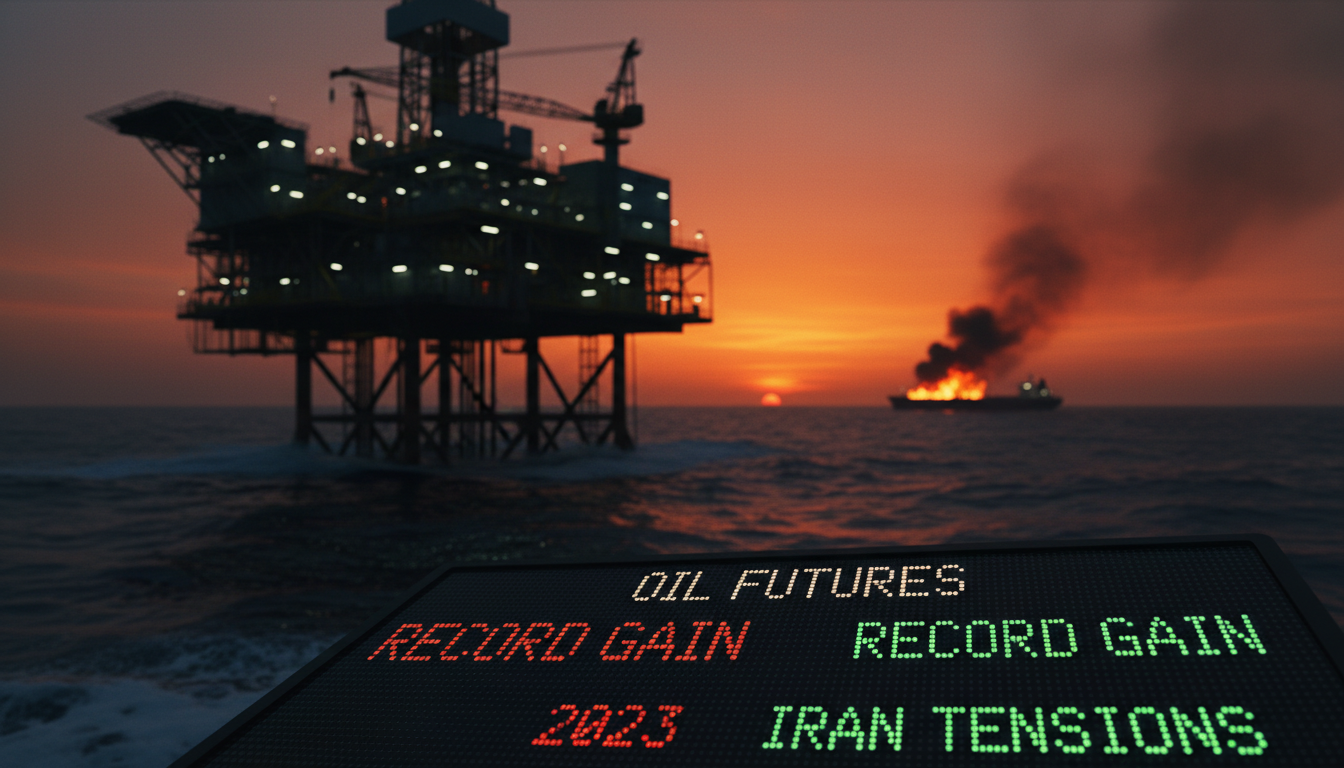
Oil Prices Surge: Geopolitical Tensions Fuel Record Monthly Gains Amid Chokepoint Risks
The global energy market is witnessing an unprecedented rally, with crude oil prices poised to lock in their most significant monthly advance on record. An extraordinary 59% surge in the international benchmark since the start of March underscores a rapidly escalating geopolitical risk premium now embedded in commodity valuations. Investors are closely monitoring a volatile confluence of factors, from intensified regional conflicts to high-level political rhetoric, all contributing to an increasingly bullish sentiment in the oil and gas sector.
At the close of recent trading, Brent crude, the global benchmark, commanded a price of $115.52 per barrel, having briefly topped the $116 mark in Asian trading sessions following fresh news of Houthi militant strikes. Concurrently, West Texas Intermediate (WTI), the key North American benchmark, traded at $101.04 per barrel. This robust price action reflects profound concerns over potential disruptions to vital supply routes, making crude oil an essential topic for any investor focused on energy market dynamics.
Expanding Conflict Zones Threaten Critical Shipping Lanes
Analysts at J.P. Morgan have issued stark warnings regarding the broadening scope of regional hostilities, noting that the conflict’s center of gravity has shifted dramatically. “The conflict is no longer concentrated in the Persian Gulf and around the Strait of Hormuz, but now extends into the Red Sea and the Bab el-Mandeb — one of the world’s most crucial chokepoints for crude and refined product flows,” their recent market commentary highlighted. This geographical expansion fundamentally alters the risk profile for global oil shipments, introducing new vulnerabilities for tankers navigating these indispensable waterways.
The Strait of Hormuz, historically a flashpoint, has seen its immediate criticality for Saudi Arabian exports somewhat mitigated by alternative routes. However, the Red Sea, bordered by several key oil-producing and consuming nations, has emerged as Saudi Arabia’s principal conduit for crude oil exports. This makes the region’s stability paramount for global energy security and, consequently, for investors holding positions in upstream or downstream oil and gas assets. Any significant disruption here could trigger a cascade of logistical and pricing challenges.
Trump’s Intervention and Iran’s Oil Ambitions
Further complicating the market’s outlook are recent statements from President Trump, who indicated Iran had largely agreed to the United States’ proposed 15-point ceasefire plan released last week. Speaking from Air Force One, President Trump conveyed optimism, stating, “They gave us most of the points. Why wouldn’t they? We’re going to be asking for a couple of other things.” While not specifying these additional demands publicly, an interview with the Financial Times revealed a direct objective: President Trump’s desire to secure Iran’s oil reserves. Such political maneuvering introduces a layer of uncertainty regarding future Iranian supply and its potential integration, or lack thereof, into global markets, a factor that profoundly influences long-term investment strategies in the energy sector.
Houthi Actions Magnify Supply Disruption Fears
The direct involvement of Yemen’s Houthi group in the broader conflict represents a potent new bullish catalyst for crude prices. Their demonstrated capacity to target maritime traffic in the Red Sea poses a tangible threat to the uninterrupted flow of global energy supplies. With the Red Sea now serving as the primary export channel for Saudi Arabian crude after previous closures impacting the Strait of Hormuz, any successful Houthi interdiction could have immediate and severe consequences for global oil availability. Data from Kpler, cited by Reuters, illustrates the magnitude of this vulnerability, reporting Saudi Arabian oil exports from the port of Yanbu at a robust rate of 4.658 million barrels per day. The sheer volume passing through this newly threatened chokepoint underscores the market’s sensitivity to regional instability.
Should Red Sea exports face substantial disruption, Saudi Arabia would be compelled to reroute its vast oil flows. The most viable, albeit constrained, alternative would be the SUMED pipeline, which transports crude from the Suez Canal to Egypt’s Mediterranean coast. However, as J.P. Morgan analysts have cautioned, this pipeline possesses a maximum capacity of only 2.5 million barrels daily. This significant reduction in potential export capacity—nearly half of current Red Sea volumes—highlights a critical bottleneck. The prospect of such a redirection scenario is a major concern for energy investors, as it would inevitably lead to tighter global supply, longer transit times, and increased shipping costs, driving up the already elevated risk premium on crude oil.
Investor Outlook: Navigating Extreme Volatility
The current market environment is characterized by extreme volatility and an escalating geopolitical risk landscape. For oil and gas investors, understanding the intricate interplay between military actions, political statements, and critical infrastructure vulnerabilities is paramount. The record-setting monthly gains in crude prices reflect a market actively pricing in significant supply-side risks that could materialize with little warning. Monitoring developments in the Red Sea, tracking Houthi activities, and interpreting the evolving rhetoric from key global players will be crucial for making informed investment decisions in the months ahead. The energy sector remains a dynamic arena where geopolitical events can swiftly redefine investment opportunities and challenges.
