


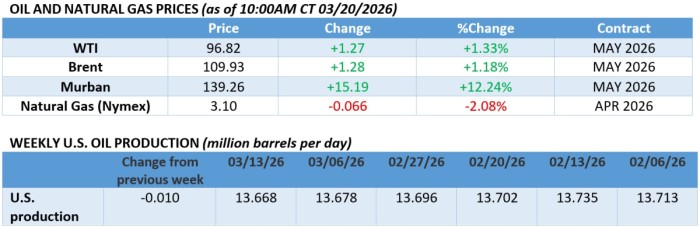
Oil is heading for a fifth straight weekly gain, with Brent near $109, as the Strait of Hormuz remains shut for a third week, keeping supply tight despite policy efforts to ease the market.

Friday, March 20, 2026
Oil markets are set to post their fifth consecutive weekly gain (excepting WTI which will see a minor week-over-week decline), with ICE Brent trading around $109 per barrel. Whilst the Trump administration has sought to defuse market concerns using any means available – waiving the Jones Act, easing Russian sanctions further or de-sanctioning Iranian oil on water – the main thing defining the market’s bullishness is that the Strait of Hormuz remains firmly shut, marking three full weeks of no navigation in the world’s main energy chokepoint.
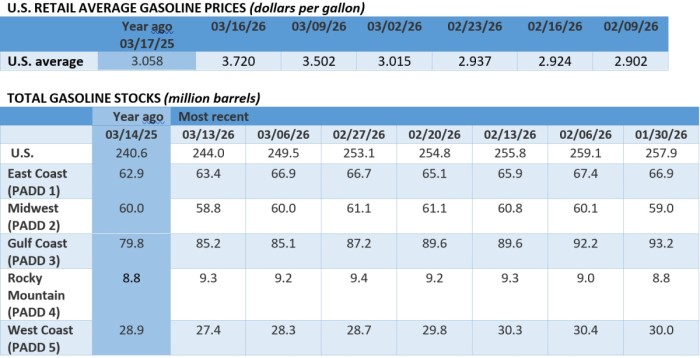
White House Pours Cold Water on Export Ban. US Vice President JD Vance refuted media speculation that the White House would be putting restrictions on the export of oil and gas to lower soaring gasoline prices (currently at $3.91 per gallon), a potential export tax could still be implemented.
Related: The Three Companies Rebuilding America’s Rare-Earth Arsenal
Israel Hits Iran’s Key Gas Field. The Israeli army struck natural gas facilities associated with Iran’s offshore South Pars field, damaging at least four processing plants, prompting a rare rebuke from US President Trump, who called on the Netanyahu administration not to repeat attacks on key energy sites.
Iran Aims Retaliatory Strikes at Gulf Countries. Iran’s military targeted Qatar Energy’s giant Ras Laffan liquefaction plant, Saudi Arabia’s Samref and Yanbu refineries, oil fields in the United Arab Emirates, and two refineries in Kuwait as retaliation for Israel’s South Pars attacks, prompting regional outcry.
White House Waives Jones Act. The Trump administration announced a 60-day waiver of the Jones Act shipping law, temporarily allowing foreign-flagged tankers to move refined products and fertilizers between US ports, seeking to cap the pricing upside from rising oil prices by lowering the shipping costs.
Qatar LNG Repairs to Take Years. Saad al Kaabi, chief executive of Qatar’s state oil and gas company QatarEnergy, stated that damage from Iran’s drone attack on the Ras Laffan complex would take 3 to 5 years to repair, with two of the country’s 14 liquefaction trains damaged, equivalent to 17% of capacity.
EU Ban on Russian LNG Enters 1st Phase. The European Union’s ban on Russian natural gas and LNG entered its first phase as Brussels barred European buyers from any spot deals, to be followed by the phase-out of term LNG contracts by January 2027 and term pipeline deals by September 2027.
Alaska Lease Sale Sparks Interest of Majors. The US Department of Interior held its first lease sale in the Alaska Petroleum Reserve since 2019, receiving bids on 1.3 million acres across 187 tracts from 11 companies, with Shell (bidding in a partnership with Repsol) submitting the most aggressive bids.
Tehran Mulls Taxing Hormuz Transits. Iranian officials are reportedly considering a proposal to levy transit fees on vessels passing through the Strait of Hormuz, with former vice president Mohammad Mokhber announcing Tehran would define a ‘new regime for the strait’ after the US-Iran conflict.
Confusion Looms Over Saudi Yanbu Loadings. Exports of crude oil from Saudi Arabia’s Red Sea coast turned into a risk factor after a drone hit the Yanbu refinery on Thursday, halting all of the country’s exports after staff was evacuated, only for operations to be resumed later that same day.
Brazil Eyes Lower Fuel Consumption Taxes. Brazil’s Finance Ministry proposed to scrap the ICMS state tax on diesel imports to limit runaway prices, claiming that the measure would be equivalent to a $600 million loss every month it’s in place, having already slashed the federal consumption tax by 50%.
Asia Mops Up All Russian Oil Available. Asian countries are expected to import an all-time high volume of Russian fuel oil after the US eased sanctions on its purchase, with more than 3 million tonnes (or 615,000 b/day) expected to discharge this month and almost half of those flows ending up in China.
Guinea Rocks Market with Mulled Export Cuts. The government of Guinea is considering adjusting export volumes of bauxite after soaring freight costs for Capesize tankers undermined the competitiveness of Guinea’s aluminium feedstocks to China, adding to aluminium’s bullish outlook.
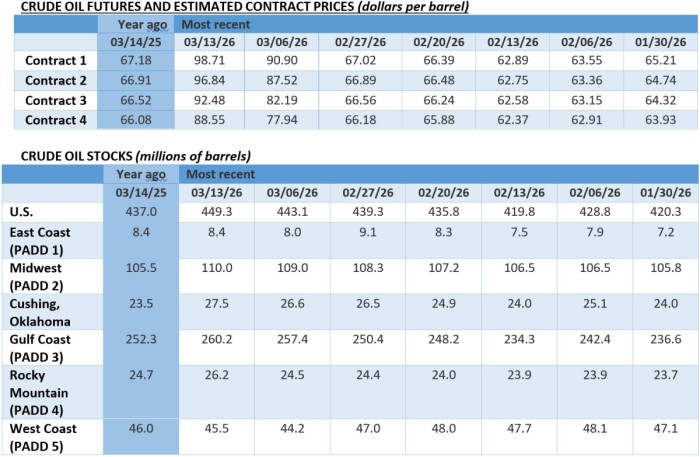
WTI Pretends There’s No Oil Crisis. The discount of US crude benchmark WTI to Europe’s Brent has widened sharply this week, with the front-month spread plunging to a 12-year low of $13.55 per barrel, as the US market’s lower exposure to Gulf disruptions and the upcoming SPR release cap WTI’s upside.
Shippers Warn of Impending Fuel Shortages. Global shipping companies warn of emerging shortages of bunkering fuel in Asia and West Africa, with Singapore rationing fuel and Fujairah struggling to operate 24/7, sending fuel oil prices across the region above $1,000 per metric tonne, the highest since 2022.
By Tom Kool for Oilprice.com
More Top Reads From Oilprice.com
