

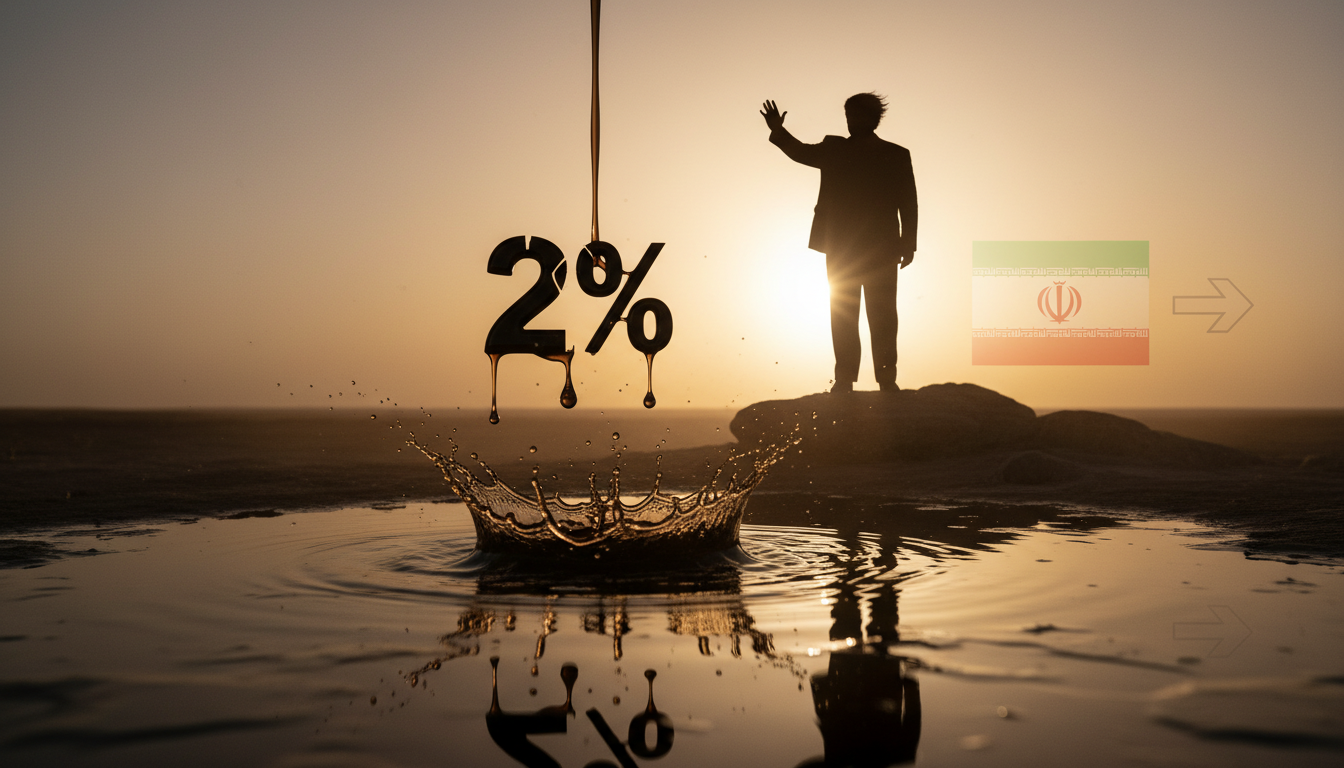
Crude Prices Fluctuate Amidst Mixed Signals from Middle East Tensions
Global oil benchmarks experienced a notable dip on Wednesday morning, with investors reacting to ambiguous signals regarding de-escalation in the volatile Middle East. Both Brent and WTI crude contracts shed value as market participants attempted to decipher the true trajectory of geopolitical tensions, particularly concerning Iran and its allies.
Market Snapshot: Price Correction on De-escalation Hopes
The immediate catalyst for the price correction appeared to be remarks from U.S. President Donald Trump, who hinted at a potential withdrawal of American military operations from Iran in the near term. This prospect of reduced direct confrontation temporarily eased the geopolitical risk premium embedded in crude valuations. Brent crude for May delivery saw a 1.9% decline, settling at $102.01 per barrel by 11:41 am ET. Simultaneously, the corresponding West Texas Intermediate (WTI) contract for front-month delivery registered a 1.27% drop, trading at $100.01 per barrel.
President Trump’s statement, “I can’t tell you exactly … we’re going to be out pretty quickly,” suggested an expedited departure, contingent on Iran’s inability to develop nuclear capabilities. He further elaborated, “They won’t have a nuclear weapon because they are incapable of that now, and then I’ll leave, and I’ll take everybody with me, and if we have to we’ll come back to do spot hits.” These comments, coupled with a threat to potentially withdraw from NATO over perceived insufficient support in Middle Eastern operations, injected a new layer of uncertainty into an already complex geopolitical landscape, yet provided a brief window of optimism for oil markets anticipating a reduction in military footprint.
Persistent Geopolitical Undercurrents and Unresolved Standoffs
Despite the fleeting hopes of a quick de-escalation, the broader regional instability remains firmly entrenched. Oil prices continue to trade more than 40% above their late February levels, when the current wave of conflict initially erupted, underscoring the market’s assessment of sustained risk. The prospect of a swift return to pre-crisis stability appears dim, as multiple flashpoints continue to simmer.
Iran, for its part, maintained a defiant posture. On Tuesday, Tehran declared its readiness to either pursue a diplomatic resolution or intensify attacks on U.S. assets and those of its allies. However, the declaration lacked specific details on how such actions would manifest, especially given the significant and conflicting demands from both sides. This ambiguity leaves investors guessing about the potential scope and nature of any future Iranian responses. Attempts at mediation have also stalled; two sources in Pakistan indicated that Islamabad’s proposal for a temporary ceasefire had not elicited a response from either Washington or Tehran, highlighting the entrenched nature of the current impasse.
Escalating Threats from Iran’s Allies and Regional Proxies
The threat landscape extends beyond direct U.S.-Iran interactions, with significant implications for global business and maritime trade. Iran’s Islamic Revolutionary Guard Corps (IRGC) has issued direct warnings, identifying 18 prominent American technology and industrial companies operating in the Middle East as “legitimate targets.” This list includes industry giants such as Microsoft, Google, Intel, Tesla, IBM, Apple, and Boeing. The IRGC accuses these firms of being “spy companies” allegedly involved in designing and tracking targets for U.S. and Israeli military operations. Such pronouncements introduce a new dimension of cyber and economic warfare, potentially disrupting critical infrastructure and investor confidence across the region.
Further exacerbating regional instability, Yemen’s Houthi rebels have significantly escalated their offensive capabilities. The group launched a series of coordinated missile and drone strikes targeting southern Israel. Crucially, the Houthis have warned of further escalation, including the potential closure of the strategically vital Bab al-Mandeb strait to any ships linked to Israel. Such a naval blockade would have profound economic repercussions, potentially impacting an estimated 30% of Israel’s imports by rerouting shipping lanes and increasing costs. This coordinated offensive marks a significant uptick in hostilities from the Houthis, who had largely remained on the sidelines for approximately a month following the broader U.S.-Israeli conflict with Iran that commenced in February 2026. Their re-engagement signals a widening scope of the conflict, posing direct threats to global maritime security and trade routes.
Investor Outlook: Navigating Persistent Volatility in Energy Markets
For energy investors, the current environment necessitates a cautious yet agile approach. While a fleeting moment of de-escalation might temporarily depress crude prices, the underlying fundamentals of geopolitical risk in the Middle East remain largely unchanged. The robust premium on oil prices since late February underscores the market’s deep-seated concern over supply disruptions. Iran’s defiant rhetoric, the explicit threats from the IRGC against major corporations, and the Houthi rebels’ capacity to disrupt crucial shipping lanes collectively paint a picture of ongoing volatility rather than impending calm.
Investors should continue to monitor developments closely, recognizing that any true and sustained de-escalation would require clear, verifiable steps towards resolution, rather than rhetorical pronouncements. Until such definitive progress emerges, the global oil market is likely to remain highly sensitive to every shift in the geopolitical narrative, maintaining an elevated risk premium that will drive price fluctuations in the near to medium term. The confluence of military posturing, economic threats, and proxy conflicts ensures that the Middle East will remain a critical determinant of crude oil’s trajectory on global exchanges.
