

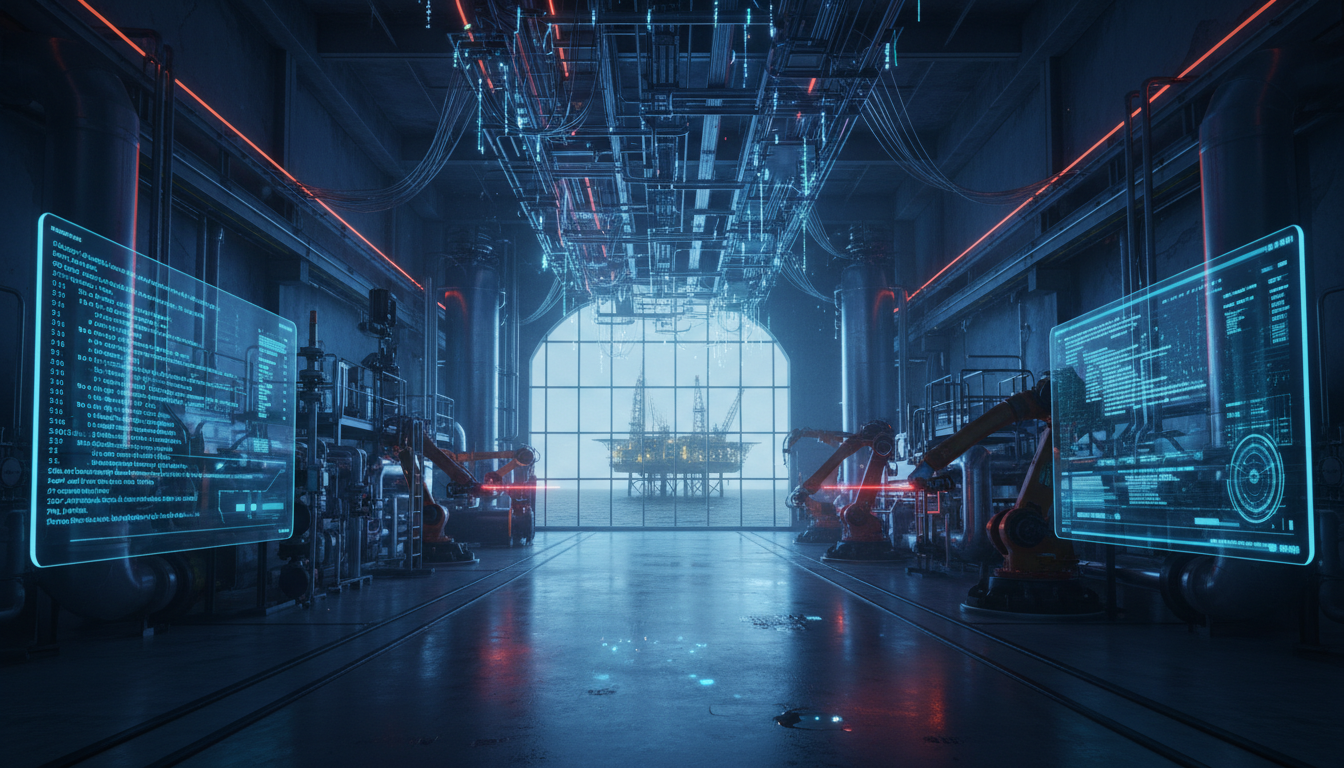
The energy sector stands at the precipice of a profound transformation, driven not by geopolitics or commodity cycles alone, but by the accelerating integration of artificial intelligence. As sophisticated algorithms begin to perform tasks once considered exclusively human domains, the oil and gas industry confronts a concept gaining traction in advanced manufacturing: the “dark factory.” This notion, where operations are so automated that human presence is rendered unnecessary, allowing lights to be extinguished, is rapidly transitioning from a theoretical discussion to an imminent reality for hydrocarbon exploration, production, and refining.
AI’s Ascendancy in Hydrocarbon Operations
For years, AI in oil and gas has predominantly served as an augmented intelligence tool. Geologists leveraged machine learning to interpret vast seismic datasets, engineers utilized predictive analytics for equipment maintenance schedules, and traders employed algorithms to identify market inefficiencies. The workflow typically involved human experts defining objectives, overseeing AI processes, and critically, validating the output – be it an optimal drilling path or a refined financial model. This human-in-the-loop approach has been the industry standard, ensuring accuracy and mitigating risk in high-stakes environments.
However, the rapid evolution of AI capabilities is challenging this paradigm. We are witnessing a fundamental shift, where the AI is not just assisting, but beginning to orchestrate entire sequences with minimal human intervention. Imagine autonomous drilling rigs making real-time adjustments based on downhole conditions, or smart refineries dynamically optimizing throughput and energy consumption without manual overrides. The critical question for investors is no longer “if” AI will automate, but “when” and “how comprehensively” it will assume full operational oversight, pushing the industry closer to lights-out operations.
Navigating Workforce Evolution and Investor Value
The implications for the energy workforce are significant, echoing trends observed across other industries where major players like Klarna, IBM, Block, and Oracle have attributed recent workforce adjustments to AI integration. Within oil and gas, roles traditionally requiring extensive human expertise – from geological interpretation to complex reservoir modeling and even aspects of financial analysis – are increasingly being augmented, or even replaced, by advanced AI. Industry insiders who, just half a year ago, might have considered widespread automation in core engineering tasks as futuristic, now acknowledge that a substantial majority of their analytical outputs are generated by AI, not manual input.
For investors, this shift presents a dual perspective. On one hand, it signals potential labor cost reductions and enhanced operational efficiencies. AI-driven systems can operate 24/7 without fatigue, process exponentially more data than humans, and execute complex operations with unparalleled precision. This translates directly into improved profitability, reduced operational expenditure (OPEX), and optimized capital expenditure (CAPEX) for upstream, midstream, and downstream segments. Companies aggressively pursuing digital transformation and AI integration are positioning themselves for superior competitive advantage and stronger returns on capital.
The “Dark Factory” Vision for Energy Assets
The concept of the “dark factory” finds potent analogues across the oil and gas value chain. Consider the prospect of autonomous offshore platforms or remote well sites, monitored and managed almost entirely by AI, requiring only periodic, specialized human intervention. In refining, a truly “dark” facility could see AI-driven systems continuously adjust parameters, predict maintenance needs, and optimize product yields, all without a constant human presence on the plant floor. Pipeline networks could be managed by AI for flow optimization, leak detection, and security protocols, far exceeding human capacity for real-time monitoring and response across vast distances.
This vision is not merely about cost reduction; it’s about unlocking new levels of safety, environmental performance, and operational resilience. AI can identify anomalies and predict failures with far greater accuracy than traditional methods, preventing costly downtime, environmental incidents, and ensuring continuous production. For investors, identifying companies at the forefront of this technological adoption, those investing in the infrastructure, data pipelines, and algorithms necessary to realize this automated future, is paramount. These are the companies likely to achieve superior operational leverage and sustain profitability through future commodity price volatilities.
Strategic Imperatives for Oil and Gas Investors
While AI undoubtedly streamlines execution, the foundational driver remains human ingenuity. The ability to conceive truly novel exploration strategies, develop breakthrough production techniques, or design innovative energy transition solutions remains critical. Investors should scrutinize management teams not just for their technological adoption rates, but for their strategic vision in leveraging AI to generate new opportunities and drive differentiation. Companies that merely implement AI for incremental efficiency gains risk being outmaneuvered by those using it to fundamentally redefine their business models or uncover untapped value.
The pace of AI’s advancement means that what was considered an aspirational technology a mere six months ago is now becoming mainstream. The oil and gas sector, historically cautious, is embracing this revolution at an unprecedented rate. For investors on OilMarketCap.com, understanding this shift is crucial. The future success of energy portfolios will increasingly hinge on identifying companies that are not only technologically adept but also strategically astute in harnessing AI to unlock superior operational performance, create new value, and navigate the evolving energy landscape. The lights are dimming on traditional operations, signaling a brighter, more efficient future for those who adapt.
