

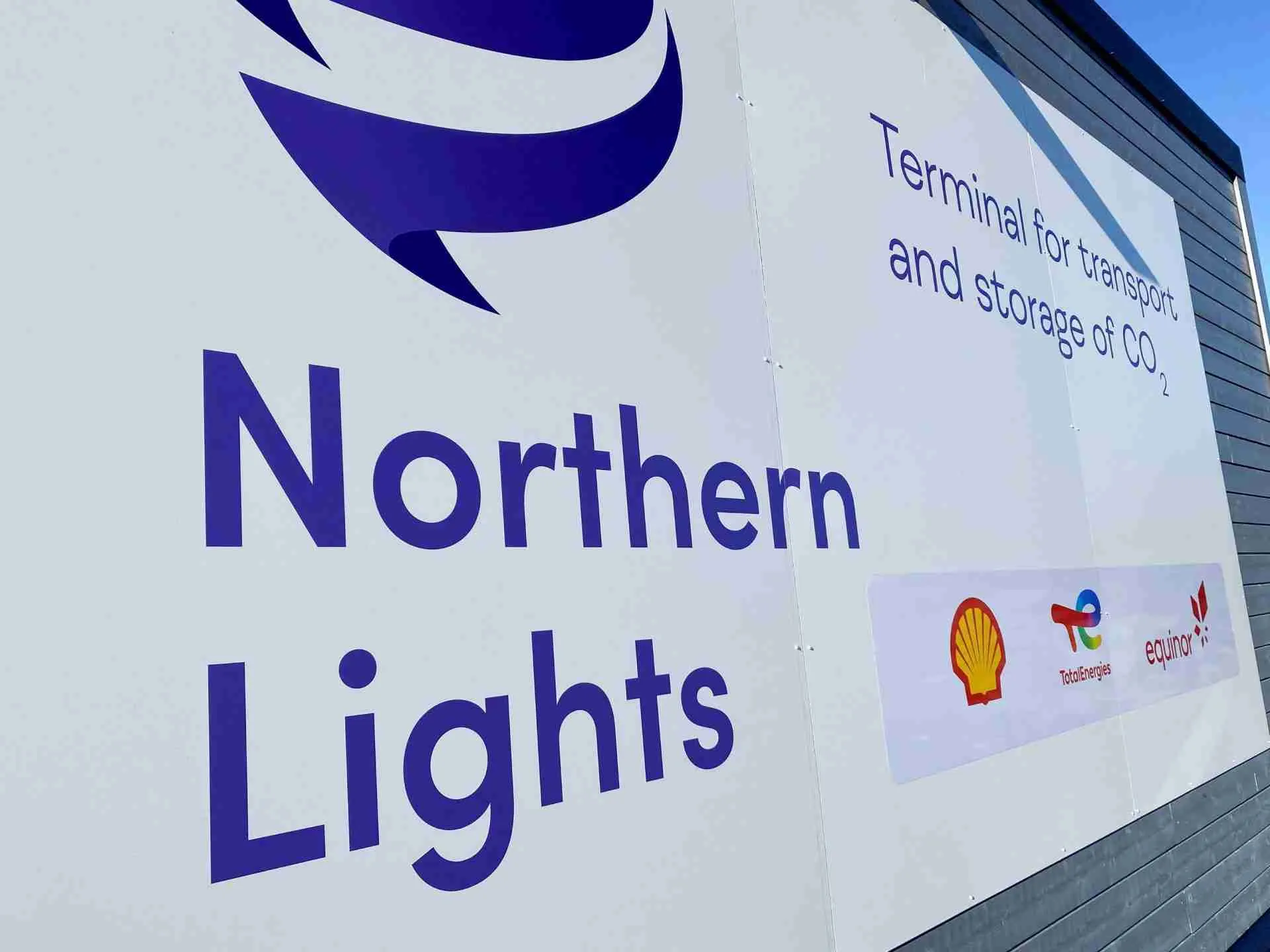
Northern Lights will scale carbon transport and storage capacity from 1.5 million to over 5 million tonnes of CO2 per year by 2028 following a March 2025 Final Investment Decision.
A 15-year cross-border agreement with Stockholm Exergi covers 900,000 tonnes of biogenic CO2 annually, reinforcing Europe’s emerging carbon removal market.
Backed by TotalEnergies, Equinor and Shell, the project anchors Norway’s role as a regional CO2 storage hub under Europe’s industrial decarbonization strategy.
Norway Positions Itself As Europe’s CO2 Storage Hub
Northern Lights, owned equally by TotalEnergies, Equinor and Shell, is the world’s first CO2 transport and storage project open to third party industry. Operational since 2024, its first phase is designed to handle up to 1.5 million tonnes of CO2 annually. A second phase, approved in March 2025, will lift that capacity to more than 5 million tonnes per year from 2028.
The expansion follows the partners’ Final Investment Decision and reflects growing commercial demand for cross-border carbon storage solutions as EU climate targets tighten.
From Pilot To Platform
The first phase of Northern Lights established the core infrastructure. A purpose built onshore terminal receives liquefied CO2 shipped from industrial emitters. From there, a 100 kilometer subsea pipeline transports the CO2 to an offshore storage site, where it is injected via subsea facilities into a geological reservoir 2,600 meters beneath the seabed.
With a capacity of 1.5 million tonnes per year, the reception and storage facility was completed in 2024. Operations will begin in summer 2025, when the first CO2 shipment arrives from Heidelberg Materials’ cement plant in Brevik, Norway. The captured emissions will be permanently stored off the coast of western Norway.
The project is explicitly designed as shared infrastructure. Its backers describe carbon transport and storage as “one of the essential levers for reducing emissions” and “a realistic decarbonization solution for European industry.”
For heavy emitters such as cement, chemicals and waste-to-energy operators, geological storage is one of the few viable pathways to address residual emissions that cannot be eliminated through electrification or efficiency gains.
Phase Two And The Commercialization Of Carbon Storage
The second phase significantly expands capacity while leveraging existing onshore and offshore assets. Additional storage tanks, pumps, a jetty, injection wells and new transport vessels will increase throughput to more than 5 million tonnes annually from 2028.
Crucially, the investment is underpinned by long term offtake agreements. In parallel with the FID, Northern Lights signed a 15-year commercial contract with Stockholm Exergi, Sweden’s largest district heating provider. The agreement covers cross-border transport and storage of 900,000 tonnes of biogenic CO2 per year starting in 2028.
Stockholm Exergi becomes the fifth industrial customer to commit volumes to Northern Lights. Previous agreements include Heidelberg Materials and Celsio in Norway, Yara in the Netherlands and Ørsted in Denmark. The partners are also in advanced discussions with additional European customers to commercialize the remaining capacity.
The inclusion of biogenic CO2 signals another shift. As voluntary and compliance carbon removal markets mature, infrastructure capable of handling negative emissions is likely to attract growing interest from corporates with net zero commitments that extend beyond operational reductions.
RELATED ARTICLE: Shell, TotalEnergies, Equinor Approve $700M Investment to Expand Northern Lights Carbon Storage Project
Governance And Policy Tailwinds
Northern Lights sits at the intersection of national industrial policy and EU climate governance. Norway has positioned itself as a storage hub for European CO2 under a regulatory framework aligned with EU climate objectives. The project supports broader EU ambitions to develop cross border carbon capture and storage networks under the Net Zero Industry Act and industrial decarbonization strategies.
For policymakers, the project demonstrates how state support, geological assets and private capital can converge to create scalable decarbonization infrastructure. For energy majors, it offers a pathway to repurpose subsurface expertise toward low-carbon services.
The companies involved emphasize their “core competencies in large scale project management, gas processing and geosciences” as foundational to developing industrial CO2 storage projects, both to reduce residual emissions and to support customers’ decarbonization pathways.
What Executives And Investors Should Watch
For C-suite leaders, Northern Lights is more than a single project. It is a template for a European carbon logistics market, where capture, transport and storage operate as integrated services.
Long-term contracts are beginning to de-risk revenue streams. Cross-border shipments are normalizing under evolving EU regulations. And industrial emitters are locking in capacity ahead of stricter carbon pricing regimes.
As capacity rises toward 5 million tonnes annually, Northern Lights strengthens Norway’s strategic role in Europe’s climate transition. It also raises the bar for infrastructure scale required to meet 2030 and 2050 targets.
The question for Europe’s heavy industry is no longer whether geological storage will be part of the decarbonization toolkit. It is how quickly capacity can expand to meet demand as carbon constraints tighten across the region.
Follow ESG News on LinkedIn
