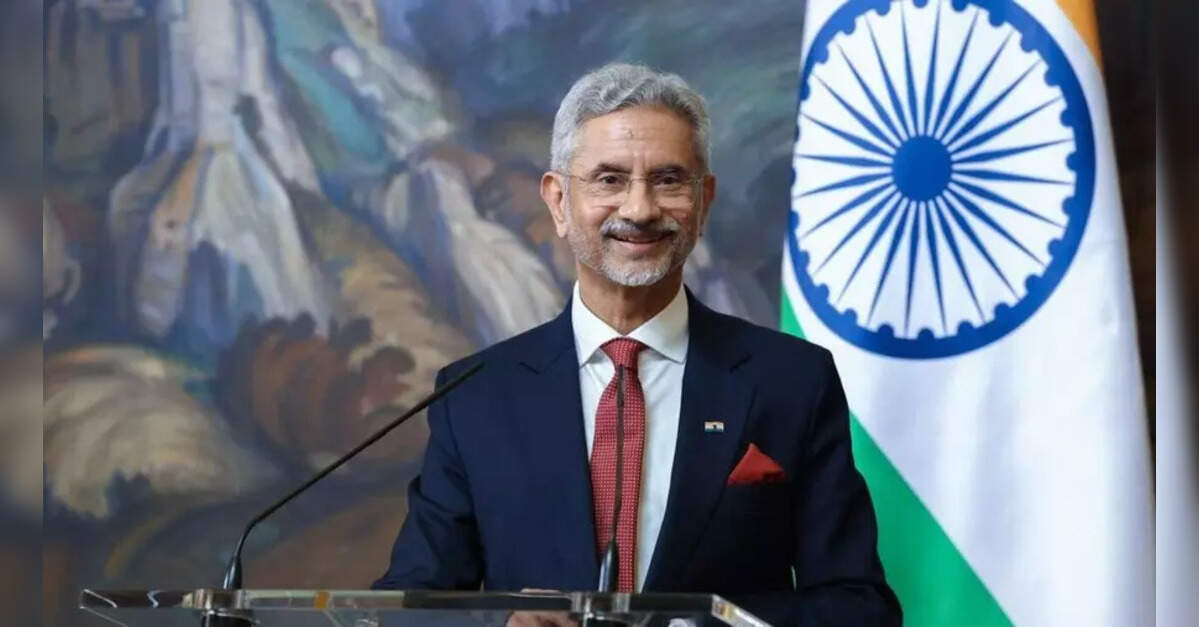
India’s External Affairs Minister (EAM) S Jaishankar said that there is no “blanket arrangement” with Iran for Indian-flagged ships passing through the strategically crucial Strait of Hormuz, even as New Delhi continues diplomatic engagement with Tehran to ensure safe maritime movement.
In an interview with the Financial Times published on Sunday, Jaishankar said that while India has been in talks with Iran, the passage of Indian vessels through the strait is not based on any formal or standing agreement.
“There was no blanket arrangement and Iran had not received anything in exchange,” he said, stressing that India’s approach has focused on direct diplomatic communication.
Jaishankar added that dialogue with Tehran has already produced some results, citing the recent movement of two Indian-flagged liquefied petroleum gas carriers through the strait.
According to Reuters, the vessels — Shivalik LPG Carrier and Nanda Devi LPG Carrier — carrying around 92,712 metric tonnes of LPG, crossed the Strait of Hormuz on Saturday while heading to India.
The minister said that the safe transit of these vessels demonstrated the value of diplomatic engagement.
“Certainly, from India’s perspective, it is better that we reason and we coordinate and we get a solution than we don’t,” Jaishankar added.
The remarks come amid heightened tensions in West Asia following military strikes involving the United States and Israel against Iranian targets.
On Saturday, US President Donald Trump called on major global economies to deploy naval forces to safeguard shipping routes through the Strait of Hormuz.
In a post on his social media platform Truth Social, Trump urged countries including China, France, Japan, South Korea and the United Kingdom to send warships to help secure the narrow maritime corridor.
Why is it important?
The Strait of Hormuz is one of the world’s most critical energy chokepoints, with roughly one-fifth of global oil shipments passing through the route.Jaishankar said that while India’s discussions with Tehran have helped facilitate the movement of its vessels, the arrangement cannot necessarily be replicated by other countries. “Each relationship with Iran stands on its own merits,” he said, adding that comparisons between India’s engagement and that of other nations may not be straightforward.
However, he indicated that New Delhi remains open to sharing its diplomatic approach with European governments if requested.
Jaishankar also noted that several European capitals have been holding their own discussions with Tehran as part of broader efforts to prevent disruptions in maritime trade.
Despite the recent transit of Indian vessels, the minister cautioned that the situation remains fluid and requires continued diplomatic engagement. “While this is a welcome development, there is continuing conversation because there is continued work on that,” he said.
India is among the countries closely monitoring developments in the region, given its heavy reliance on energy imports that pass through the Strait of Hormuz. Any prolonged disruption could have implications for global oil supply chains as well as India’s energy security.