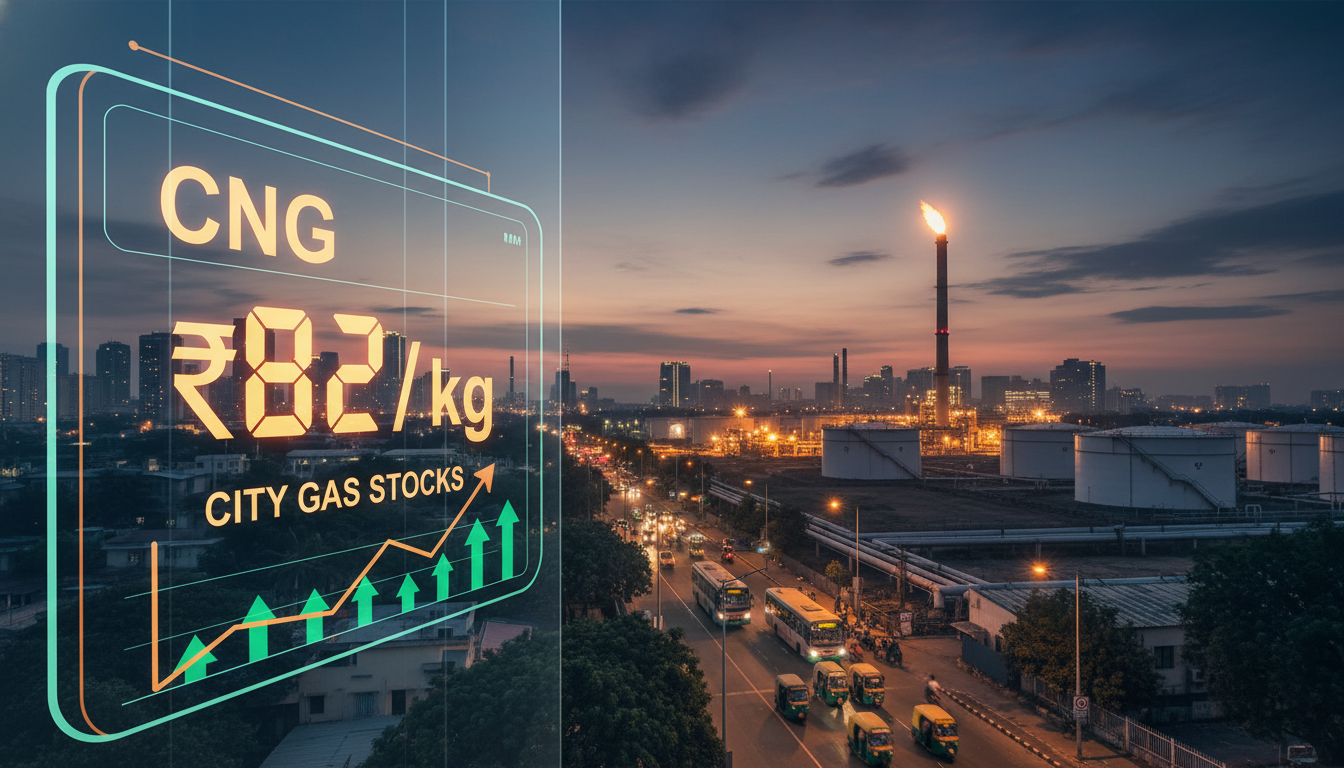
The recent upward revision in Compressed Natural Gas (CNG) prices across the Mumbai Metropolitan Region (MMR) has brought India’s city gas distribution (CGD) companies sharply into focus for energy investors. Effective this past Sunday, Mahanagar Gas Limited (MGL), a dominant player in the urban gas supply chain, implemented a ₹1 per kilogram increase, elevating the retail price to ₹82 per kg. This adjustment, while seemingly modest, is a critical indicator of the complex interplay between global energy market dynamics and local operational realities, warranting a closer look at the investment landscape for these essential infrastructure providers.
MGL’s Cost Pressures Amidst Global Volatility
MGL’s decision to increase CNG prices stems from a confluence of factors, primarily centered on escalating procurement costs. Geopolitical instabilities continue to ripple through global supply chains, directly impacting the availability and pricing of natural gas. Domestically, MGL faces reduced gas allocation, compelling it to source higher-cost alternative supplies. Furthermore, the persistent strength of international crude oil prices and an unfavorable Indian Rupee to US Dollar exchange rate have added significant pressure on input expenses, alongside revised trade margins.
To put MGL’s challenges into perspective, consider the broader energy market. As of today, Brent Crude trades at $95.57, marking a significant +5.74% increase within the day’s range of $92.77 to $97.81. This surge comes after a period of considerable volatility, with Brent having trended from $112.78 on March 30th down to $90.38 by April 17th – a $22.4 or nearly 20% swing in just over two weeks. Such sharp movements in global crude prices directly influence MGL’s input costs and, critically, the relative attractiveness of CNG compared to liquid fuels like petrol and diesel. Despite the hike, MGL maintains that CNG still offers substantial savings, approximately 46% against petrol and around 9% against diesel in Mumbai, underscoring its enduring economic viability for commuters and commercial fleets.
Investor Focus: Crude Prices and Upcoming Catalysts
Our proprietary reader intent data reveals a clear preoccupation among investors: the direction of crude oil prices. Questions like “is WTI going up or down” and “what do you predict the price of oil per barrel will be by end of 2026?” highlight the direct link investors draw between global benchmarks and the performance of energy-related equities, including city gas distributors. The volatility observed in WTI Crude, currently trading at $87.45 (+5.88% today within a range of $85.45-$89.60), directly feeds into the operational economics of companies like MGL.
For investors tracking CGD stocks, the coming weeks present several crucial forward-looking catalysts. The OPEC+ Joint Ministerial Monitoring Committee (JMMC) Meeting scheduled for April 20th, followed by the full OPEC+ Ministerial Meeting on April 25th, will be paramount. Any decisions regarding production quotas will directly impact global crude supply and, consequently, price trajectories. A tighter supply environment could push crude higher, potentially widening the cost advantage of CNG and boosting demand for MGL’s products. Conversely, an increase in production could put downward pressure on prices, narrowing that margin. Furthermore, weekly releases such as the API Crude Inventory on April 21st and the EIA Weekly Petroleum Status Report on April 22nd will offer short-term insights into supply-demand balances, influencing market sentiment and providing further signals for crude price movements. These events are not just about crude; they are about the competitive landscape for natural gas distributors.
Piped Natural Gas Stability and Sector Growth Trajectories
While CNG prices have adjusted upwards, an important counterpoint for investors is the stability of domestic Piped Natural Gas (PNG) prices. This segment, serving residential households and smaller commercial establishments, has remained untouched by the recent increase. This offers a degree of relief for a significant consumer base and provides a stable, predictable revenue stream for distributors like MGL. The ability to manage price adjustments across different segments (CNG for transport vs. PNG for residential) demonstrates strategic flexibility in navigating varying cost pressures and consumer sensitivities.
The broader growth trajectory for India’s CGD sector remains robust. Natural gas is increasingly recognized as a cleaner transitional fuel, aligning with India’s environmental goals. This fundamental demand driver, coupled with ongoing infrastructure expansion into new geographic areas, promises sustained volume growth for companies in this space. While global energy price volatility and exchange rate fluctuations will remain perpetual challenges, the underlying structural demand for a more affordable and environmentally friendly fuel, along with the stable base provided by PNG, offers a compelling long-term investment thesis for resilient and strategically managed CGD entities.
Navigating Investment Risks and Valuation Considerations
Despite the inherent growth potential, investors must remain cognizant of the risks. Beyond the aforementioned crude oil price volatility and currency fluctuations, regulatory intervention, particularly concerning potential fare hikes for public transport, could impact demand elasticity for CNG. Competition from alternative fuels, including the nascent but growing electric vehicle (EV) segment, presents a long-term consideration, although the infrastructure and cost hurdles for widespread EV adoption remain significant in India. For evaluating CGD stocks, metrics such as Price-to-Earnings (P/E) ratios, Enterprise Value to EBITDA (EV/EBITDA), and dividend yields should be assessed against their growth prospects and capacity expansion plans. The ability of companies like MGL to consistently grow volumes and effectively pass on cost increases, while maintaining a competitive edge, will be crucial for sustained investor returns. The Mumbai CNG price hike, therefore, is not just a local news item but a microcosm of the global energy investment challenge: balancing cost realities with market competitiveness and strategic growth.


