

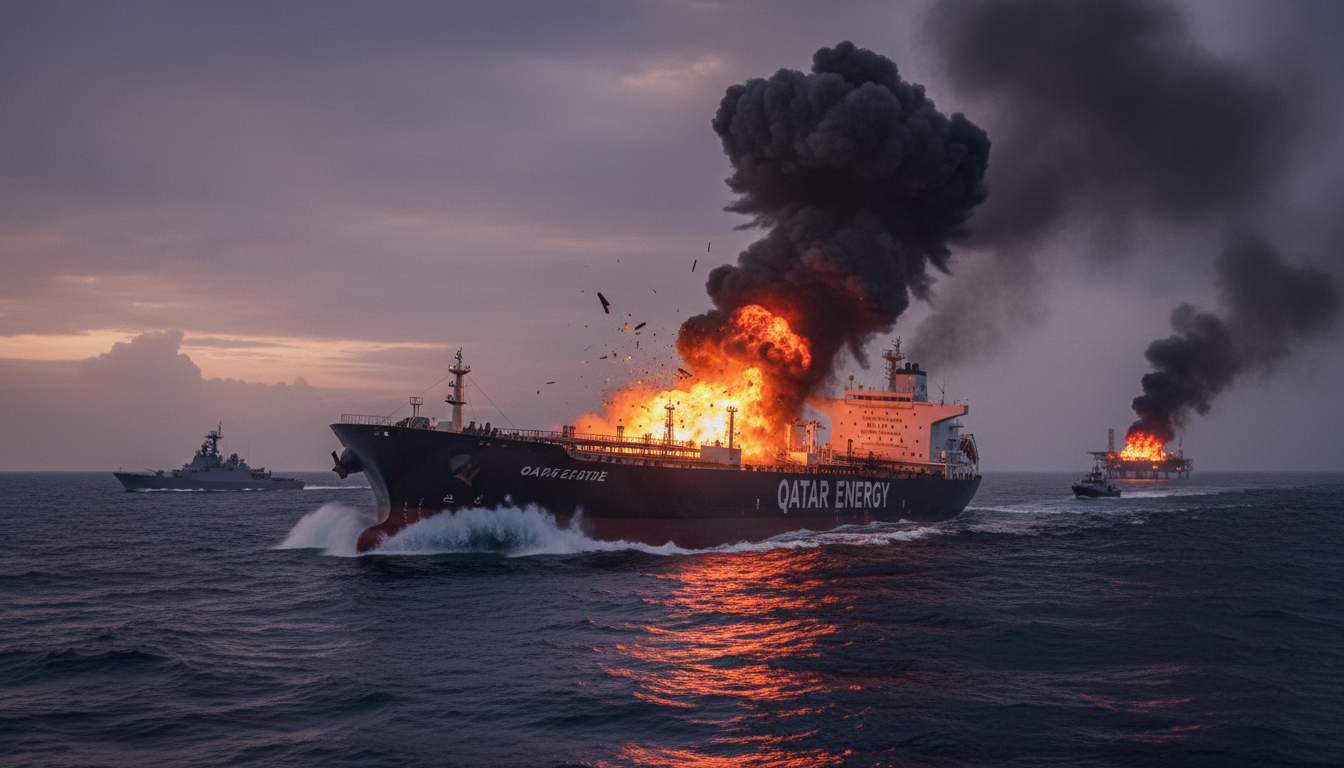
Escalating Regional Tensions Imperil Global Energy Supply: QatarEnergy Tanker Struck, Major LNG and GTL Facilities Face Years of Disruption
Global energy markets are grappling with heightened geopolitical risk following a direct missile strike on a fuel oil tanker chartered by QatarEnergy. The incident, occurring in the early morning hours, underscores a concerning trend of escalating aggression targeting critical energy infrastructure in the region, prompting significant long-term implications for liquefied natural gas (LNG) and gas-to-liquids (GTL) supplies worldwide.
The Aqua 1 fuel oil tanker, operating under charter to Qatar’s state-owned energy giant, was hit by a cruise missile within Qatari territorial waters. Fortunately, all 21 crew members on board emerged unharmed, and QatarEnergy confirmed no adverse environmental impact resulted from the attack. This swift confirmation offers some relief amidst an otherwise alarming situation.
Qatar’s Defense Ministry quickly attributed the strike to Iran, reporting that three cruise missiles were launched towards Qatar on Wednesday. While two were successfully intercepted by Qatari defenses, the third missile found its mark on the Aqua 1. This precision attack on a commercial vessel highlights a dangerous escalation that directly threatens the free flow of energy commodities through vital shipping lanes, a critical concern for oil and gas investors monitoring supply chain vulnerabilities.
This latest event is not an isolated incident but rather fits into a disturbing pattern of missile attacks that QatarEnergy has endured. Since the onset of the ongoing conflict between Iran and the United States-Israel alliance, Qatar’s energy facilities have become increasingly vulnerable. This sustained pressure has forced QatarEnergy to invoke force majeure on its LNG production since early last month, signaling severe disruptions to its contractual obligations and the broader global market.
The long-term repercussions of these hostilities are particularly stark for Qatar’s massive energy complex at Ras Laffan Industrial City. Damage sustained there, resulting from previous missile attacks, is projected to cost QatarEnergy approximately $20 billion annually in lost revenue. Furthermore, the necessary repairs to this vital infrastructure could extend for up to five years, signaling an enduring challenge to global energy security and investor confidence.
Specifically, the attacks have crippled two crucial LNG production trains, Train 4 and Train 6. These facilities collectively account for 12.8 million tons per annum (MTPA) of LNG output, representing a substantial 17 percent of Qatar’s total LNG export capacity. Notably, U.S. energy major Exxon Mobil Corp. holds partial ownership in both of these affected trains, indicating a direct impact on international energy companies and their stakeholders.
Saad Sherida Al-Kaabi, QatarEnergy’s President and CEO, who also serves as Qatar’s energy minister, has underscored the gravity of the situation. He unequivocally stated that the damage to these LNG facilities will necessitate a repair timeline spanning between three and five years. This extended period of downtime compels QatarEnergy to declare force majeure on some of its long-term LNG contracts, affecting key importing nations. Primary among these are major Asian economies like China and South Korea, alongside European partners such as Italy and Belgium, all of whom face significant supply uncertainty and potential energy price volatility.
Beyond LNG, the attacks have also severely impacted the Pearl gas-to-liquids (GTL) facility, a strategically important co-project with Britain’s Shell PLC. The Pearl GTL plant is instrumental in producing high-value base oils, which are critical components for manufacturing premium engine oils and lubricants. Damage to one of its two trains has effectively halted this specialized production, with assessments indicating this specific train will remain offline for a minimum of one year. This disruption sends ripples through the global lubricants market, potentially affecting various industrial sectors.
The total projected production losses extend across a broad spectrum of commodities, painting a comprehensive picture of the operational setbacks. QatarEnergy anticipates a shortfall of 18.6 million barrels of condensates, a critical feedstock for refineries. Additionally, the company faces losses of 1.28 million tons (MT) of liquefied petroleum gas (LPG), 0.59 MT of naphtha, and 0.18 MT of sulfur. Even the niche market for helium production is not immune, with projected losses reaching 309.54 million cubic feet (MCFA). These figures collectively highlight the profound and multifaceted impact on Qatar’s energy output, influencing various commodity markets globally.
For investors navigating the complexities of the global energy landscape, these developments present a stark reminder of the intrinsic link between geopolitical stability and energy market performance. The prolonged repair timelines and significant production shortfalls from a key global supplier like Qatar introduce considerable uncertainty into pricing mechanisms and supply security, particularly for natural gas and refined products. Monitoring these regional tensions and QatarEnergy’s recovery efforts will be paramount for anyone invested in the future of oil and gas.
