

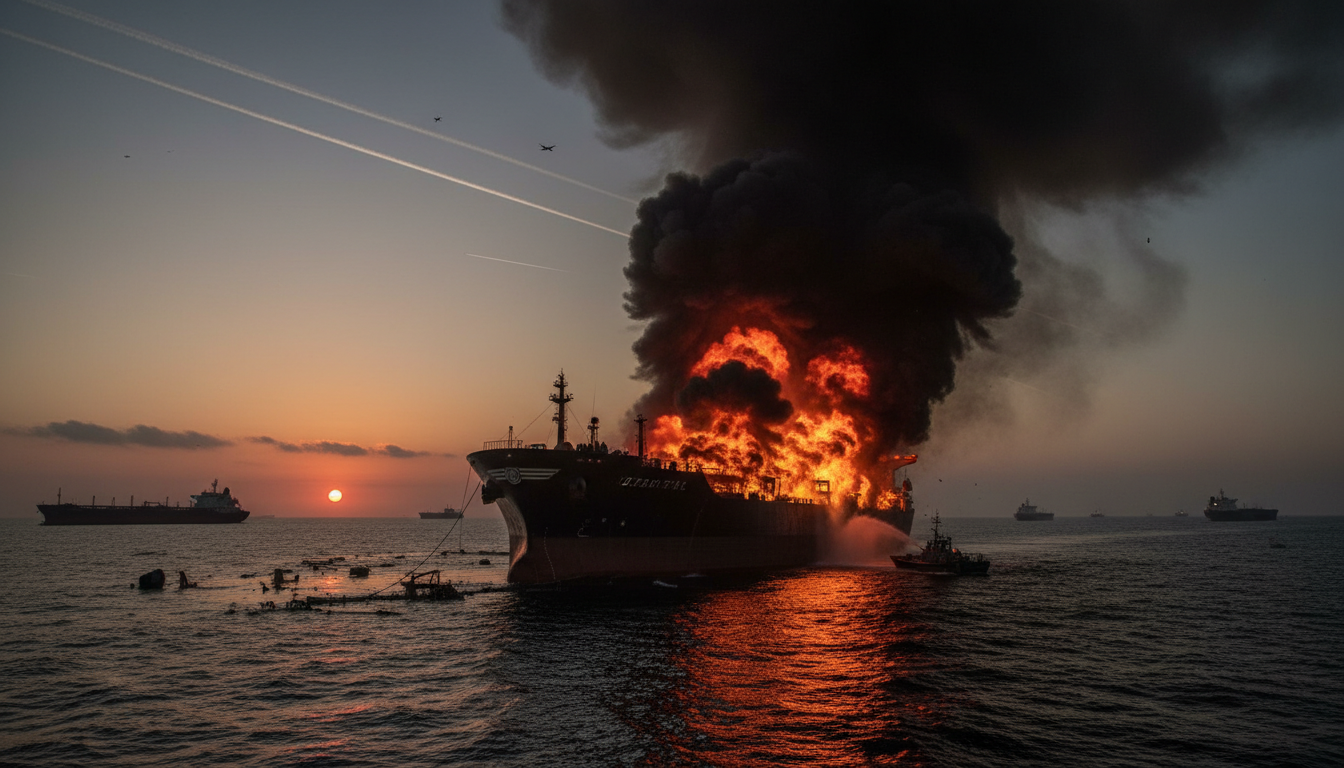
Global crude oil markets experienced an immediate surge this week as geopolitical tensions in the Middle East intensified, directly impacting critical shipping routes. Investors watched closely as Brent and WTI benchmarks reacted sharply to news of an attack on a fully-loaded crude oil tanker anchored off Dubai Port. This incident, attributed to Iranian actions by Kuwait’s state news agency, ignites serious concerns regarding energy security and supply chain vulnerabilities in one of the world’s most vital oil transit zones.
Following the attack, U.S. crude futures (CLc1) quickly climbed over $3, registering a 2.9% increase to settle at $105.91 a barrel. This sharp upward movement underscores the market’s sensitivity to disruptions in the Persian Gulf, a region pivotal for global oil flows. The Kuwait-flagged Al-Salmi tanker was reportedly set ablaze, sustaining damage to its hull, with Kuwait Petroleum Corp (KPC) cautioning about the potential for a significant oil spill – an environmental and economic hazard that further compounds investor anxiety.
Escalating Maritime Risks in the Gulf
The strike on the Al-Salmi is not an isolated event but rather the latest in a troubling pattern of assaults targeting merchant vessels navigating the Gulf and the strategic Strait of Hormuz. Since a critical incident involving the U.S. and Israel on February 28, the region has witnessed a series of aggressions, employing missiles and both aerial and sea-based explosive drones. This persistent threat matrix presents a formidable challenge for maritime insurance costs, shipping schedules, and ultimately, the predictable delivery of global energy supplies. For investors in the oil and gas sector, these developments translate directly into increased operational risks and potential upside for crude prices due to constrained supply perceptions.
Dubai authorities swiftly confirmed their response to the drone attack, deploying specialized maritime firefighting teams to contain the blaze. Fortunately, all 24 crew members aboard the tanker were secured, and no injuries were reported. KPC, identified as the parent entity of the vessel’s registered owner and commercial operator by Lloyd’s List Intelligence data, has initiated an comprehensive assessment to quantify the full extent of the damage inflicted upon the Al-Salmi. This evaluation will be crucial in determining the tanker’s operational status and the broader financial implications for its stakeholders.
A Broader Pattern of Regional Aggression
Further compounding the volatile situation, an earlier incident on the same Monday involved a Greek-owned container ship positioned off the coast of Saudi Arabia’s Ras Tanura. Maritime security experts disclosed that this Liberian-flagged vessel, the Express Rome, reported two separate occurrences where unidentified projectiles impacted the water in close proximity to the ship. These splashes occurred approximately 22 nautical miles (40.7 km) northeast of Ras Tanura around 1352 GMT, within an hour of each other, as reported by the British maritime risk-management firm Vanguard.
The Express Rome incident draws a direct historical link to prior regional hostilities. Vanguard noted that the Islamic Revolutionary Guard Corps (IRGC) had previously asserted responsibility for an attack on the very same container ship on March 11. Although no immediate claims of responsibility emerged for either the Al-Salmi tanker strike or the recent projectile incidents near Ras Tanura, the recurrence of such events in strategically sensitive waters underscores an undeniable and persistent security threat. This environment of heightened risk demands meticulous attention from investors evaluating exposure to Middle Eastern energy assets and maritime logistics.
Investor Outlook: Navigating Elevated Geopolitical Risk
The recent surge in crude oil prices, particularly the >$3 spike in U.S. crude futures to $105.91, serves as a stark reminder of how quickly geopolitical events can reprice energy commodities. Investors must recognize that the ongoing instability in the Gulf, marked by repeated attacks on commercial shipping, inherently builds a “geopolitical risk premium” into oil prices. This premium reflects the market’s anticipation of potential supply disruptions, whether from direct attacks, increased insurance costs, or delayed transit times through critical chokepoints like the Strait of Hormuz, through which approximately 20% of the world’s oil transits daily.
For those invested in oil and gas, this volatile landscape presents both risks and opportunities. While the threat of supply chain interruptions can drive up crude prices, it also introduces uncertainty and potential for market corrections if tensions de-escalate or if alternative supply routes gain prominence. Monitoring the diplomatic efforts, military postures, and official statements from all regional actors, alongside the precise assessments of damage and operational impacts on affected vessels, becomes paramount. The incidents of this week firmly underscore that the security of maritime trade in the Gulf remains a critical variable for global energy markets and investor portfolios for the foreseeable future.
