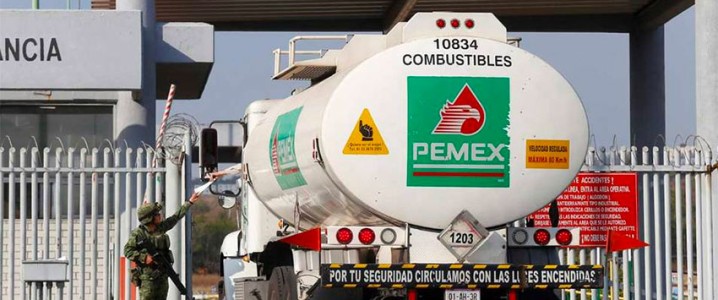
Mexico’s Lifeline for Pemex: A Deep Dive into Sovereign Support and Market Implications
Mexico’s recent announcement to launch a new financial operation aimed at supporting state oil company Pemex has sent ripples through the global energy investment community. This move, employing a novel mechanism described as “Pre-Capitalized Notes,” seeks to inject liquidity into the world’s most indebted energy firm, ostensibly without triggering direct government guarantees. As senior analysts at OilMarketCap, we view this development not merely as a headline, but as a critical juncture for investors evaluating the long-term viability of Mexican energy assets and the broader crude market dynamics. While such interventions offer a temporary reprieve, the underlying structural challenges at Pemex, coupled with shifting global energy landscapes, demand a nuanced assessment of what this means for capital allocation and market stability.
Pemex’s Deepening Financial Quagmire Amidst Shifting Crude Prices
Pemex’s financial woes are well-documented, yet the sheer scale of its struggles continues to challenge any easy fix. The company reported a substantial $2 billion loss in the first quarter of 2025, following a staggering $9.1 billion loss in Q4 2024. These figures underscore a persistent inability to generate sustainable profits, even as crude prices have shown volatility. As of today, Brent crude trades at $94.72 per barrel, down 0.22% within its daily range of $94.42-$94.91, while WTI crude sits at $90.97, down 0.35% within its daily range of $90.52-$91.50. This current pricing environment, while robust compared to historical averages, still falls short of providing a substantial buffer for Pemex’s massive debt burden, which stands at over $105 billion in financial liabilities alongside an additional $20 billion in unpaid supplier bills. Our proprietary data indicates a significant downward trend in Brent over the past two weeks, falling from $108.01 on March 26th to $94.58 on April 15th – a decline of 12.4%. This sharp contraction in crude values only exacerbates the challenge for a company already bleeding capital, making the government’s intervention all the more pressing, yet potentially less impactful on its core profitability.
The “Pre-Capitalized Notes” and Investor Skepticism
The introduction of “Pre-Capitalized Notes” as a means to bolster Pemex’s balance sheet without a formal government guarantee is a finely-tuned political and financial maneuver. For investors, the immediate question centers on the true nature of this financial instrument and its capacity to provide genuine, sustainable stability. Our reader intent data shows a strong focus this week on fundamental Brent price forecasts for the next quarter and the consensus 2026 Brent outlook. This highlights investor demand for clarity on long-term market trends, which directly influences the perceived risk of entities like Pemex. While these notes aim to inject liquidity, the lack of specific details surrounding their structure and repayment mechanism raises questions about the ultimate credit implications for both Pemex and the Mexican sovereign. Past interventions, including a significant cash infusion in 2024 and credit-default swaps issued by major oilfield service providers like SLB, have only offered temporary relief. Without a clear path to structural reform that addresses operational inefficiencies, declining production, and crude quality issues, such financial engineering may only kick the can down the road, leaving investors seeking more concrete assurances of Pemex’s fiscal health.
Operational Challenges: Production Declines and Export Collapses
Beyond the financial acrobatics, Pemex faces severe operational headwinds that directly impact its ability to capitalize on prevailing market prices. Crude production has fallen significantly to 1.58 million barrels per day, well below the government’s ambitious 1.8 million bpd target. This persistent decline means Pemex is simply producing less oil to sell, directly impacting its revenue streams. The situation is further complicated by a dramatic collapse in exports, which plunged an alarming 44% in January, reaching their lowest levels since 1990. Compounding these issues are persistent problems with crude quality, including high water content, which has alienated key international buyers. The company’s attempts to counter this decline – including slashing 3,000 jobs, restructuring leadership, and announcing plans to reopen thousands of idle wells – are capital-intensive initiatives that are difficult to fund given its deeply negative working capital. For investors tracking global supply dynamics, especially those keenly interested in refinery runs and regional demand signals, Pemex’s struggles represent a significant drag on potential Mexican contributions to the global crude market, irrespective of the financial support it receives.
Navigating Upcoming Market Signals and Pemex’s Future Outlook
Looking forward, the effectiveness of Mexico’s latest support for Pemex will unfold against a backdrop of crucial energy market events that could significantly sway crude price trajectories. Investors should closely monitor the upcoming Baker Hughes Rig Count reports on April 17th and April 24th, which offer insights into North American drilling activity and potential supply shifts. Even more critical are the OPEC+ meetings scheduled for April 18th (JMMC) and April 20th (Full Ministerial). Any decisions regarding production quotas from these gatherings will directly impact global crude supply and, consequently, the price Pemex can command for its dwindling exports. Furthermore, the API and EIA Weekly Crude Inventory reports on April 21st, 22nd, 28th, and 29th will provide real-time data on U.S. crude stockpiles, influencing short-term market sentiment. For a company as financially strained as Pemex, even minor shifts in crude prices can have magnified effects on its revenue and ability to service debt. While the “Pre-Capitalized Notes” may provide a lifeline in the near term, the long-term outlook for Pemex, and by extension, for investors in Mexican energy, remains contingent on a credible strategy for operational recovery and sustained profitability, rather than just repeated financial interventions.


