

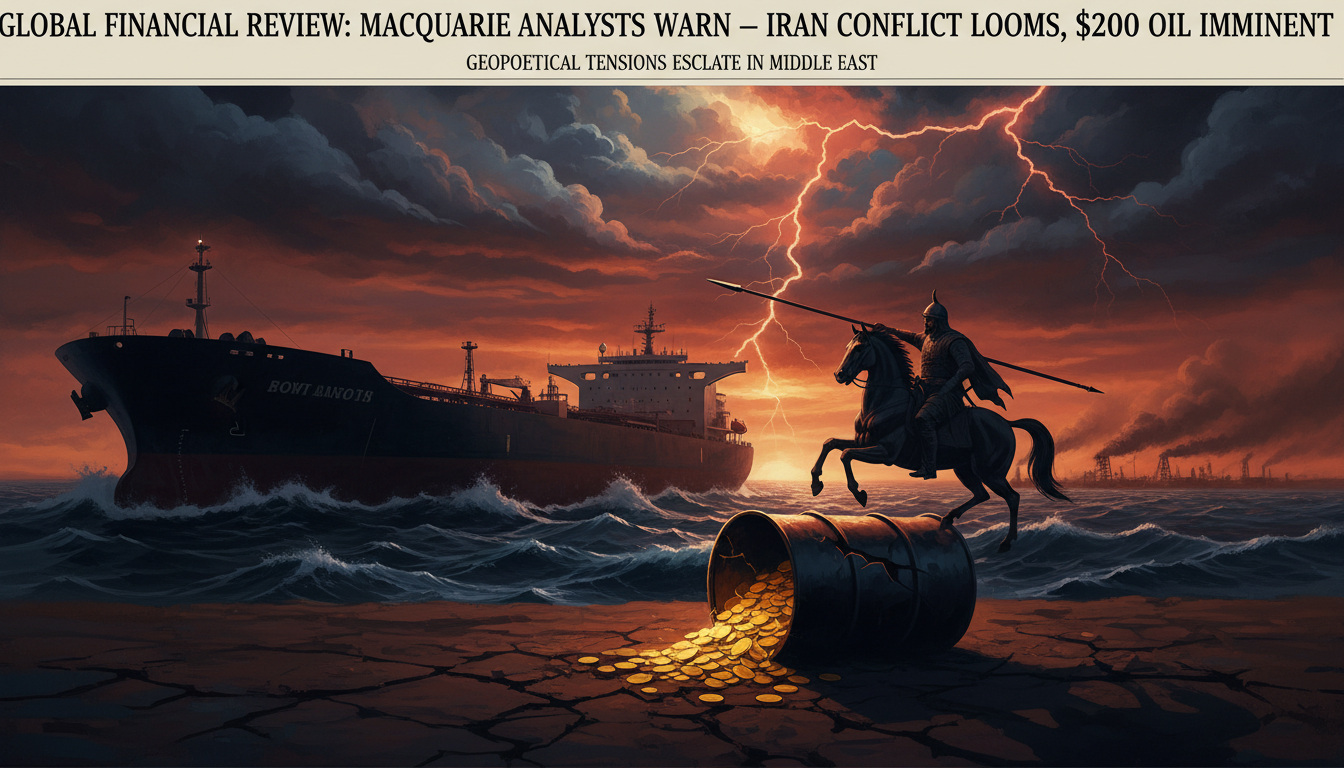
Global crude markets find themselves at a perilous inflection point, with influential financial institutions now warning of an unprecedented surge in oil prices. Macquarie Group, a prominent player in commodity analysis, has issued a stark alert: Brent crude could skyrocket to an astonishing $200 per barrel if the escalating geopolitical tensions involving Iran persist through the middle of the year and crucially, lead to an extended closure of the vital Strait of Hormuz.
This dire forecast, detailed in a recent analytical note dated March 27, posits a significant 40 percent probability for this extreme scenario. Under this bearish projection, a prolonged conflict extending deep into the second quarter would catapult oil into what analysts, including Vikas Dwivedi, describe as “historically high” real price territory. A more favorable resolution, assigned a 60 percent likelihood, anticipates a de-escalation of hostilities before the close of the current month, offering a glimmer of hope amidst the volatility.
Market participants are not waiting idly. Traders have aggressively positioned themselves in the derivatives arena, placing substantial bets on Brent crude reaching an all-time high of at least $150 per barrel by the end of April. This speculative fervor directly reflects deep-seated concerns over the ongoing Middle East conflict’s capacity to severely disrupt supply lines, particularly through the Strait of Hormuz, a critical chokepoint for global energy flows.
The specter of $200 oil emerges as Brent crude appears poised to deliver one of its most robust monthly gains in recent memory. This sharp ascent is directly fueled by the escalating tensions involving the United States, Israel, and Iran, which have profoundly rattled the energy-rich region. At the core of the market’s anxiety is the near-complete interdiction of the Strait of Hormuz by Tehran. This strategic waterway facilitates a substantial portion of the world’s seaborne oil shipments, and its disruption has already led to a sharp curtailment of supply, amplifying fears of a much deeper and more protracted energy crisis.
Despite some nascent signals suggesting Washington and Tehran may be exploring avenues for de-escalation, prices remain precariously balanced. The derivatives market vividly illustrates this apprehension: options betting on oil hitting at least $150 a barrel by the end of April have surged nearly tenfold in recent weeks. Such a move would eclipse Brent crude’s previous nominal record of $147 per barrel, established in 2008 when surging demand profoundly strained global supply capacity.
Data from Intercontinental Exchange underscores the intensity of this market positioning. A significant spike in activity has been observed around April-expiry call options, which grant holders the right to purchase June Brent futures at $150. The open interest in these particular contracts has ballooned to almost ten times the levels recorded just a month prior, undeniably highlighting the aggressive stance traders are adopting in anticipation of a near-term price shock.
Macquarie analysts emphasize the profound implications of an extended closure. They state unequivocally that “if the strait were to stay closed for an extended period, prices would need to move high enough to destroy an historically large amount of global oil demand.” The duration of the strait’s closure and any physical damage inflicted upon critical energy infrastructure will serve as the primary determinants of the long-term impact across the commodity complex.
On a recent Friday, Brent crude was trading near $107 a barrel, having previously spiked to a crisis high of $119.50 earlier in the month. While current levels remain below the 2008 nominal record of $147.50, these latest projections suggest investors must recalibrate their expectations, not merely to $150, but to the tangible possibility of an even more extreme and disruptive price escalation.
Approximately one-fifth of the world’s daily oil supply is currently bottlenecked within the Persian Gulf. This critical obstruction has sent ripples across the entire energy ecosystem, driving the price of physical oil, along with the costs associated with its transportation and insurance, to multi-year or even record highs. Any clear indication of a meaningful resumption of marine traffic through the Strait of Hormuz will undoubtedly prompt an immediate reassessment of market pricing by investors.
Interestingly, ownership of put options expiring in late April is largely concentrated at levels well below current prices, with the most significant open interest observed between $45 and $70 a barrel. While positions at these lower strikes have also increased, their buildup has been considerably slower compared to the aggressive accumulation in upside calls. This dynamic suggests that while investors acknowledge the potential for extreme outcomes in both directions, they perceive a significantly higher probability of further price spikes in the immediate future.
Historically, oil has surpassed the $100 mark for extended periods without derailing global economic expansion. Notably, it surged to $147 in 2008 and subsequently averaged well above $100 between 2011 and 2014. However, a sustained climb to $150 or even $200 a barrel would usher in a fundamentally different economic regime. At pre-crisis levels of roughly $65-70, oil expenditure accounted for approximately 2.5-3 percent of global GDP. Should prices reach $150, that economic burden would nearly double, pushing into the historically dangerous 5-6 percent zone, a level typically associated with severe economic contractions.
The duration of any such price spike is equally, if not more, critical than its absolute peak. A brief, 10-day geopolitical surge can certainly rattle market sentiment without inflicting lasting economic damage. Conversely, an extended period of elevated prices – say, 18 months – would prove far more disruptive, necessitating a wholesale repricing of commercial contracts, governmental budgets, and global supply chains. Furthermore, elevated global crude oil and natural gas prices amid ongoing developments in West Asia are expected to significantly influence the Government of India’s fiscal position for FY2026-27, according to a recent assessment by ICRA. Investors must carefully monitor these complex intertwined factors as the oil market navigates unprecedented uncertainty.
