

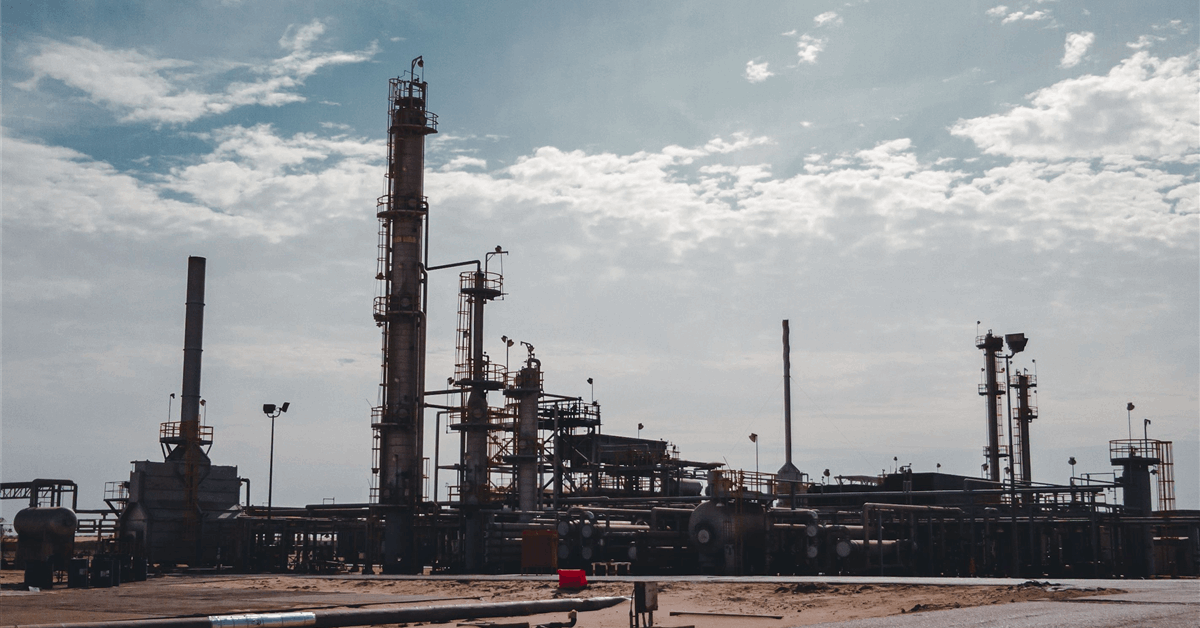
Libya’s National Oil Corp (NOC) said Thursday the Sarir refinery is back to producing gasoline after a three-year hiatus.
Sarir, which went online 1989, has a declared capacity of 10,000 barrels per day (bpd). Besides gasoline, it also produces diesel, kerosene and others, according to the NOC’s Arabian Gulf Oil Co (AGOCO).
“This development will strengthen local supplies and help meet some of the domestic market’s gasoline demands, and enhancing the stability of fuel supply operations and supporting the refinery’s ongoing activity [sic]”, the NOC said in a press release on its website.
“This achievement reflects the exceptional skills and expertise of the refinery’s Libyan staff, showcasing their ability to tackle technical and operational challenges. Their efforts are pivotal for ensuring sustainable production operations and supporting the country’s oil and gas sector”.
The NOC earlier reported February 4 that AGOCO had resumed “full operations” at the Sarir refinery after a “major overhaul” of the crude distillation unit.
“Crude oil pumping to the unit started at 10:53 AM [February 4], and the refinery gradually returned to the production line after successfully passing a series of rigorous technical tests”, the NOC wrote. “The major overhaul was completed on January 21, as planned, and was followed by a comprehensive evaluation phase to ensure that all operational systems were ready.
“During the overhaul, the technical teams encountered unexpected challenges along with harsh weather conditions, including severe sandstorms. These factors led to temporary work stoppages to ensure the safety of personnel and equipment”.
Rigzone sought clarification from the NOC about the reports.
Also last month the NOC said the refinery’s source field has unlocked a new production capacity following the development of a well that was drilled 1982 but had only been used to monitor reservoir pressures.
The L-028HR well has a daily production capacity of 2,200 barrels of crude oil and 350,000 cubic feet of gas, the NOC said in a news release February 4.
AGOCO says on its website the Sarir field produces up to 225,000 bpd, with potential to increase to 300,000 bpd. Oil output not sent to the refinery is transported to the Hariga port in Tobruk via a 513-kilometer (318.76 miles), 34-inch pipeline, according to AGOCO.
Mabruk, another Libyan field whose shutdown in 2015 has been blamed to a “terrorist” attack, restarted flows on February 28 after firing up a new “early production unit”.
“Operating through the Early Production Unit, the field starts with an initial capacity of approximately 25,000-30,000 bpd”, operator Mabruk Oil Operations Co, a joint venture of the NOC and France’s TotalEnergies SE, announced Monday.
The NOC said separately Mabruk Oil Operations is working to increase production at Mabruk and Jurf to a total of around 40,000 bpd by the end of March.
Earlier AGOCO restarted production at the Sinoun field. Sinoun had been shut down for three and a half years due to “financial and technical challenges with shipping through the pipeline to the Mellitah Industrial Complex”, the NOC said February 22, 2026 announcing the restart of production.
“Initially launched in 2020, the field is back in operation and plays a vital role in the oil infrastructure of the western region, significantly contributing to the overall performance of the sector”, the NOC said.
To contact the author, email jov.onsat@rigzone.com
element
var scriptTag = document.createElement(‘script’);
scriptTag.src = url;
scriptTag.async = true;
scriptTag.onload = implementationCode;
scriptTag.onreadystatechange = implementationCode;
location.appendChild(scriptTag);
};
var div = document.getElementById(‘rigzonelogo’);
div.innerHTML += ” +
‘ ‘ +
‘ +
”;
var initJobSearch = function () {
////console.log(“call back”);
}
var addMetaPixel = function () {
if (-1 > -1 || -1 > -1) {
/*Meta Pixel Code*/
!function(f,b,e,v,n,t,s)
{if(f.fbq)return;n=f.fbq=function(){n.callMethod?
n.callMethod.apply(n,arguments):n.queue.push(arguments)};
if(!f._fbq)f._fbq=n;n.push=n;n.loaded=!0;n.version=’2.0′;
n.queue=[];t=b.createElement(e);t.async=!0;
t.src=v;s=b.getElementsByTagName(e)[0];
s.parentNode.insertBefore(t,s)}(window, document,’script’,
‘https://connect.facebook.net/en_US/fbevents.js’);
fbq(‘init’, ‘1517407191885185’);
fbq(‘track’, ‘PageView’);
/*End Meta Pixel Code*/
} else if (0 > -1 && 69 > -1)
{
/*Meta Pixel Code*/
!function(f,b,e,v,n,t,s)
{if(f.fbq)return;n=f.fbq=function(){n.callMethod?
n.callMethod.apply(n,arguments):n.queue.push(arguments)};
if(!f._fbq)f._fbq=n;n.push=n;n.loaded=!0;n.version=’2.0′;
n.queue=[];t=b.createElement(e);t.async=!0;
t.src=v;s=b.getElementsByTagName(e)[0];
s.parentNode.insertBefore(t,s)}(window, document,’script’,
‘https://connect.facebook.net/en_US/fbevents.js’);
fbq(‘init’, ‘1517407191885185’);
fbq(‘track’, ‘PageView’);
/*End Meta Pixel Code*/
}
}
// function gtmFunctionForLayout()
// {
//loadJS(“https://www.googletagmanager.com/gtag/js?id=G-K6ZDLWV6VX”, initJobSearch, document.body);
//}
// window.onload = (e => {
// setTimeout(
// function () {
// document.addEventListener(“DOMContentLoaded”, function () {
// // Select all anchor elements with class ‘ui-tabs-anchor’
// const anchors = document.querySelectorAll(‘a .ui-tabs-anchor’);
// // Loop through each anchor and remove the role attribute if it is set to “presentation”
// anchors.forEach(anchor => {
// if (anchor.getAttribute(‘role’) === ‘presentation’) {
// anchor.removeAttribute(‘role’);
// }
// });
// });
// }
// , 200);
//});
