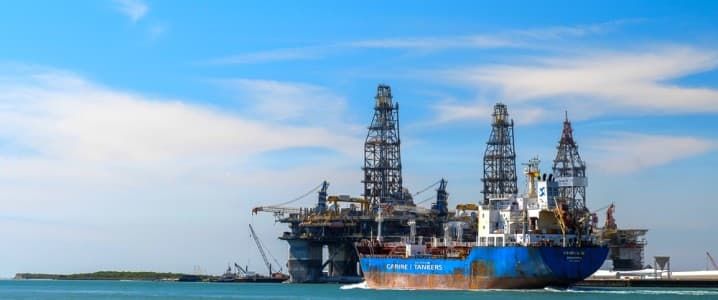
The Eastern Mediterranean energy landscape has been abruptly reshaped, demanding immediate attention from oil and gas investors. Israel’s unilateral order to halt operations at its colossal Leviathan gas field, citing escalating security threats in a region already simmering with geopolitical tensions, marks a critical pivot. This shutdown severs a vital supply artery to Egypt and sends ripples through an already sensitive global gas market. As a senior analyst, we view this not merely as a temporary disruption but as a significant recalibration of regional energy security and a potent reminder of the inherent risks in volatile operating environments. Understanding the implications for gas supply, crude pricing, and investment strategy is paramount.
The Immediate Shockwaves in the East Med Gas Market
The directive to cease production at the Leviathan gas field, confirmed by operator Chevron, is a monumental development for regional energy flows. This field, Israel’s most significant energy asset, boasts an impressive 22.9 trillion cubic feet of recoverable natural gas. Its importance to Egypt cannot be overstated; in 2024, Leviathan was exporting a robust 981 million cubic feet per day to Egypt, representing an 18% year-over-year surge and underscoring Cairo’s increasing reliance on these imports. With domestic gas production in decline and its population facing peak summer demand, Egypt now confronts a substantial supply gap. The immediate consequence is a forced pivot to emergency liquefied natural gas (LNG) purchases, an action that will undoubtedly tighten an already brittle global gas market. European gas prices, sensitive to any East Med disruption, spiked as much as 6.6% on Friday following the news. While Chevron’s Tamar field and Energean’s Karish field continue to operate, serving Israeli domestic demand, the prolonged shutdown of Leviathan places Egypt’s LNG export ambitions, and indeed its own power grid stability, under severe strain. Jordan’s access to gas also hangs in the balance, highlighting the interconnectedness of regional energy infrastructure and the broad impact of geopolitical instability on critical energy supplies.
Geopolitical Risk Premium and Investor Sentiment
The Leviathan shutdown is a sharp reminder that geopolitical events can swiftly inject volatility across the energy complex, extending beyond direct gas market implications. As of today, Brent crude trades at $95.67, reflecting a +0.93% increase, with WTI crude at $92.33, up +1.15%. These price movements occur within a daily range for Brent of $91 to $96.89, indicating market sensitivity to any supply-side news. While the past fortnight saw Brent crude trend downwards from $102.22 on March 25th to $93.22 on April 14th, marking an 8.8% decline, this recent gas disruption adds a renewed, albeit localized, risk premium. Investors are actively seeking clarity on the future trajectory of crude prices, with a recurring question being, “Build a base-case Brent price forecast for next quarter.” This event complicates such forecasting significantly. While Leviathan is a gas asset, the underlying geopolitical tensions that forced its closure contribute to a broader risk aversion across energy markets. The uncertainty surrounding future supply reliability from a key energy-producing region makes it challenging to establish a firm consensus 2026 Brent forecast, as requested by many of our readers. The current environment demands heightened vigilance for any escalation or de-escalation that could further influence global energy benchmarks and investor confidence.
Egypt’s LNG Export Ambitions and Global Supply Implications
Egypt has been strategically positioning itself as a crucial player in the global LNG market, aiming to leverage its liquefaction facilities to become an export hub. However, this ambition has always been predicated on a robust supply of natural gas, whether from domestic fields or through imports from partners like Israel. The Leviathan shutdown directly undermines this strategy. With 981 million cubic feet per day of Israeli gas now offline, Egypt is forced to divert its own domestic gas resources to meet internal power generation needs, particularly as summer demand peaks. This significantly diminishes the volume of natural gas available for liquefaction and export. Consequently, we anticipate a reduction in Egypt’s LNG cargoes, tightening an already finely balanced global LNG market. Investors are keenly asking, “What’s driving Asian LNG spot prices this week?” The potential for reduced Egyptian exports, coupled with increased competition for available spot cargoes from Europe and Asia, could exert upward pressure on Asian LNG prices. Furthermore, the long-term implications are considerable: just months ago, Leviathan operators announced plans to expand capacity from 12 to 21 billion cubic meters with Europe as a target customer. This expansion, a critical component of future European energy security, is now on indefinite hold, reinforcing the fragility of East Med supply routes and the global interconnectedness of natural gas markets.
Navigating Upcoming Market Catalysts and Regional Dynamics
The duration of the Leviathan shutdown will be the primary determinant of its ultimate impact, but investors must also monitor broader market catalysts. The coming days are packed with events that will shape the energy outlook. The OPEC+ Joint Ministerial Monitoring Committee (JMMC) meets on April 18th, followed by the full OPEC+ Ministerial Meeting on April 20th. While these meetings primarily address crude oil production policy, the underlying geopolitical tensions driving the Leviathan shutdown will undoubtedly feature in their strategic considerations, influencing decisions on supply management. Closer to home, the Baker Hughes Rig Count on April 17th and April 24th will offer insights into North American production trends, while the API Weekly Crude Inventory (April 21st, April 28th) and the EIA Weekly Petroleum Status Report (April 22nd, April 29th) will provide critical data points on U.S. supply and demand. These reports will be scrutinized for any signs of market tightening or loosening that could either amplify or mitigate the effects of the East Med gas disruption. For investors, the immediate focus remains on de-escalation efforts in the region. Until Leviathan can safely resume its operations, the East Med will remain a significant point of volatility, influencing not just gas prices but the broader sentiment across global oil and gas investing portfolios.