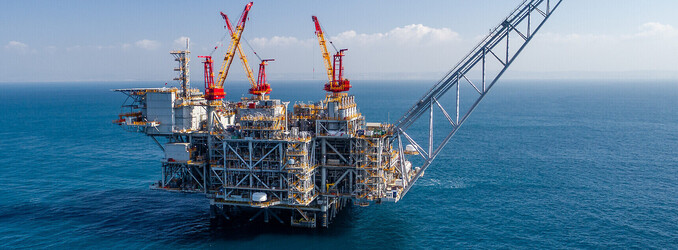
The Eastern Mediterranean energy landscape is once again commanding investor attention, as Chevron’s strategic move to award Hanwha Ocean a module fabrication contract for the Leviathan Expansion Project signals a significant long-term commitment to increasing natural gas output. This development underscores the enduring importance of the Leviathan field as a cornerstone of regional energy security and export potential, even as geopolitical currents introduce immediate operational challenges. For investors navigating volatile energy markets, understanding the drivers behind this expansion, alongside the prevailing market conditions and upcoming catalysts, is crucial for assessing its implications for their portfolios.
Leviathan Expansion: A Strategic Imperative for Regional Gas Supply
Chevron’s decision to advance the Leviathan Expansion Project, entrusting Hanwha Ocean with the critical module fabrication, highlights a clear strategic imperative: to significantly boost natural gas production capacity. This expansion aims to integrate additional modules into the existing offshore platform, enabling higher gas output designed to meet the escalating demand from both Israel’s domestic market and an expanding network of regional export partners. Hanwha Ocean’s involvement isn’t new; the firm has been providing essential constructability input during the design phase since the third quarter of 2024, demonstrating a deep, pre-existing partnership and a commitment to the project’s long-term success. This proactive investment in infrastructure signals Chevron’s confidence in the sustained demand for Eastern Mediterranean gas, positioning Leviathan as a vital energy artery for the region for decades to come.
Navigating Geopolitical Headwinds Amidst Market Fluctuations
While the long-term outlook for Leviathan remains robust, investors must contend with immediate geopolitical realities impacting its operations. Currently, production from the Leviathan field is temporarily shut in due to the ongoing Iran conflict and the subsequent retaliatory attacks across the region. This operational pause serves as a stark reminder of the inherent risks associated with energy assets in politically sensitive areas. Against this backdrop, global crude markets show a nuanced picture. As of today, Brent crude trades at $93.04 per barrel, reflecting a modest dip of 0.21% within a daily range of $92.57 to $94.21. Similarly, WTI crude is priced at $89.43, down 0.27%. This recent stability, however, comes after a more significant correction, with Brent having declined by approximately 7% over the past 14 days, from $101.16 on April 1st to $94.09 on April 21st. This broader market softening, alongside the specific regional conflict, underscores the complex interplay of supply, demand, and geopolitical risk that investors must weigh when evaluating projects like Leviathan.
Investor Focus: Long-Term Growth Versus Short-Term Volatility
Investors are consistently seeking clarity on future market direction, with a frequent question on our platform being about the trajectory of crude prices by the end of 2026. While predicting an exact price point is challenging, Chevron’s commitment to Leviathan’s expansion offers insight into the long-term demand thesis for natural gas. The investment in Leviathan suggests a conviction that global and regional gas demand will continue to grow, supporting higher output despite current geopolitical disruptions. For investors, this project represents a long-duration asset, leveraging natural gas as a crucial bridge fuel in the energy transition and a strategic resource for energy independence. The expansion, therefore, is not merely about increasing capacity but about strengthening energy security and ensuring a reliable supply chain for a commodity that remains central to industrial, power generation, and residential needs. The temporary shutdown is viewed as a disruption, not a definitive end to the asset’s potential, reinforcing the importance of a long-term perspective in volatile sectors.
Upcoming Catalysts and Forward-Looking Indicators for Energy Markets
The broader energy market context, shaped by key data releases and forward-looking analyses, will continue to influence investor sentiment around major projects like Leviathan. Investors will be keenly observing the upcoming EIA Weekly Petroleum Status Report, scheduled for April 22nd and again on April 29th, which provides vital snapshots of crude oil, gasoline, and distillate inventories, impacting short-term price dynamics. Furthermore, the Baker Hughes Rig Count on April 24th and May 1st will offer insights into North American drilling activity, a crucial indicator of future supply. Perhaps most influential for long-term outlooks will be the EIA Short-Term Energy Outlook on May 2nd. This comprehensive report often sets the tone for future price expectations and supply-demand balances across various energy commodities, informing strategic decisions for integrated majors like Chevron. Such events, alongside the evolving geopolitical situation in the Eastern Mediterranean, will collectively shape the investment thesis for assets poised for significant growth, like the expanded Leviathan field.