

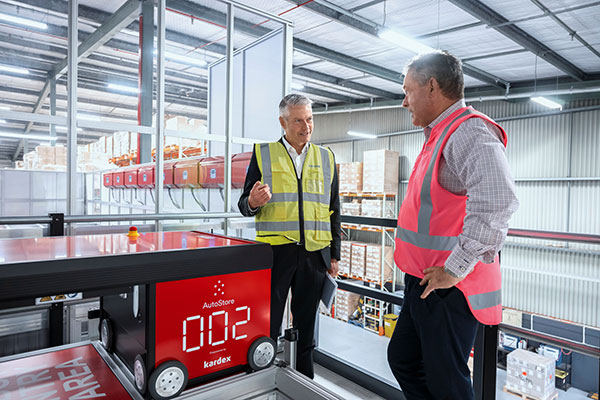
Kardex has hit a major milestone, completing its 100th site in less than five years.
What’s Related
The company launched its automated storage business in early 2021 and has grown quickly since then, working with customers across e-commerce, retail, manufacturing, automotive, and third-party logistics.
Kardex’s first AutoStore project was built for Arbeitsschutz-Express, a large German e-commerce company. Since then, demand has continued to grow. When system expansions are included, Kardex has now delivered about 120 projects worldwide.
In the U.S., AutoStore systems powered by Kardex are now running at sites in Kentucky, Las Vegas, Seattle, Ohio, Houston, Detroit, Illinois, New Jersey, and Mississippi.
“This is more than a number, it’s a testament to the dedication of our team, the trust of our customers, and the strength of our long-term partnership with AutoStore,” said Daniel Hauser, Head of Business Unit Kardex AS Solutions AG. “It also reflects our ability to scale quickly and sustainably, while delivering measurable value across industries.”
Kardex supports AutoStore customers in 20 countries and says it focuses on fast system rollouts, scalability, and long-term performance. The company is also continuing to invest in its FulfillX Warehouse Execution Software, which it uses to support automated operations tied to AutoStore systems.
“This 100-site milestone underscores the strength of our partnership with AutoStore and our dedication to delivering transformative automation across the region,” said Fred Fox, President of Kardex Solutions. “The innovation coming from our teams – such as the Intuitive Picking Assistant (IPA), which takes AutoStore picking processes to the next level – enables us to support customers through every phase of their growth. Our rapid expansion reflects not only the strength of our AutoStore offering, but also our ability to execute with consistency and care.”
Kardex says it plans to build on that momentum as more companies turn to automated storage systems to address growth, labor challenges, and faster fulfillment demands.
