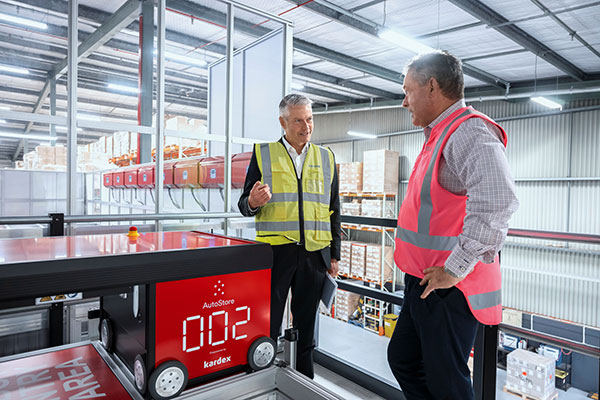
The energy sector, often perceived through the lens of volatile commodity prices and geopolitical shifts, is increasingly shaped by underlying technological advancements that drive efficiency and operational resilience. While the headlines frequently focus on crude oil benchmarks or OPEC+ decisions, shrewd oil and gas investors understand that the long-term value proposition also hinges on how companies adapt to evolving industrial landscapes. A recent milestone achieved by Kardex, completing its 100th automated storage site in less than five years, serves as a powerful reminder of the accelerating trend towards automation and its profound implications for global supply chains, including those critical to the energy industry.
Automation: A Foundational Shift for Energy Logistics
Kardex’s rapid expansion, having deployed approximately 120 projects worldwide when including system expansions, underscores a significant industrial imperative: the need for faster fulfillment, enhanced labor efficiency, and robust scalability. The company launched its automated storage business in early 2021 and has quickly become a force across diverse sectors like e-commerce, retail, manufacturing, automotive, and third-party logistics. For oil and gas investors, this achievement, spanning 20 countries and leveraging solutions like the FulfillX Warehouse Execution Software and the Intuitive Picking Assistant (IPA), signals a broader trend that the energy sector cannot afford to ignore. Streamlining the handling of critical spare parts, equipment, and consumables across complex operational footprints – from offshore platforms to sprawling refinery complexes – directly translates into reduced operational expenditure, minimized downtime, and improved safety. As the industry grapples with skilled labor shortages and the demand for leaner operations, the principles of intelligent automation exemplified by Kardex’s growth become not just advantageous, but essential for competitive survival.
Navigating Volatility: Strategic Capital Allocation in a Dynamic Market
In a sector characterized by dramatic price swings, the pursuit of operational efficiency takes on heightened importance. As of today, Brent crude trades at $91.87 per barrel, reflecting a sharp 7.57% decline on the day, having seen a daily range from $86.08 to $98.97. Similarly, WTI crude stands at $84 per barrel, down 7.86%, with its daily range spanning $78.97 to $90.34. This immediate downturn follows a broader trend over the past two weeks, where Brent has fallen from $112.57 on March 27th to $98.57 on April 16th, representing a $14 or 12.4% drop. Such volatility, alongside gasoline prices currently at $2.95 per gallon, down 4.85% today, underscores the constant pressure on oil and gas companies to optimize every aspect of their business. Investors frequently ask about the future trajectory of oil prices, with many questioning what the price of oil per barrel will be by the end of 2026. While predicting commodity prices remains challenging, investments in core operational improvements, such as advanced logistics and automation, provide a robust buffer against market fluctuations. Companies that proactively adopt these technologies ensure more stable margins and greater resilience, regardless of whether crude prices finish 2026 higher or lower than current levels.
Anticipating Future Headwinds and Tailwinds: The Event Horizon
The coming weeks are packed with critical events that will undoubtedly shape the near-term outlook for oil and gas, further highlighting the need for agile and efficient operations. The energy market is keenly awaiting the OPEC+ Joint Ministerial Monitoring Committee (JMMC) meeting tomorrow, April 17th, followed by the full Ministerial meeting on April 18th. Decisions from these gatherings regarding production quotas are paramount for global supply and investor sentiment. Investors are particularly interested in understanding OPEC+ current production quotas and their implications for market balance. Immediately following, the API Weekly Crude Inventory reports on April 21st and 28th, alongside the EIA Weekly Petroleum Status Reports on April 22nd and 29th, will provide crucial insights into demand and storage levels in the United States. Additionally, the Baker Hughes Rig Count on April 24th and May 1st will offer a snapshot of upstream activity. In this environment of constant flux, where supply-side policies and real-time inventory data dictate market direction, the ability of oil and gas firms to quickly adapt their logistics and supply chains becomes a competitive advantage. The rapid scalability and efficient deployment demonstrated by automation providers like Kardex, with systems now running in key U.S. industrial hubs such as Kentucky, Las Vegas, Seattle, Ohio, Houston, Detroit, Illinois, New Jersey, and Mississippi, serve as a blueprint for the operational agility required to navigate these upcoming market catalysts.
Investor Sentiment and the Long-Term View on Operational Excellence
Investor sentiment in the oil and gas sector remains a complex mix of optimism for demand growth and caution regarding geopolitical risks and energy transition pressures. While questions about specific company performance, such as Repsol’s potential April 2026 closing, reveal a focus on individual equities, the overarching theme is often about sustainable value creation. The substantial milestone achieved by Kardex, reflecting a sustained commitment to efficiency and customer trust across multiple industries, offers a compelling parallel for oil and gas investors. It underscores that beyond commodity price speculation, companies capable of delivering measurable value through operational excellence are poised for long-term success. By investing in automation, refining their supply chains, and embracing technological innovation, oil and gas companies can not only mitigate the impact of market volatility but also enhance their attractiveness to investors seeking robust, future-proof portfolios. The rapid adoption of automated systems globally points to a fundamental shift in how industries operate, and the energy sector’s embrace of similar transformative automation will be critical in defining its leaders for the next decade.