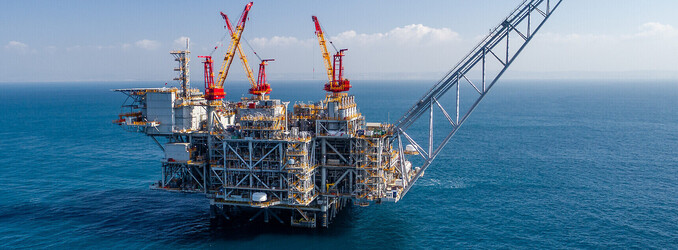
Israel’s Leviathan Reopens: A Stabilizing Force in Eastern Mediterranean Gas
The Eastern Mediterranean’s critical natural gas supply chain has received a crucial affirmation of stability with the confirmed resumption of operations at Israel’s largest gas field, Leviathan. Following a precautionary shutdown on June 13 amidst regional hostilities, the Chevron-operated Leviathan field, alongside the smaller Karish field, is now returning to full production. This swift reactivation, occurring after a declared ceasefire on Tuesday, June 17, signals a significant de-escalation of immediate supply risks and provides much-needed relief to regional energy markets, particularly for key importers like Egypt and Jordan. For investors tracking global energy security and supply resilience, this development underscores the operational fortitude of major players in a geopolitically sensitive region.
Immediate Impact on Regional Gas Dynamics and Stakeholder Value
The return of Leviathan and Karish to full production capacity marks a pivotal moment for the energy security of Israel’s neighbors. Egypt, in particular, had been severely impacted by the supply disruption, forcing industrial curtailments and a prioritization of gas for power generation. The country had actively pursued contingency plans, including significant purchases of liquefied natural gas (LNG) to avert potential summer power blackouts, with more LNG cargoes slated for July. The resumption of pipeline flows from Leviathan will alleviate this pressure, reducing Egypt’s immediate need for costly spot LNG and ensuring a more stable domestic power supply. Jordan, another recipient of Israeli gas, also benefits from this renewed stability. From a stakeholder perspective, the shutdown represented a direct financial hit. Ratio Energies, holding 15% in Leviathan, estimated a revenue loss of approximately $12 million during the halt, while NewMed Energy, with 45.34% ownership, reported a more substantial impact of around $39 million, which included royalties from Karish. Chevron, as the operator with 39.66%, worked swiftly to restore regular output, demonstrating the operational imperative to minimize downtime and secure revenue streams from these strategic assets.
Market Stability Amidst Shifting Crude Prices
While the Leviathan restart primarily impacts natural gas markets, its contribution to regional stability reverberates across the broader energy complex. As of today, Brent Crude is trading at $95.8, marking a 1.07% increase, while WTI Crude stands at $92.9, up 1.77%. Gasoline prices have also seen an uptick, reaching $3.03, a 2.02% rise. This current upward movement occurs against a backdrop of recent volatility, where Brent had notably softened, falling 8.8% from $102.22 on March 25 to $93.22 on April 14. This prior decline suggested an easing of the geopolitical risk premium that often inflates crude prices. The swift resolution and production restart at Leviathan, even in the gas sector, contribute positively to the perception of overall energy supply resilience in a region prone to disruptions. For investors, this localized supply stabilization indirectly supports a more predictable global energy landscape, potentially dampening the knee-jerk reactions often seen in crude markets to regional tensions.
Forward-Looking Analysis: Geopolitics, Supply Security, and Upcoming Catalysts
The reopening of Leviathan removes an immediate point of concern for Eastern Mediterranean gas supply, yet the underlying geopolitical landscape remains a critical factor for long-term investment theses in the region. Investors must now consider how this demonstrated resilience in infrastructure operations influences future supply security assessments. Looking ahead, the global energy calendar is packed with events that will shape the broader market trajectory. This Friday, April 17, brings the Baker Hughes Rig Count, providing insights into drilling activity. The following week is particularly crucial for crude markets, with the OPEC+ Joint Ministerial Monitoring Committee (JMMC) meeting scheduled for April 18, leading into the full OPEC+ Ministerial meeting on April 20. These gatherings will dictate global crude supply policy, a major determinant of price direction. Further insights into demand trends will come from the API Weekly Crude Inventory on April 21 and 28, and the EIA Weekly Petroleum Status Reports on April 22 and 29. While these events are focused on crude, the stability brought by Leviathan’s restart in regional gas markets could subtly influence broader energy sentiment, potentially tempering some of the upward pressure on LNG spot prices that our readers have been closely monitoring.
Investor Focus: Price Forecasts and Strategic Plays
Our proprietary reader intent data reveals a strong investor focus on predicting future market movements, with key questions centering on a base-case Brent price forecast for the next quarter and the consensus 2026 Brent forecast. Additionally, “What’s driving Asian LNG spot prices this week?” remains a pertinent inquiry. The Leviathan restart, by bolstering regional gas supply and reducing Egypt’s immediate reliance on alternative LNG imports, directly addresses some of these concerns. A more stable regional gas supply generally contributes to an easing of spot LNG prices by freeing up global cargo capacity, thereby influencing the broader energy complex. For investors evaluating companies with exposure to the Eastern Mediterranean, such as Chevron, NewMed Energy, and Ratio Energies, the rapid resumption of production after a geopolitical event highlights the operational robustness and strategic importance of their assets. This resilience provides a clearer line of sight to sustained revenue generation, reinforcing the long-term investment case for these critical natural gas producers despite inherent regional risks. The ability to swiftly restore production after a shutdown offers a tangible demonstration of operational control, a key factor for investors seeking stability in volatile energy markets.


