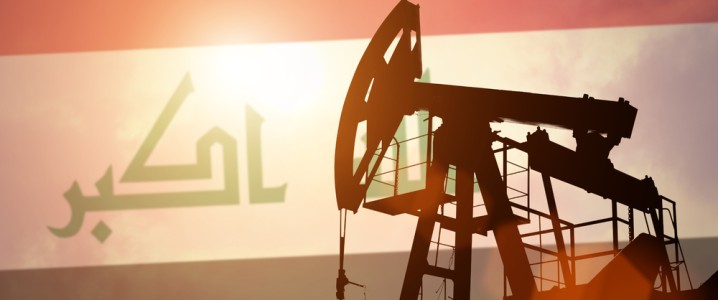
Iraq is positioning itself to significantly boost its crude oil exports, not solely through traditional production increases, but also by strategically leveraging renewable energy. This dual-pronged approach aims to free up substantial volumes of crude currently consumed domestically, paving the way for increased revenue and greater market influence. Our proprietary data indicates a volatile market, making Iraq’s strategic moves particularly relevant for investors assessing future supply dynamics and regional stability.
Iraq’s Dual Strategy: Unlocking Export Potential Through Solar and Production Growth
Baghdad is executing a shrewd two-part strategy to enhance its position in the global oil market. First, the nation aims to reclaim a significant portion of its domestic crude consumption, currently estimated at approximately 250,000 barrels per day, by transitioning to solar power for electricity generation. This volume, equivalent to the output of a respectable mid-tier oil producer, could then be redirected for export, directly impacting the global supply landscape without an immediate increase in drilling activity.
The commitment to solar is ambitious, with plans to scale capacity from a modest 42 megawatts at the close of 2024 to an impressive 12 gigawatts by the end of this decade. Tangible progress is already underway, exemplified by TotalEnergies’ 1-gigawatt solar installation, with the initial 250 megawatts expected to commence generation by the end of the current year. This shift not only promises to free up crude but also addresses Iraq’s reliance on imported natural gas and electricity, particularly from Iran, a dependency that has faced geopolitical pressures and sanctions complications.
Simultaneously, Iraq’s oil minister recently outlined aggressive crude oil production targets. The government plans to ramp up output from its current average of 4.4 million barrels daily to 5.5 million barrels per day by the close of the year. Looking further ahead, Baghdad projects a substantial increase to 7 million barrels daily by 2030. This makes it clear that Iraq intends to maximize returns from its vast oil reserves, recognizing the critical window for fossil fuel monetization.
Navigating Current Market Headwinds and Volatility
While Iraq outlines an ambitious path for increasing exports, the immediate market environment presents a complex backdrop for these plans. As of today, Brent Crude is trading at $90.38 per barrel, reflecting a notable decline of 9.07% over the last 24 hours, with an intraday range stretching from $86.08 to $98.97. Similarly, WTI Crude has fallen to $82.59, down 9.41% on the day. This daily drop is part of a broader trend; our proprietary data indicates Brent has shed approximately $22.4, or nearly 20%, since March 30th.
This significant price correction, alongside a 5.18% drop in gasoline prices to $2.93, creates a challenging environment for producers banking on increased revenues. Investors must consider whether Iraq’s planned export gains and production increases will be met with robust demand or contribute to further market softening, especially if global economic growth forecasts temper. The volatility underscores the importance of a flexible strategy for any major oil producer.
Investor Outlook: Production Quotas and Future Price Dynamics
A key concern for our readers, frequently highlighted in questions about “OPEC+ current production quotas” and predictions for “the price of oil per barrel by end of 2026,” directly intersects with Iraq’s strategic moves. Iraq’s stated ambition to increase production to 5.5 million bpd by year-end, and subsequently 7 million bpd by 2030, places it in an interesting position relative to OPEC+ agreements. As a prominent member, Iraq’s output levels are subject to collective decisions aimed at market stabilization.
The upcoming OPEC+ Ministerial Meeting on April 19th is a critical event for investors monitoring global supply. Any decisions made regarding collective output targets will directly impact the market’s capacity to absorb Iraq’s planned production increases. Should OPEC+ maintain or even tighten existing quotas, Iraq’s ability to execute its production ramp-up without creating internal or external friction will be a significant watch point. Conversely, if the alliance signals a more accommodative stance, Iraq’s growth trajectory could be smoother.
Furthermore, the long-term price outlook, a consistent query from our investor base, will be heavily influenced by the interplay between global demand growth, geopolitical stability, and the supply decisions of major producers like Iraq. The strategic deployment of solar to free up crude for export, rather than increasing total production from the ground, offers a nuanced approach to supply expansion that could be viewed favorably by the cartel, as it doesn’t directly add new crude extraction volumes to the market.
The Strategic Value of Iraq’s Renewable Pivot
Beyond the immediate financial gains from increased oil exports, Iraq’s pivot towards solar power carries significant strategic weight. The country currently relies heavily on natural gas for its electricity, much of which is imported from Iran. This dependency has historically exposed Iraq to geopolitical vulnerabilities, including the recent cancellation of a U.S. sanctions waiver that complicated energy imports from its neighbor. By developing domestic solar capacity, Iraq enhances its energy independence and national security.
The significant target of 12 GW of solar by 2030, a massive jump from current levels, demonstrates a long-term vision that extends beyond mere energy savings. It represents an investment in grid stability, a reduction in costly imported fuels, and a commitment to diversifying its energy mix in a rapidly evolving global landscape. For investors, this signals a more resilient and self-sufficient Iraq, which can be a positive factor in assessing long-term stability and investment potential within the country’s energy sector.


