

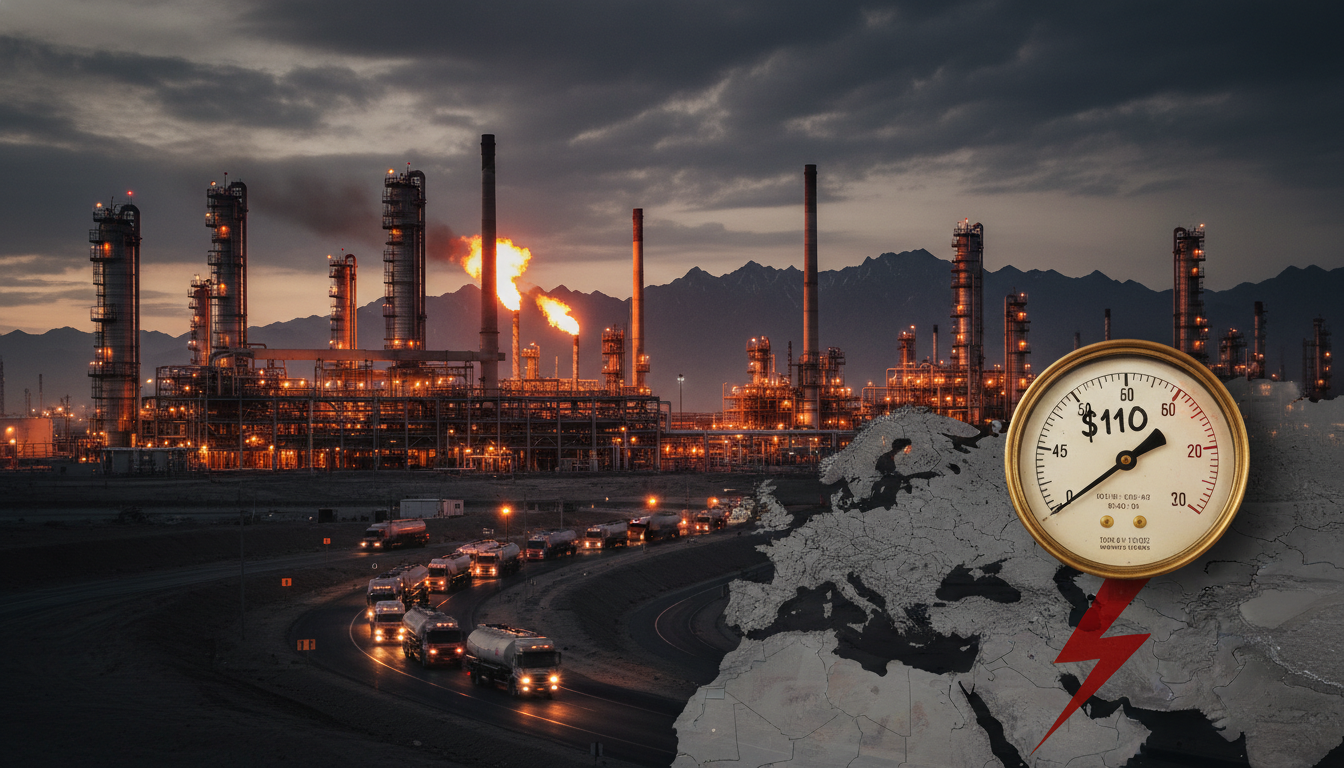
Global oil markets experienced a significant upward thrust, with crude prices surging past the $110 per barrel mark, following an assertive stance from U.S. President Donald Trump regarding escalating tensions in Iran. This declaration immediately heightened investor concerns over potential protracted disruptions to vital energy shipments traversing the Strait of Hormuz, a critical maritime chokepoint for a substantial portion of the world’s oil supply.
The immediate market response was pronounced. West Texas Intermediate (WTI) crude for May delivery soared by an impressive 11%, ultimately settling at $111.54 per barrel in New York. Concurrently, the international Brent benchmark for June settlement climbed 7.8%, closing near $109.03 a barrel. Beyond crude, the refined fuels sector witnessed even more dramatic gains, with Europe’s diesel futures benchmark climbing above $200 a barrel—a level not seen since 2022. Dated Brent, recognized as the most crucial pricing point for physical oil transactions globally, reached an extraordinary 18-year high, underscoring the acute physical market tightness.
Geopolitical Dynamics Fueling Market Volatility
President Trump’s rare primetime address to the nation, wherein he characterized the ongoing conflict as a success, served as the primary catalyst for this aggressive market movement. He signaled an intensification of U.S. efforts against Iran within the next two to three weeks and suggested the Strait of Hormuz would “naturally” reopen once the conflict concludes, though specifics or a clear timeline remained absent. This hawkish rhetoric diverged sharply from market expectations of de-escalation. French President Emmanuel Macron subsequently offered a contrasting view, stating that employing military means to force open the strait would be an unrealistic approach.
The market’s expectation for a rapid end to the conflict was thoroughly upended. Scott Shelton, an energy specialist at TC ICAP, succinctly captured the sentiment, noting, “The market was not positioned for this. Investors expected de-escalation talk and got the exact opposite.” This sudden shift led to a rapid unwinding of bearish positions. Consequently, WTI’s prompt spread, which measures the premium of the nearest contract over the subsequent one, ballooned to over $16 a barrel at one point on Thursday, establishing a new record premium. Traders attributed this record spread to expectations of tightening U.S. supplies as international buyers aggressively sought American crude amidst global uncertainty.
Strait of Hormuz: A Bottleneck of Global Significance
With the Strait of Hormuz effectively constrained for approximately a month, and significant disruptions projected to continue for several more weeks, the pressure on global oil markets shows little sign of abating. WTI prices, notably, have nearly doubled since the beginning of the year, reflecting the persistent supply concerns exacerbated by the chokepoint’s status. Robert Rennie, head of commodity research at Westpac Banking Corp., emphasized this enduring reality: “Nothing in Trump’s speech alters the underlying market reality: the strait has effectively been closed for a month, and flows remain materially constrained with at least several weeks of disruption still likely, if not more.”
Amidst this backdrop, diplomatic signals offered some conflicting nuances. Iranian state media indicated the Islamic Republic is collaborating with Oman to draft a protocol for monitoring traffic through the strait. Simultaneously, Yuri Ushakov, an aide to Russian leader Vladimir Putin, communicated through a state-run publication that Hormuz remains open for Russian shipping. In a separate development, the United Arab Emirates has appealed to the United Nations to authorize a range of measures, potentially including military force, to ensure the unhindered flow of oil and gas through the critical waterway.
Refined Products and the Looming Inflationary Threat
While crude oil prices garner significant attention, the trajectory of refined fuel markets presents an even starker picture of potential economic strain. The substantial jump in European diesel futures highlights the severe inflationary impact that constrained energy supplies can inflict on the global economy. In response to regional shortages and disrupted supply chains, energy cargoes are reportedly traversing thousands of miles as buyers across various geographies scramble to secure available product.
Prior to President Trump’s address, oil prices had actually softened on expectations of a ceasefire, while broader financial markets had rallied. However, the President’s speech not only confirmed an escalation but also renewed threats of targeting Iranian oil facilities and “every one of their electric-generating plants.” The Islamic Republic, for its part, continued its offensive actions across the Persian Gulf on Thursday, demonstrating little inclination towards initiating diplomatic talks.
Dan Ghali, a commodity strategist at TD Securities, warns of the cascading effects of diminishing inventories: “As market inventory buffers erode, the physical tightness seen thus far in Asia begins to cascade globally. This suggests that, without a resumption of flows, benchmark crude and product pricing will face increasing upward pressure in the coming weeks and months until pricing forces further demand destruction.” Investors should also note that oil futures will not trade on Friday due to the Easter holiday weekend, creating an extended period without active price discovery.
As the situation develops, market participants are closely monitoring vessel traffic through the Strait of Hormuz. Reports indicated three tankers broadcasting Omani ownership managed to enter the strait by navigating along their home country’s coastline, offering a glimmer of movement in an otherwise tightly constrained waterway. The confluence of geopolitical risks, dwindling inventories, and unyielding demand promises continued volatility in energy markets.
