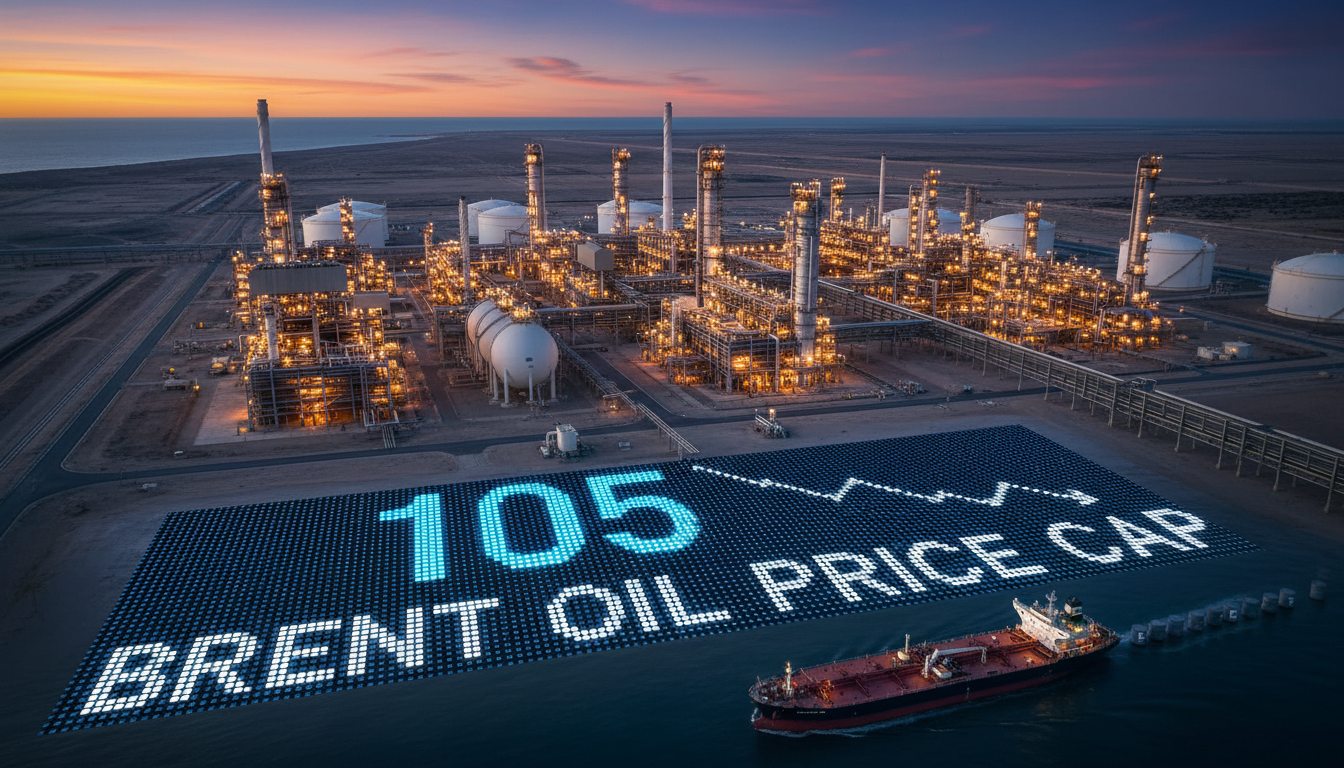
April 24, 2026 – Global crude oil markets are concluding the week with a significant upward trajectory, seeing ICE Brent crude futures firmly planted at $105 per barrel, marking a robust $15 weekly gain. However, renewed diplomatic efforts between the United States and Iran are tempering further upward momentum, keeping the benchmark below the crucial $110 threshold. This delicate balance between supply concerns and potential diplomatic breakthroughs defines the current investment landscape in the energy sector. Meanwhile, West Texas Intermediate (WTI) is trailing the global benchmark by $10, rolling over into its June contract, reflecting regional market dynamics and the influence of international geopolitical factors on pricing.
Geopolitical Flashpoints Reshape Maritime Security and Oil Flows
The Strait of Hormuz remains a critical choke point for global energy trade, and recent events highlight its fragility. Iran’s Islamic Revolutionary Guard Corps (IRGC) escalated tensions by seizing two container ships, the MSC Francesca and the Epaminondas. This action followed a prior U.S. seizure of the Iranian cargo vessel Touska, effectively halting the passage of non-oil tankers through the vital waterway. This incident underscores the significant geopolitical risk premium embedded in current oil prices and demands close monitoring from investors with exposure to global shipping and energy supply chains.
Conversely, some easing of supply concerns materialized in Europe. Ukraine has reactivated Russian crude oil flows through the Druzhba pipeline, ending a three-month hiatus. This crucial restart for European energy security immediately followed Slovakia and Hungary lifting their vetoes on a $105 billion EU loan package, essential for Kyiv’s government expenses. The resumption of Druzhba flows offers a measure of relief to regional oil markets that have contended with tightening supply.
Adding another layer to the complex geopolitical tapestry, the European Union has formally adopted its 20th package of sanctions against Russia. This latest iteration targets Russia’s shadow fleet, adding 46 tankers to its prohibited list. Furthermore, it bans transactions involving the ports of Murmansk and Tuapse and introduces a ‘no-Russia’ clause for all future tanker sales. These measures aim to further constrict Russia’s oil revenue streams but also introduce new complexities and costs for the global maritime and energy logistics sectors, impacting shipping rates and vessel availability.
Strategic Reserves and Supply Adjustments in Focus
Government interventions through strategic petroleum reserves (SPRs) continue to play a significant role in managing global oil supply. The U.S. government has so far released 79.7 million barrels to 12 companies. Notably, at least 4 million barrels of this crude are currently en route from the Gulf Coast to Europe, including a very large crude carrier (VLCC) transporting 2 million barrels of Bryan Mound medium sour crude to Rotterdam. This strategic deployment aims to alleviate European supply pressures and stabilize prices.
Japan, a heavily import-dependent nation, has announced plans for a second round of SPR releases commencing May 1. The country intends to offer 36 million barrels to its domestic refiners, following a substantial 80-million-barrel release earlier this month—the largest single SPR drawdown globally. These coordinated efforts by major economies underscore the perceived tightness in the global oil market and the desire to prevent price volatility.
In contrast, Canada’s commitment to supply an additional 23.6 million barrels of crude oil, initially presented as part of Ottawa’s International Energy Agency (IEA) strategic petroleum release, has been clarified. This volume represents natural output growth already anticipated for the summer of 2026, irrespective of the U.S.-Iran crisis. Investors should note that this growth does not constitute new, incremental supply responding directly to market tightness but rather reflects existing production forecasts.
Diversifying Supply Chains and Refining Sector Challenges
Global energy partnerships are shifting, with Mexico’s President Claudia Sheinbaum announcing that state oil company Pemex will commence exporting crude oil to energy-deprived Japan. A initial shipment of 1 million barrels signals the restart of flows that had ceased in October 2023, highlighting evolving trade relationships and Japan’s search for diversified energy sources.
Similarly, Indonesia’s Energy Ministry revealed a significant deal to import 150 million barrels of crude oil from Russia in 2026, equating to approximately 600,000 barrels per day. This ambitious agreement follows a period where Indonesian refiners had purchased only one cargo from Russia this year, signaling a strategic shift towards securing long-term supply, with intentions for a similar LPG deal in the near future.
The refining sector faces its own set of challenges. The 440,000 b/d Whiting refinery in Indiana, a critical asset for Midwest fuel supply, has entered its second month of lockout as contract negotiations between UK oil major BP and its workers remain at an impasse. Despite the dispute, BP has maintained output by deploying temporary workers, mitigating immediate supply disruptions but highlighting potential labor risks for investors.
Meanwhile, Pakistan has re-entered the spot LNG market with its first tender since December 2023, prompted by the closure of the Strait of Hormuz disrupting Qatari supplies. The country is seeking extremely prompt cargoes for late April and early May, with JKM (Japan Korea Marker) prices currently trading around $17 per MMBtu, reflecting persistent demand in Asian LNG markets.
Long-Term Recovery and Corporate Governance
Looking ahead, Goldman Sachs has provided a sobering assessment for Gulf oil production, estimating that recovery will take several months even after the Strait of Hormuz reopens. Approximately 14.5 million barrels per day of the region’s oil production currently remains offline, representing a significant 57% of its pre-conflict supply. This outlook suggests a prolonged period of reduced output, reinforcing the importance of other global supply sources.
In a related regulatory development, the U.S. administration extended a waiver of the Jones Act by 90 days, permitting foreign-flagged vessels to transport crude, refined products, and fertilizers between U.S. ports through mid-August. This marks an ongoing effort to enhance domestic shipping flexibility, with 15 such vessels already authorized since mid-March.
Corporate governance within the energy giants also remains a key focus for investors. At BP’s annual general meeting, new Chief Executive Meg O’Neill and Board Chair Albert Manifold faced shareholder dissent, failing to secure backing for two proposed resolutions. Notably, one resolution aimed to scrap previously adopted company-specific climate disclosures, signaling strong investor scrutiny on environmental, social, and governance (ESG) commitments within the oil and gas industry.
Finally, the United States and the European Union are set to formalize a strategic partnership on critical minerals through a memorandum of understanding. This initiative, designed to establish minimum price guarantees, seeks to bolster supply chain resilience and reduce reliance on dominant Chinese suppliers, offering potential investment avenues in the critical minerals sector vital for the energy transition.