The Middle East tinderbox has ignited a new, dangerous front in the global energy markets, shifting investor focus from traditional crude transit risks to direct threats against critical natural gas infrastructure. Recent escalations between Iran and Israel have seen both sides target key energy assets across the Persian Gulf, raising the specter of widespread supply disruptions. While initial reports indicated a sharp surge in crude prices, our proprietary market data reveals a more nuanced, and perhaps more concerning, picture for the broader energy complex. Investors must now navigate heightened geopolitical premiums alongside the evolving dynamics of both oil and gas supply.
Geopolitical Premium Meets Market Reality: A Divergent Narrative
The immediate aftermath of these intensified hostilities saw a predictable spike in energy prices. However, the market’s reaction has since tempered, suggesting a complex interplay of fear and underlying fundamentals. As of today, Brent crude trades at $92.95 per barrel, reflecting a marginal 0.31% decline within its day range of $92.57 to $94.21. Similarly, WTI crude stands at $89.45, down 0.25% today. This current pricing stands in stark contrast to earlier reports of Brent surging above $108 a barrel following the initial attacks.
Our proprietary 14-day Brent trend data offers critical insight: from April 1st, when Brent touched $101.16, it has actually retreated by 7% to $94.09 yesterday. This significant pullback suggests that while geopolitical risk remains acutely elevated, the market has absorbed some of the immediate shock. Investors are clearly grappling with the dual pressures of supply disruption fears and broader demand concerns, preventing a sustained, runaway rally. The current gasoline price of $3.11 per gallon, down 0.32% today, further indicates this balanced, albeit tense, market sentiment.
Gas Supply Under Siege: A New Front in Energy Warfare
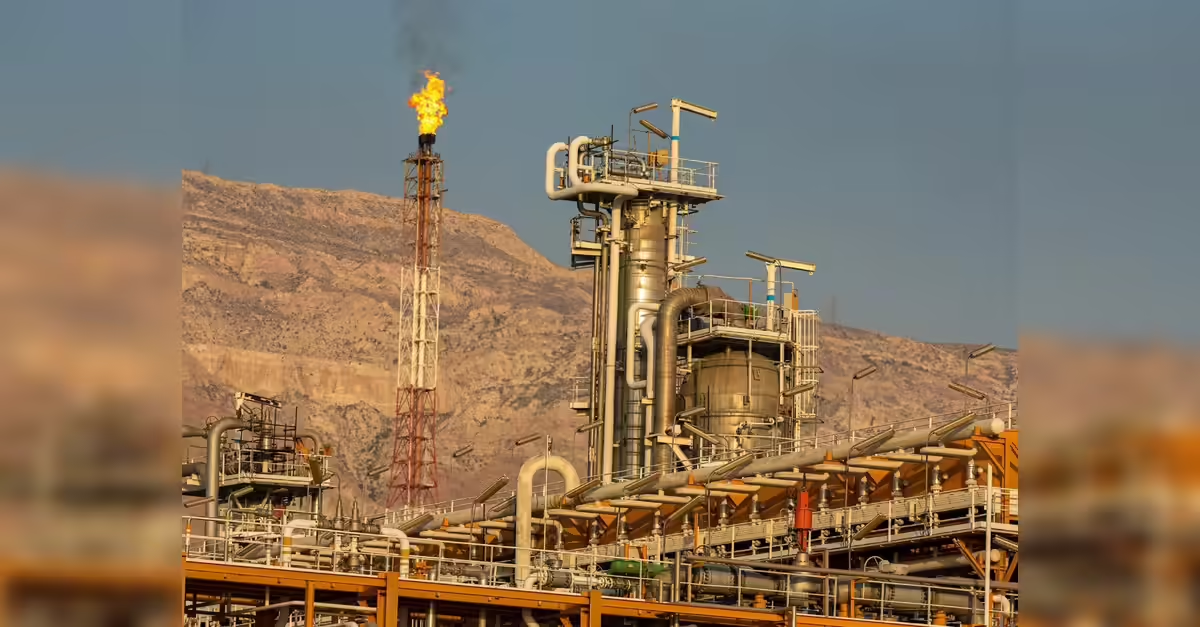
The most alarming development for energy investors is the direct targeting of natural gas facilities. Iran has reportedly struck the United Arab Emirates’ Habshan gas facility and Bab field, as well as gas infrastructure in Qatar. These actions follow an Israeli strike on Iran’s massive South Pars offshore natural gas field, which Iran shares with Qatar and is a cornerstone of global LNG supply. These are not merely symbolic gestures; they represent direct attacks on the operational heart of the region’s gas production, a significant escalation from previous threats focused primarily on crude oil transit.
The South Pars field alone accounts for a substantial portion of the world’s natural gas reserves and production, making any disruption here a potential tremor for global LNG markets. While the full extent of the damage and operational impact remains unclear, investors should prepare for increased volatility in natural gas futures. We will be closely monitoring upcoming data releases for any indications of regional production shifts. Specifically, the EIA Weekly Petroleum Status Reports on April 29th and May 6th, along with the EIA Short-Term Energy Outlook on May 2nd, will be crucial for assessing any reported impacts on inventories or production capacity that could reflect these direct attacks.
Investor Jitters and the Search for Stability Amidst Volatility
Our first-party intent data reveals what’s truly on investors’ minds: “Is WTI going up or down?” and “What do you predict the price of oil per barrel will be by end of 2026?” These questions underscore the deep uncertainty pervading the market. The current environment presents a complex calculus: geopolitical premiums push prices higher, but persistent global demand concerns, strategic reserve releases, and the introduction of alternative supplies can cap those gains. The recent decision by the Trump administration to ease sanctions on Venezuela, allowing US companies to do business with PDVSA, is a clear strategic move to potentially bolster global oil supplies and mitigate the impact of Middle East instability. While Venezuelan production faces significant hurdles, this move signals a proactive effort by major consumers to diversify supply sources.
For investors, this means maintaining a highly agile strategy. While the immediate impulse might be to chase short-term price spikes driven by headlines, the underlying market dynamics, as seen in the recent Brent pullback, suggest a more measured approach is warranted. Monitoring events like the Baker Hughes Rig Count on April 24th and May 1st will provide insights into North American supply responses, which could further influence WTI’s trajectory.
The Strait, Sanctions, and Strategic Energy Plays
Beyond the direct attacks on gas facilities, the ongoing threat to the Strait of Hormuz remains a critical concern. As the conduit for one-fifth of the world’s oil, any sustained disruption or escalation in shipping risks would undoubtedly trigger a far more severe market reaction than what we have witnessed to date. Iran’s continued pressure on this vital shipping channel, alongside its attacks on Saudi Arabia’s Eastern Province, Kuwait, and Bahrain, underscores the regional nature of this conflict and its potential to ensnare multiple major producers.
The US decision to ease sanctions on Venezuela, while politically charged, highlights a broader strategic imperative: reduce global reliance on a perpetually volatile Middle East. This move, alongside potential future developments in other non-OPEC+ regions, could provide crucial long-term offsets to Middle Eastern supply risks. For energy investors, this means diversifying exposure beyond the immediate geopolitical hotspots and considering companies with strong operational footprints in less volatile regions, or those focused on technologies that enhance energy security and reduce reliance on traditional supply chains. The current environment demands not just reactive trading, but a proactive, forward-looking investment thesis built on resilience and strategic optionality.
2026-04-22T05:15:03Z


